




Gold Tone Carriage Clock
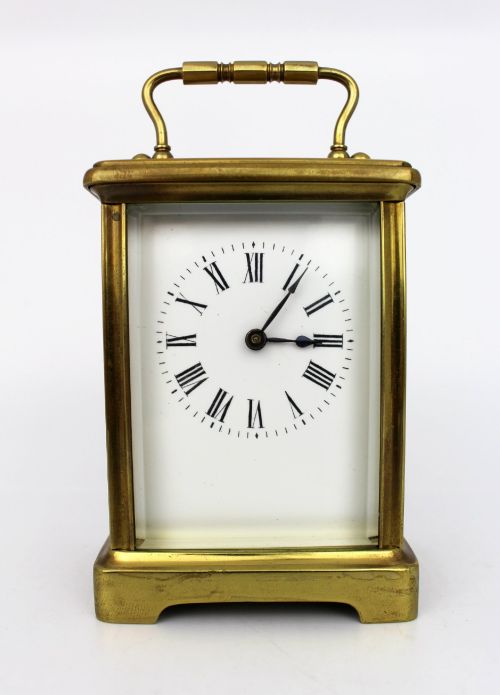
A gold tone carriage clock brings polished brass and bevelled glass into a room, offering the portable mechanical precision of the nineteenth and twentieth centuries.
Gold Tone Carriage Clock
When you search for a gold tone carriage clock, you are looking at portable timepieces encased in brass, gilt brass, and bronze, often featuring glass panels that reveal the movement within. The examples found here span from the mid-nineteenth century through the Edwardian era and into the Art Deco period of nineteen-thirty, with French workshops providing many of the key pieces.
You are most likely to meet French and Swiss examples housed in gilt brass cases, sometimes accompanied by travel cases in leather or retaining their original winding keys. Forms range from miniature desk clocks and repeating timepieces to models equipped with alarms and engraved gorge cases.
The styles shift across these decades from Victorian and Second Empire heaviness to cleaner geometric lines by nineteen-thirty. Makers such as Antoine Redier, Henry Jacot, and Penlington and Batty appear among the pieces, marking out the higher tiers of carriage clock production.
Materials and construction
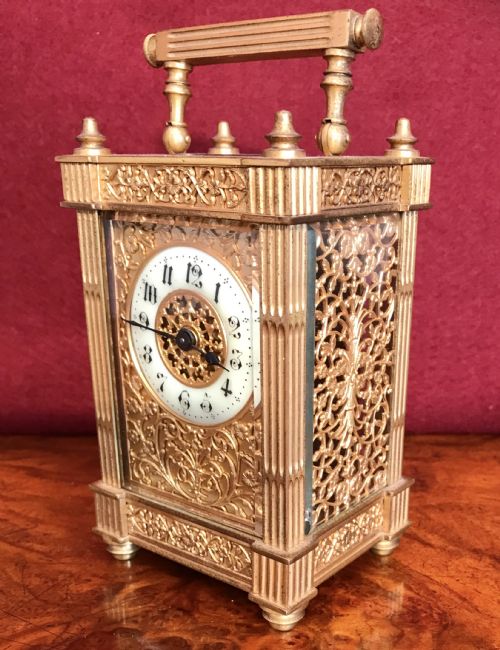
Brass, gilt brass, and bronze form the structural chassis of these clocks, polished or fire-gilt to create the characteristic golden metallic sheen. Panels of clear or bevelled glass enclose the movement, occasionally decorated with filigree masks, enamel dials, or fully engraved surface patterns.
Movements rely on steel components driven by springs, often engineered for eight-day operation and sometimes incorporating repeaters or patent alarm mechanisms. Leather outer travel cases lined with velvet or silk accompanied many of these pieces to protect them during journeys.
Some nineteenth-century carriage clock buyers specified race horse interest mechanisms, ensuring their travel clocks noted sporting schedules alongside the hours.
Distinctions in quality
The standard of engraving across the gilt brass case separates standard production from finer workshop output, with deeply hand-chiseled gorge cases indicating superior craftsmanship. Fully engraved panels and signed movements by known makers elevate the standing of a piece.
The presence of original components, such as matching winding keys, original leather travel cases, and functional repeaters or alarms, distinguishes the better-preserved examples on the market.
Antoine Redier·Henry Jacot·Penlington and Batty
The Gold Tone Carriage Clock Glossary
- Gilt brass
- Brass treated with a gold-coloured finish or gold leaf layer. This material provides the bright metallic exterior seen on the majority of nineteenth-century carriage clocks.
- Repeater
- A mechanical complication that chimes the hours and quarters upon pressing a button on the case. This function allowed owners to check the time in the dark.
- Platform escapement
- The horizontal assembly mounted on top of the movement containing the balance wheel and hairspring. It replaced the pendulum to allow portable timekeeping.
- Enamel dial
- A metal face fused with powdered glass fired at high temperatures to create a smooth white surface. Roman or Arabic numerals are then painted onto this field.
Gold Tone Carriage Clock: Frequently Asked Questions
How do I wind a carriage clock?
Use the appropriate key on the winding arbours located at the back of the movement behind the rear glass door. Turn gently until resistance is felt, avoiding overwinding.
Ensure you support the clock properly on a flat surface while performing this maintenance to avoid straining the case handle or glass panels.
Why did people use carriage clocks?
Travellers during the nineteenth century needed reliable portable timekeeping that could withstand movement in carriages and trains. The sturdy metal cases and platform escapements allowed these clocks to keep time away from the mantelpiece.
Wealthy Victorians also used them as desk clocks and bedside timepieces equipped with alarms or repeater chimes.
How can I date a carriage clock?
Examine the style of the brass case, the shape of the handle, and the decoration of the enamel dial. Victorian and Second Empire models often feature heavier decorative casting, while later Edwardian and Art Deco examples show simpler lines.
Signatures on the movement backplate or inside the case often point to specific makers and active workshop periods.
What is a gorge case carriage clock?
A gorge case is a specific architectural housing style defined by stepped mouldings along the upper and lower edges of the brass frame. This design originated in France and offers a robust housing for the movement.
These cases frequently feature multi-piece brass construction that breaks down for cleaning and repair of the interior mechanics.