
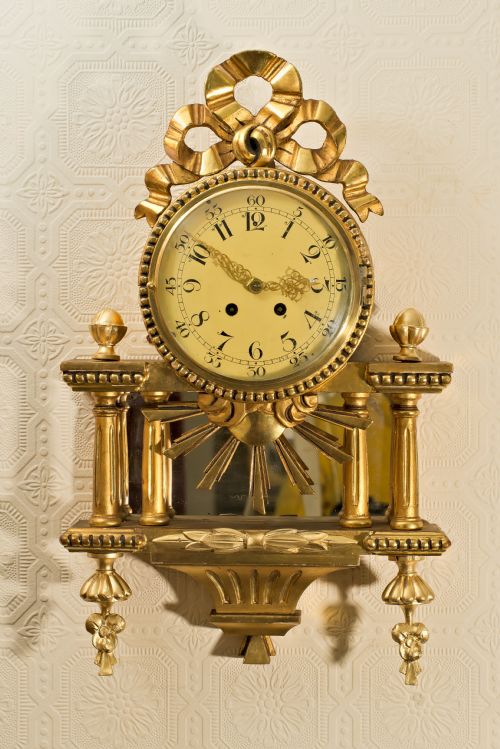


Gold Cartel Clock
These gold cartel clock pieces bring ornate French and English wall timekeeping into a room, framed in giltwood, ormolu, and bronze.
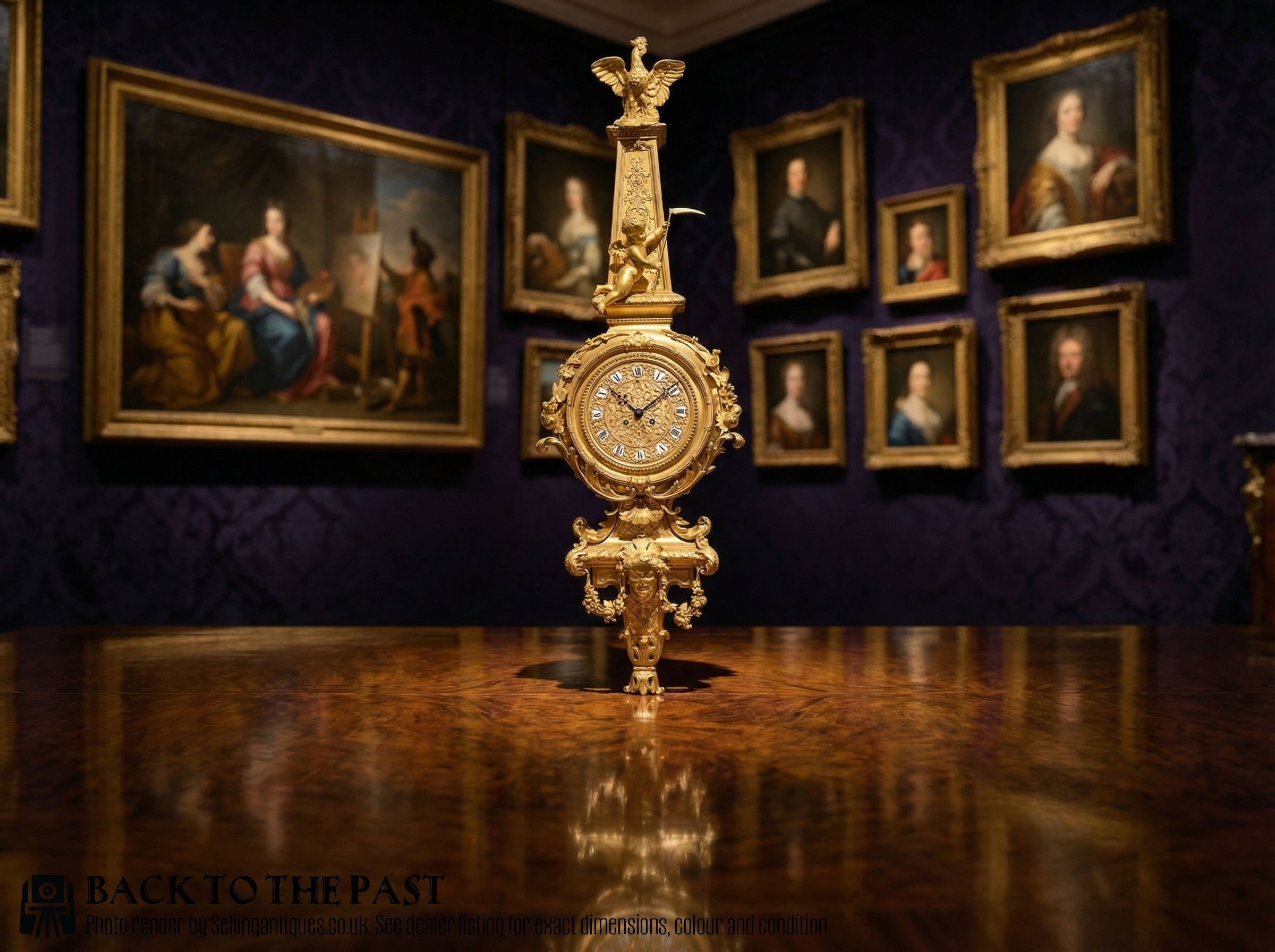
Gold Cartel Clock
A gold cartel clock is an ornate wall timepiece designed for hanging, appearing across the eighteenth, nineteenth, and early twentieth centuries. When searching for a gold cartel clock, buyers encounter pieces fashioned in French Rococo, Louis XVI, and Gustavian Neoclassical styles. The most common examples seen here are nineteenth-century French models rendered in gilt bronze, ormolu, and brass.
Makers and origins span from English workshops like William Webster and Perivale to Swedish makers such as Wetterstrands, alongside numerous French pieces. Forms range from large substantial wall clocks measuring over fifty inches to carved wood examples from the George III period. Enamel dials and glass face covers appear frequently across these diverse regional designs.
How they were made
Construction relies heavily on cast bronze, brass, and giltwood shaped into elaborate Rococo scrolls and Louis XVI architectural motifs. Guilds and makers applied fire gilding or gold leaf to achieve the characteristic ormolu and gilt surfaces seen on these wall clocks.
Enamel provides the ground for dial numerals, while glass protects the delicate hands and face. Some Swedish and English variants incorporate eglomise glass panels and carved wood alongside the metalwork.
Gold Cartel Clock Retail Price Guide 2026
Typical asking prices for gold cartel clock among the pieces listed under this phrase on Sellingantiques today, from the lower quarter to the upper quarter. They describe what is for sale here now, not the wider market.
Listings span from the 18th century through the Victorian era to 1920, utilising materials including giltwood, ormolu, enamel, and eglomise glass.
What varies in quality
The refinement of the casting and carving separates standard production from exceptional pieces. Crisply chased ormolu details and deeply carved giltwood demonstrate superior craftsmanship compared to softer, more uniform surface rendering.
The integration of materials such as mirror glass, eglomise panels, and hand-painted enamel dials dictates the standing of an individual clock. Signed works by notable makers carry distinct historical weight over unsigned vernacular pieces.
Wetterstrands·Perivale of England·William Webster
The Gold Cartel Clock Glossary
- Cartel clock
- A wall-mounted clock featuring an ornate frame made of gilt bronze, brass, or carved wood. These timepieces originated in France during the eighteenth century.
- Ormolu
- Finely ground high-carat gold applied to a bronze base using a mercury amalgamation technique. This process creates a durable, luminous golden finish characteristic of French decorative arts.
- Eglomise
- The technique of cold painting and gilding on the reverse side of glass to produce a reflective, metallic panel. It appears on Swedish wall clocks.
- Giltwood
- Timber, often carved, that has been coated with thin gold leaf or gold paint. This material forms the primary structure of many English and Swedish wall clocks.
- Louis XVI style
- A neoclassical design vocabulary characterised by straight lines, symmetry, classical urns, and foliate swags. It defines many nineteenth-century French pieces.
Gold Cartel Clock: Frequently Asked Questions
Where should a gold cartel clock hang?
These wall clocks suit principal reception rooms or hallways where their decorative gilt frames catch the light. They require secure wall fixings due to the substantial weight of the bronze and wood bodies.
Position them at eye level to appreciate the chased ormolu details and the enamel dial. Ensure the wall structure can support the specific weight of larger nineteenth-century examples.
What materials make up these clocks?
The primary bodies consist of cast bronze, brass, carved giltwood, or gilded metal. Dials are typically constructed from white enamel with painted numerals, protected behind a glass bezel.
Finer examples incorporate ormolu, mirror glass, and specialised eglomise panels. Each material reflects the prevailing taste of its nineteenth or eighteenth-century origin.
Are these clocks French or English?
The majority of these pieces originate from France, particularly reflecting nineteenth-century revivals of Rococo and Louis XVI aesthetics. However, English and Swedish examples also appear.
English pieces from the eighteenth century demonstrate different wood-carving traditions, while Swedish variants often utilise eglomise glass and lighter giltwood framing.