


Glastonbury Chair
A Glastonbury chair brings a distinct medieval spirit to a room through its folding X-frame design and sloping arms.
Glastonbury Chair
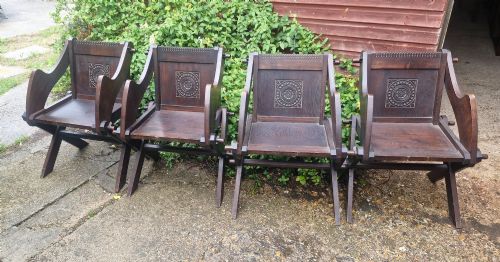
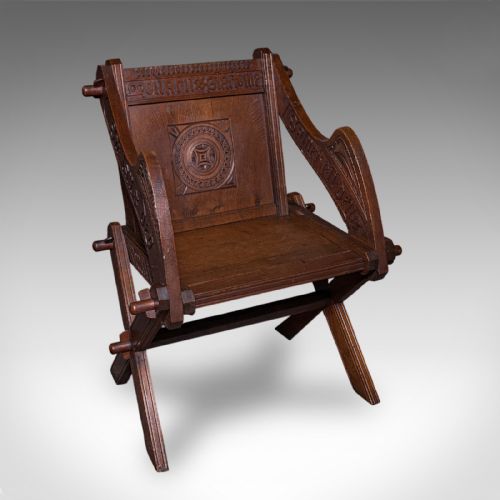
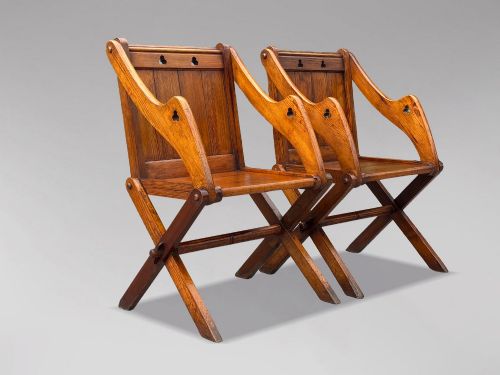
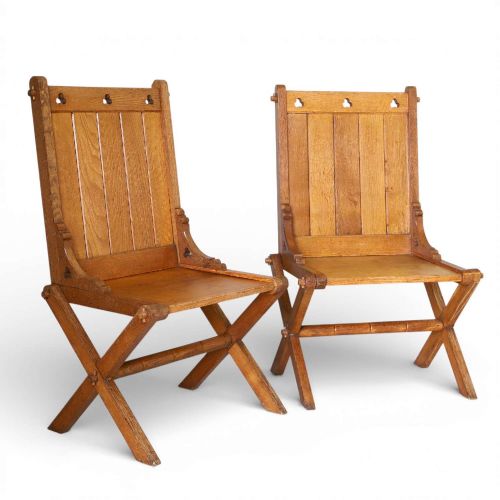
The glastonbury chair is a traditional folding armchair design characterised by its intersecting leg frame, sloping armrests, and high paneled back. These pieces appear most frequently in nineteenth century contexts, spanning the Victorian era, the 1890s, and around 1900.
Makers working in the Gothic Revival, Victorian Gothic, and Tudor Revival styles heavily favoured this form. Examples occur as single elbow seats, pairs, and occasional child chairs constructed for domestic or ecclesiastical use.
How they were made
Makers constructed the glastonbury chair primarily from solid oak, alongside pitch pine, Oregon pine, and occasional primitive elm. Carpenters joined the folding X-frame members precisely to support the sloping armrests and paneled backs.
Decoration relied on woodworking techniques rather than applied ornamentation, utilising carved details such as trefoils and the Crown of Thorns. Surfaces often display carved inscriptions or traditional timber finishes appropriate to the nineteenth century workshop.
What varies in quality
The standard of a glastonbury chair depends upon the crispness of the carved details, such as trefoils and religious motifs, executed in the timber. Heavier, solid oak construction indicates superior workshop output compared to lighter secondary woods.
Proportion and the integrity of the intersecting X-frame dictate the refinement of the piece. Untouched surfaces and period timber grain contribute significantly to the standing of an example.
The Glastonbury Chair Glossary
- Glastonbury chair
- A distinctive folding armchair with an X-frame, sloping arms, and a paneled back, rooted in medieval design and revived during the nineteenth century. The form is strongly associated with ecclesiastical and Gothic Revival interiors.
- Gothic Revival
- An architectural and decorative style popular during the Victorian period that imitates medieval Gothic forms. It manifests in pointed arches, trefoil ornaments, and heavy timber construction.
- X-frame
- A structural arrangement where pairs of diagonal members cross to support a seat or table. This configuration allows the chair to fold or gives the appearance of a folding camp structure.
- Trefoil
- A graphic ornament composed of three overlapping rings or lobes, frequently carved into wood panels. It is a standard decorative motif in Gothic architecture and furniture.
Glastonbury Chair: Frequently Asked Questions
What is a glastonbury chair?
A glastonbury chair is a traditional armchair featuring an intersecting X-frame base, sloping armrests, and an upright paneled back. The design draws inspiration from medieval examples associated with Glastonbury Abbey.
These chairs gained popularity during the nineteenth century through Gothic Revival and Tudor Revival movements. They appear in both domestic rooms and ecclesiastical settings.
How were glastonbury chairs used?
Historically, these armchairs served as study, hall, or elbow seats in nineteenth century homes and churches. Their sturdy timber construction suited them for daily sitting and reading.
They also functioned as decorative pieces within Victorian interiors designed around historical revival styles. Smaller child versions were similarly constructed for domestic use.
How do I style a glastonbury chair?
A glastonbury chair works well as an accent seat in a study, hallway, or living room where its architectural timber form can stand out. Pairing it with traditional or period interior elements complements its medieval revival aesthetic.
Because of its solid oak construction and upright back, it functions effectively as a static armchair. Placing it away from walls allows the intersecting X-frame to remain fully visible.
How do I date a glastonbury chair?
Dating relies on examining the timber species, carved motifs, and construction methods characteristic of nineteenth century workshops. Most recorded examples date from the Victorian era, the 1880s, the 1890s, or around 1900.
Stylistic markers such as Tudor Revival linenfold panels or Gothic trefoils help place a piece within this Victorian period. The presence of pitch pine or specific regional oak points towards nineteenth century British and Welsh production.