
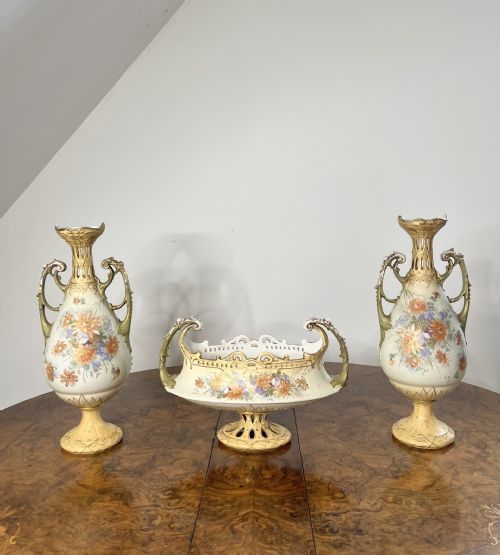


Gilt Porcelain Vase Set
These gilt porcelain vase set pieces bring nineteenth-century ceramic splendour to a mantelpiece, offering matched groups of painted porcelain mounted in gilt bronze.
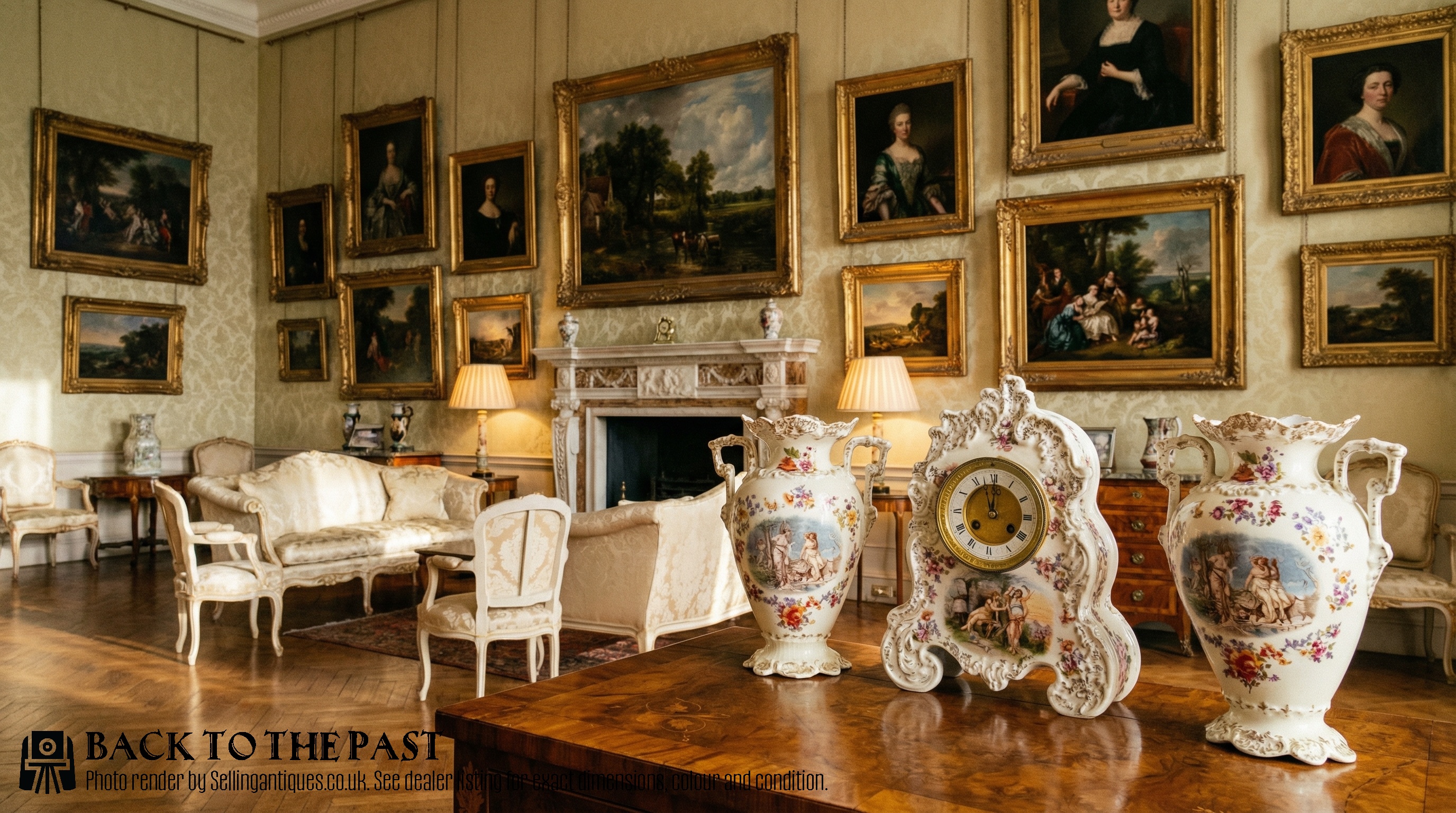
Gilt Porcelain Vase Set
A gilt porcelain vase set brings together matching decorative vessels intended to create a balanced display on a mantelpiece, sideboard or centre table. The search phrase covers nineteenth-century pieces ranging from pairs of urns to larger garnitures comprising three or four matching items.
Most examples found here date from the nineteenth century, including the Regency period, Victorian era, and later decades such as eighteen ninety and nineteen hundred. Forms extend from Paris porcelain urn vases and Sevres style lidded vessels to Minton and Royal Vienna centrepieces.
Materials and construction
The foundation of every piece is hard-paste or soft-paste porcelain, shaped by hand or moulded before receiving hand-painted scenes and enamel decoration. Makers applied gold leaf, gilding and gilt highlights to accentuate the ceramic contours and rims.
Many nineteenth-century sets incorporate metal mounts, specifically ormolu, gilt bronze and brass, which frame the ceramic bodies and provide sturdy bases or handles. This combination of fired porcelain and cast metal required specialist joinery to secure the mounts without damaging the glazed ceramic.
Listings feature nineteenth-century pieces incorporating porcelain, enamel, ormolu, gilt bronze, and brass across Regency, Victorian, and Rococo Revival styles.
Assessing quality and execution
The distinction between standard production and exceptional work rests on the precision of the hand-painted scenes and the crispness of the gilding. Superior sets display finely detailed figurative or landscape panels executed by skilled artists rather than mechanical transfer prints.
Metalwork mounts also define the grade of an object, with heavy, finely chased ormolu mounts indicating superior workshop output compared to plain pressed brass. The weight, symmetry and integration of the porcelain body within its metal framework separate ordinary decorative items from masterworks.
Royal Vienna·Flight Barr and Barr·Worcester Porcelain·Minton Porcelain·Thomas Steel
The Gilt Porcelain Vase Set Glossary
- Garniture set
- A matched group of three or more vases, urns or ornaments designed to be displayed together on a mantelpiece or furniture top.
- Ormolu
- Finely ground high-carat gold applied in a mercury amalgam to bronze, creating a rich golden surface finish on metal mounts.
- Paris porcelain
- A general term for the varied wares produced by numerous independent porcelain factories in and around Paris during the eighteenth and nineteenth centuries.
- Hard-paste porcelain
- A dense, vitrified ceramic material fired at very high temperatures, composed of kaolin and petuntse.
- Enamel
- Opaque or translucent vitreous composition fused to the surface of porcelain or metal for decoration and colour.
Gilt Porcelain Vase Set: Frequently Asked Questions
What is a porcelain garniture?
A porcelain garniture is a set of matching vases or urns, usually numbering three or five pieces, created to be displayed together as a decorative unit on a mantelpiece or cabinet.
These sets provide symmetrical visual balance in a room, often featuring a larger central vessel accompanied by matching side pieces.
How do I date a nineteenth-century set?
Dating relies on identifying factory marks on the underside of the porcelain, stylistic cues such as Regency or Rococo Revival moulding, and the composition of the metal mounts.
Examining the wear on the gilding and the specific painting style of the enamel scenes also helps narrow down the decade of production.
Were these sets meant for cut flowers?
Most nineteenth-century garniture vases served purely decorative purposes as mantel or cabinet ornaments rather than functional vessels for holding water and flowers.
Their delicate hand-painted surfaces and gilt ormolu mounts meant they were treated as fine art objects to adorn formal living spaces.
How should I clean gilt porcelain?
Cleaning requires a soft, dry feather duster or a gentle microfibre cloth to remove surface dust without disturbing the delicate gilding or hand-painted enamel.
Water and chemical cleaning agents should be avoided entirely, as moisture can damage both the painted ceramic surface and the metal ormolu mounts.