




Gilt Framed Bird Prints
Gilt framed bird prints bring natural history study indoors, pairing ornithological illustration with gilded timber moulding.
Gilt Framed Bird Prints
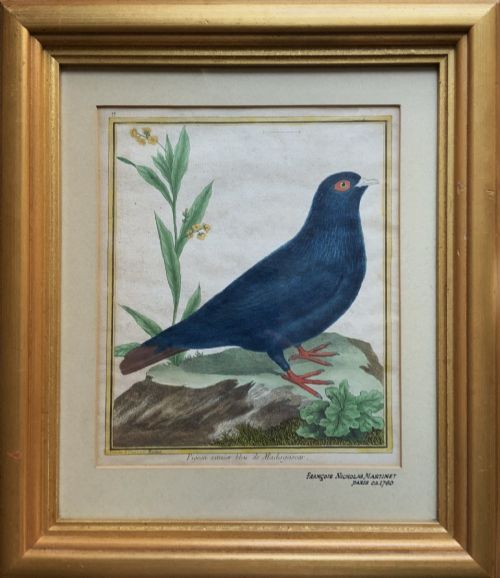
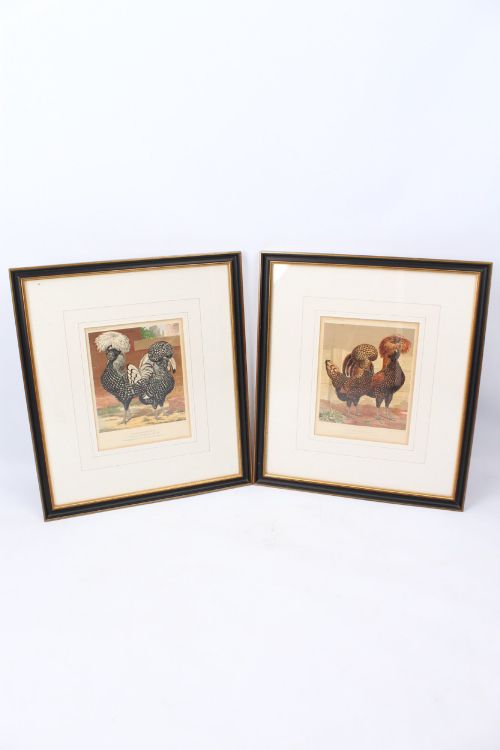
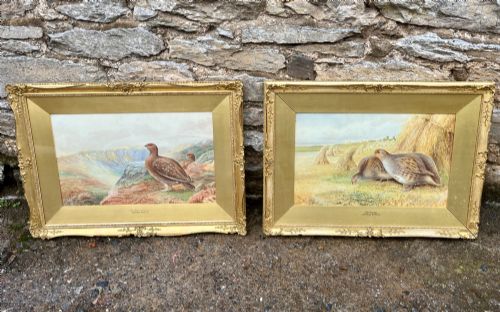
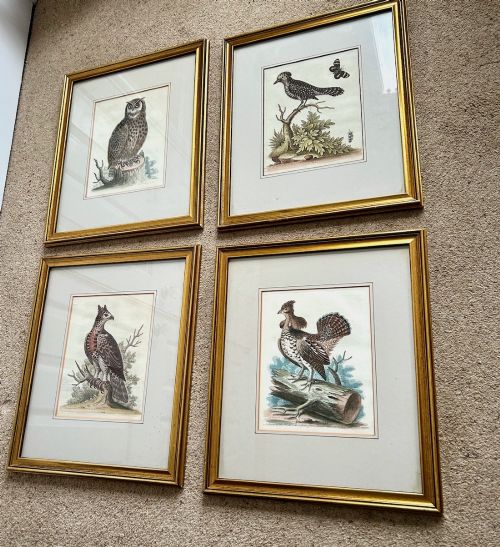
These works present avian subjects under glass within metallic timber frames, drawing from Georgian, Victorian, and Edwardian natural history traditions. Buyers encounter hand-coloured engravings, lithographs, and watercolours depicting pigeons, parrots, game birds, and waterfowl.
The selections span from mid-eighteenth-century plates through to early twentieth-century watercolours. Many pieces arrive as pairs or sets, reflecting the original publication formats of ornithological folios and scientific volumes.
Materials and construction
Images are rendered on paper using engraving, lithography, or watercolour media, often enhanced by hand colouring applied after printing. Paper supports are protected behind clear glass.
Frames are constructed from wood finished with gold leaf, gilt, or giltwood moulding to provide a reflective border around the artwork.
Gilt Framed Bird Prints Retail Price Guide 2026
Typical asking prices for gilt framed bird prints among the pieces listed under this phrase on Sellingantiques today, from the lower quarter to the upper quarter. They describe what is for sale here now, not the wider market.
The listings span from the eighteenth century to the twentieth century, utilising paper, glass, wood, and gold leaf.
Assessing quality and execution
Quality rests upon the precision of the original draughtsmanship and the crispness of the printing plate or brushwork. Hand-coloured examples display variations in the subtlety and preservation of pigment over time.
The framing materials also distinguish the pieces, with genuine gold leaf and period timber mouldings offering greater depth than later replacements.
François-Nicolas Martinet·George Rankin·George Edwards·William Swainson·Edward Lear·Arthur Wardle·Rev B. Morris
The Gilt Framed Bird Prints Glossary
- Lithography
- A planographic printing method using a stone or metal plate to transfer ink onto paper. This technique allowed for the reproduction of detailed illustrations in nineteenth-century publications.
- Engraving
- A printmaking process where an image is incised into a metal plate with a cutting tool. The resulting lines hold ink for transfer to paper under pressure.
- Giltwood
- Timber that has been coated with a thin layer of gold leaf or metallic gilt finish. It forms the decorative border characteristic of these frames.
- Ornithological
- Pertaining to the scientific study and illustration of birds. These prints frequently originate from natural history folios documenting avian species.
Gilt Framed Bird Prints: Frequently Asked Questions
How do I hang a set of bird prints?
Hanging depends on whether the works share uniform dimensions from a published series or vary in scale. Matching pairs balance well when aligned centrally at eye level.
Larger groupings benefit from measured spacing to maintain visual symmetry across the wall surface.
Are these prints original to their frames?
Many antique works are rehoused in period frames that complement the era of the artwork rather than the original mount. Wood and gilt finishes often reflect nineteenth-century framing conventions.
Inspecting the backboards and fixings provides insight into the age of the framing assembly.
How should I care for watercolour bird art?
Watercolour pigments and hand-coloured papers are sensitive to direct sunlight and high humidity. Positioning works away from bright windows preserves the intensity of the colours.
Glazing protects the delicate paper surface from dust and environmental moisture.
What distinguishes an engraving from a lithograph?
Engravings display fine, sharp lines incised into a plate, creating distinct tonal depth. Lithographs rely on chemical processes between grease and water, yielding softer tonal gradations.
Both techniques were widely utilised for natural history illustration.