
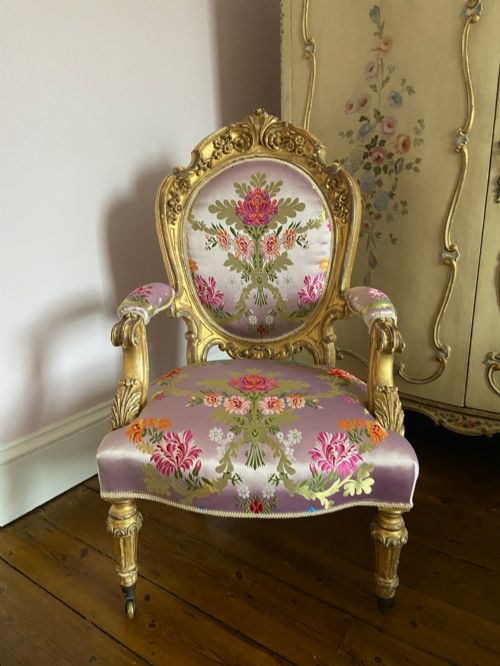


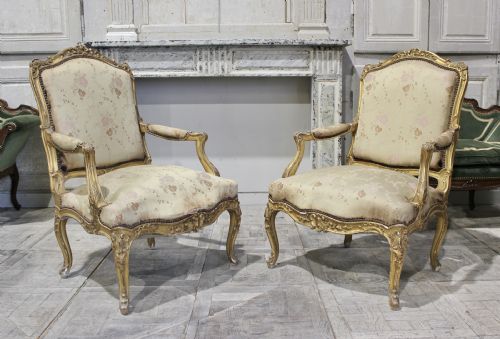


Gilt Frame Armchairs
These gilt frame armchairs bring French and English styles into the room, offering carved giltwood and upholstered comfort from the nineteenth and early twentieth centuries.
Gilt Frame Armchairs
When you search for gilt frame armchairs, you find seating built to catch the light in a formal interior, spanning the nineteenth century and early twentieth century. The examples on this page include open armchairs, tub chairs, and pairs of salon chairs.
You are most likely to meet pieces executed in the Louis XV style or Rococo Revival, alongside French Neoclassical, Regency Revival, and Victorian interpretations. Makers worked in walnut, beech, and wood, applying giltwood, paint, and ebonising to the frames.
The seating forms range from standard open armchairs and bergere tub chairs to larger salon suites and two-seat sofas. Many survive as pairs or sets, reflecting their original use in formal reception rooms.
How they were made
The underlying frames are carved from timbers such as beech, walnut, and general wood, shaped into the sweeping curves characteristic of Rococo and Regency revivals. Joinery relies on traditional carpentry methods to support the weight of the sitter and the substantial upholstery.
Surfaces receive layers of gesso and gold leaf to create the bright giltwood finish, or are painted and sometimes ebonised for contrast. Upholsters then finish the chairs in textiles including velvet, silk, and standard fabric.
The listings here feature pieces spanning the nineteenth century and the early twentieth century, utilising materials from velvet and silk to beech, walnut, and giltwood.
What varies in quality
The crispness and depth of the wood carving dictate the visual standard of the frame, distinguishing sharp hand-chiselled acanthus leaves and scrolls from softer, shallower moulding. The quality of the gilding itself, whether showing burnished gold leaf or flatter metallic paint, alters how the chair reflects light.
Proportion and structural balance separate standard production from finer pieces, particularly in the sweep of the arms and the rake of the back legs. The choice and execution of the upholstery materials, from heavy silk to rich velvet, complete the distinction between simple seating and grand salon furniture.
The Gilt Frame Armchairs Glossary
- Giltwood
- Timber coated with gold leaf applied over a prepared gesso ground. This finish provides a warm, reflective surface characteristic of formal period seating.
- Ebonised
- Wood finished to resemble ebony through staining or painting. This dark surface creates a sharp contrast when paired with gilt detailing.
- Rococo Revival
- A nineteenth-century design movement inspired by eighteenth-century French excess. It is defined by asymmetrical scrolls, C-scrolls, and naturalistic floral carving.
- Savonarola chair
- A folding chair formed of multiple curved wooden slats crossing to create a supportive X-shape frame. It draws its name from a famous Florentine Dominican friar.
Gilt Frame Armchairs: Frequently Asked Questions
Are these chairs comfortable for daily use?
Many of these pieces were designed for formal reception rooms rather than modern lounging, offering an upright and supportive sit. The depth and angle of the seat vary depending on whether the frame is an open salon armchair or a deep bergere tub chair.
Sitting habits have changed since the nineteenth century, so pairing them with an appropriate room layout ensures they function well as occasional seating.
How do I identify French style chairs?
French style armchairs usually display characteristic woodwork motifs such as Louis XV cabriole legs, flowing floral crests, and exposed giltwood frames. Their silhouettes often reference specific periods like the Regency or Neoclassical eras through symmetrical lines and refined carving.
Upholstery choices also offer clues, frequently utilising traditional textiles like silk or velvet to match the historical aesthetic of the frame.
Can I mix different chair styles together?
Pairing armchairs from different nineteenth-century revival styles works well if the scale and wood finishes share a common visual weight. Combining a Rococo Revival giltwood armchair with an ebonised tub chair introduces textural contrast while maintaining a cohesive period look.
Matching pairs provide symmetry, while single statement chairs anchor a corner or complement an existing sofa.