




Gilt Earthenware Ornaments
These gilt earthenware ornaments bring nineteenth and early twentieth century character to a room, ranging from Staffordshire mantel dogs to Japanese vases.
Gilt Earthenware Ornaments
Gilt earthenware ornaments encompass decorative figures, vases, and sculptures produced across the Victorian, Edwardian, and Art Deco periods. Buyers searching this phrase will most frequently encounter nineteenth-century Staffordshire pottery figures, particularly pairs of mantel dogs and portrait subjects.
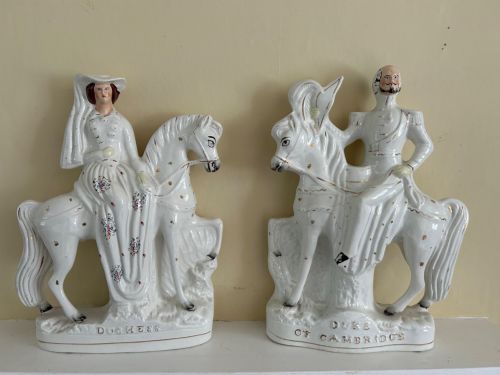
The selection ranges from early Staffordshire flatbacks depicting figures such as the Duke and Duchess of Cambridge to miniature poodles and pugs. Later examples extend into early twentieth-century production, including Japanese satsuma vases and continental ceramic animals like the Art Deco pheasant.
Most pieces serve a decorative purpose, designed to sit upon mantelpieces or display shelves within traditional and period interiors. Their appeal lies in the combination of moulded clay forms with applied metallic highlights.
How they were made
Makers shaped these pieces from earthenware clay, utilising moulds to produce consistent forms for Staffordshire dogs, figures, and animals. Glazes were then applied to the pottery body to provide a smooth, sealed surface before additional decoration.
Listings feature earthenware pieces spanning the Victorian, Edwardian, and Art Deco periods, utilising lead glazes, enamel, and gold leaf.
What varies in quality
The application and preservation of the gilt and enamel paint also determine the visual standard of a piece. Intact metallic highlights and cleanly brushed colours retain the intended decorative impact.
Wedgwood and Co. Ltd·Le Manceau·Beswick
The Gilt Earthenware Ornaments Glossary
- Earthenware
- A porous pottery body fired at lower temperatures than stoneware or porcelain. It requires a glaze to become impermeable to liquids.
- Gilt
- A thin layer of gold or gold-like material applied to the surface of the ceramic. This finish provides metallic highlights to the moulded details.
- Lead glaze
- A glossy coating containing lead oxide applied to earthenware before firing. It creates a smooth, glassy finish that enhances the colours beneath.
- Flatback
- A style of Staffordshire figure moulded with a flat, undecorated rear side. These pieces were designed to stand directly against a mantelpiece or wall.
- Enamel
- Opaque coloured glass fused to the ceramic surface through firing. It provides vibrant, durable decoration across figures and vases.
Gilt Earthenware Ornaments: Frequently Asked Questions
What are Staffordshire dogs?
Staffordshire dogs are earthenware mantel ornaments typically modelled as seated spaniels, often decorated with gilt collars and chains. Potters produced them in matched pairs to sit at either end of a fireplace.
These figures date primarily through the nineteenth century, reflecting Victorian domestic tastes and interior decoration styles.
How do I date these ornaments?
Dating relies on stylistic clues, moulding techniques, and the types of glazes and gilding applied to the earthenware body. Victorian pieces often display distinct handling of the clay compared to later Edwardian or Art Deco examples.
Makers' marks, where present on the base, provide a direct indication of the manufacturing period and origin.
Where should I display them?
These ornaments suit traditional mantelpieces, open shelving, and side tables where their moulded forms and gilt highlights remain visible. Pairs look best arranged symmetrically to echo their original domestic placement.
Keep them away from direct heat sources and strong sunlight to protect the enamel paint and gilt surfaces over time.
What is the difference between earthenware and china?
Earthenware is a permeable pottery body fired at lower temperatures, requiring a glaze to seal the clay. China refers to finer ceramic bodies that are denser and fired at higher heats.
Most traditional Staffordshire figures utilise earthenware, while certain Edwardian decorative pieces incorporate china bodies.