



Gilt Candelabra Garniture
A gilt candelabra garniture brings matched French elegance to a mantelpiece, pairing a striking clock with flanking lights for formal symmetry.
Gilt Candelabra Garniture
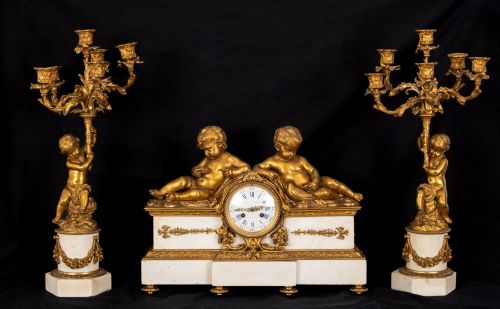
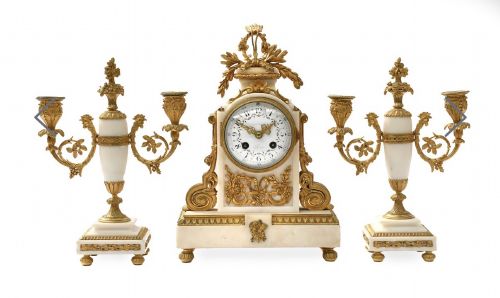
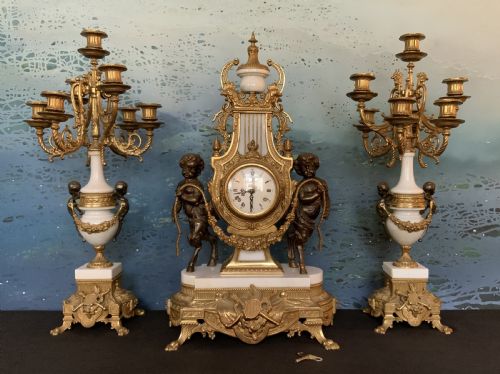
A gilt candelabra garniture combines a central mantel clock with a matching pair of multi-arm lights, designed to sit together as a unified set on a fireplace or console. These arrangements frequently emerge from nineteenth-century French workshops, drawing on Louis XVI, Empire, and Rococo revival aesthetics.
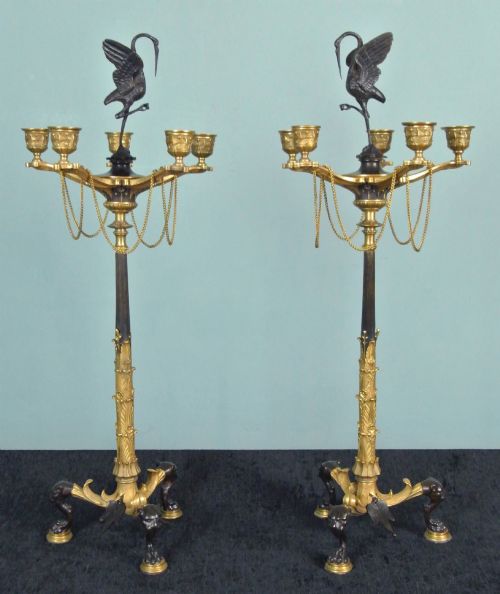
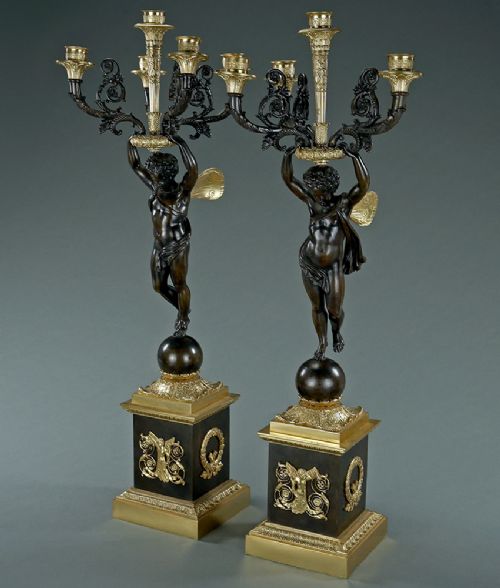
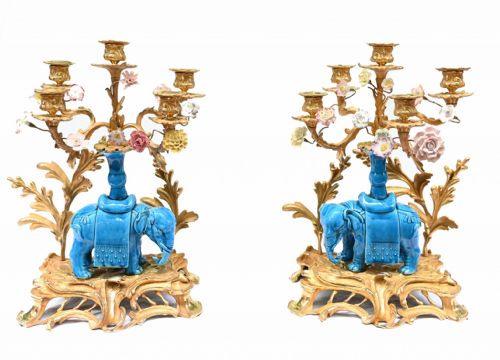
The most common configurations on this page pair white or coloured marble bases with cast metal figures, cherubs, or classical urns. Buyers encounter sets incorporating Sevres-style porcelain panels, patinated bronze, and elaborate ormolu mounts alongside the matching candelabra branches.
Pieces span the Victorian era and the later decades of the nineteenth century, reflecting periods of grand interior display. The central timepiece anchors the arrangement while the flanking candelabras echo its decorative motifs, metalwork, and proportion.
Materials and casting methods
Stonemasons shaped white marble, onyx, and bleu de roi porcelain to form the plinths and bodies of the clock sets. These rigid mineral elements contrasted with the ductile cast metal mounts fixed to the corners and feet with threaded pins.
Materials recorded across the inventory include ormolu, white marble, patinated bronze, onyx, and Sevres-style porcelain.
Distinctions in craftsmanship
The crispness of the bronze chasing dictates the visual success of the metalwork, separating sharp, hand-finished ornament from soft, uniform factory casts. Maker signatures stamped onto the movement backplates or bronze cases signal workshops of higher ambition.
The integration of the marble and porcelain components with the metal mounts reveals the maker's care, with superior examples showing tight joints and substantial gauge metals. Heavier, deeply cast ormolu retains its lustre far better than thin, washed plating applied to inferior brass bases.
Barbedienne·Henry Dasson·H Luppens Paris·Raingo Fres Paris·Samson
The Gilt Candelabra Garniture Glossary
- Ormolu
- Gilded bronze produced by applying a mercury-gold amalgam to a cast bronze object and heating it to vaporise the mercury. This technique yields a durable, rich golden finish characteristic of French decorative metalwork.
- Garniture
- A set of matched ornamental objects designed to be displayed together on a mantelpiece or sideboard, typically comprising a clock flanked by candelabras or urns.
- Candelabra
- A branched candlestick holding multiple lights, designed to match the central timepiece in a garniture set. These often feature removable arms to allow single candle use.
- Chasing
- The manual tooling of cast metal surfaces using small punches and hammers to add texture, depth, and detail. Fine chasing distinguishes high-end nineteenth-century French bronzes.
- Bleu de Roi
- A deep, rich cobalt blue ceramic glaze used prominently on Sevres-style porcelain clock bodies and urn inserts. It provides a striking contrast against bright ormolu mounts.
Gilt Candelabra Garniture: Frequently Asked Questions
What is a clock garniture?
A clock garniture is a matched set of decorative objects designed for symmetrical display, consisting of a central mantel clock accompanied by two side pieces such as candelabras or urns.
These sets were produced in nineteenth-century Europe to provide a cohesive decorative scheme for formal reception rooms and mantelpieces.
Are the clock movements original?
Many nineteenth-century French clock movements survive intact, often stamped with maker marks and serial numbers corresponding to the case. Clockmakers frequently serviced and repaired these mechanical eight-day striking movements over the decades of their use.
Checking the backplate for maker signatures helps confirm the authenticity of the movement within the bronze or marble case.
How do I date a garniture set?
Dating relies on stylistic clues, movement stamps, and material combinations, such as the heavy use of white marble and classical Revival motifs during the nineteenth century. Victorian registration marks and foundry stamps provide precise chronological markers.
Comparing the cast metal style to documented French bronzepairing patterns narrows the period of manufacture down to specific decades.