



Gold Marble Clock Set
These gold marble clock set pieces combine heavy stone with rich metalwork, bringing striking presence and period elegance to a mantelpiece.
Gold Marble Clock Set
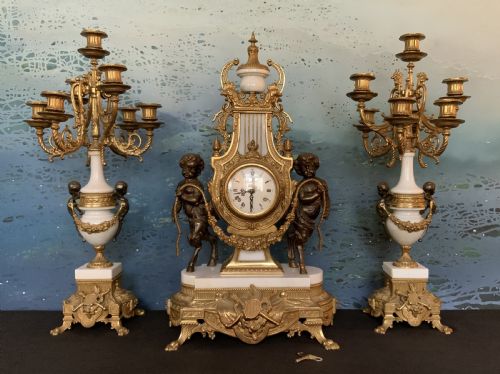
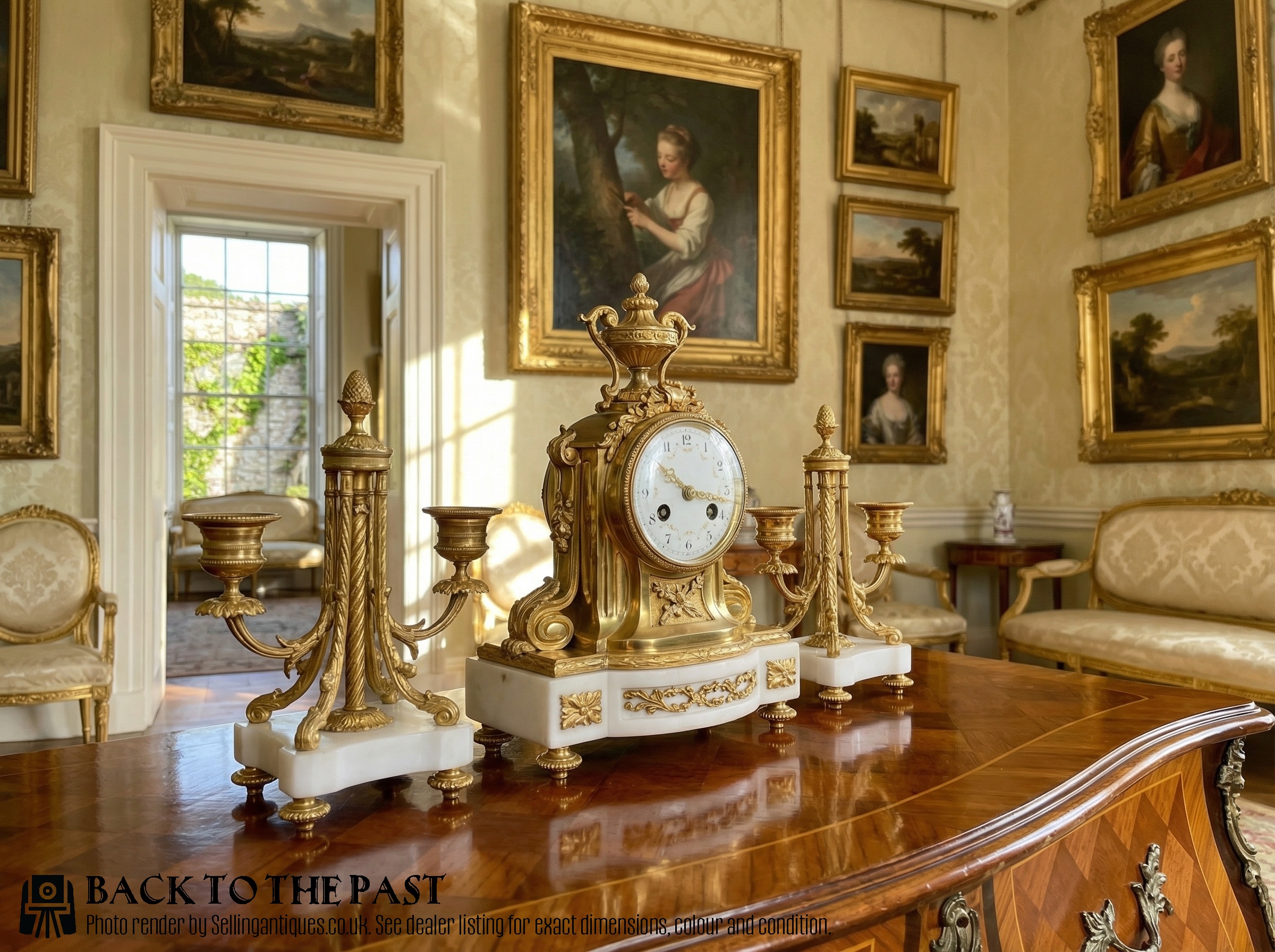
A gold marble clock set brings together a central mantel clock accompanied by matching side pieces such as candelabras or urns, forming a complete decorative garniture. The search phrase covers French and Italian works from the nineteenth century into the twentieth century, with Victorian and Napoleon III examples appearing frequently alongside Louis XVI and Louis XV styles.
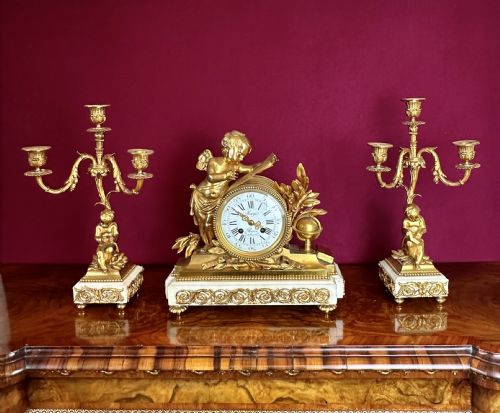
Most pieces seen here combine heavy stone bases with metallic ornamentation, often arranged in three-piece configurations that dominate a fireplace mantel. The forms range from boudoir clocks to large architectural garnitures featuring visible pendulums or cherub figures.
Neoclassical designs and revival styles dictate the overall aesthetic, drawing on classical motifs and ornate mounts. Buyers encounter these sets in various configurations, uniting timekeeping with sculptural metalwork and polished stone.
How they were made
Maker workshops built these sets using contrasting materials, pairing white or dark marble with cast bronze, ormolu, and gilt metal. The stone was cut and polished to provide a solid architectural foundation for the metal mounts.
Casting techniques allowed artisans to shape gilt bronze and ormolu into elaborate scrolls, cherubs, and Neoclassical frames that fitted tightly against the marble bodies. Enamel dials were often fitted with fine numerals to complete the clock faces.
Several sets feature watchful cherubs keeping time beside the pendulum.
What varies in quality
The standard of the chasing in the gilt bronze or ormolu separates finer works from simpler production, showing in the crispness of leaf work and figures. Heavier marble cutting and more substantial bronze casting elevate the presence of the entire set.
The integration between the stone body and the metal mounts indicates the level of craftsmanship involved, with superior examples showing seamless fitting and balanced proportions across all three garniture pieces.
Vincenti
The Gold Marble Clock Set Glossary
- Ormolu
- Gilded bronze produced by applying a mercury-gilt mixture to cast bronze. This technique creates a rich golden surface found on many French mantel pieces.
- Garniture
- A set of matched decorative objects designed to be displayed together on a mantelpiece. These typically consist of a central clock flanked by two matching candelabras or urns.
- Louis XVI Style
- A Neoclassical design movement characterised by straight lines, symmetry, and classical architectural motifs. It draws heavily on ancient Greek and Roman art.
- Visible Pendulum
- A clock design featuring a glass bezel or opening that displays the swinging pendulum in motion. This mechanical detail animates the face of the timepiece.
Gold Marble Clock Set: Frequently Asked Questions
What is a clock garniture?
A clock garniture is a matching set composed of a central timepiece and side ornaments designed for display together. The side pieces often take the form of candelabras or decorative urns.
These sets were arranged on mantelpieces to create a balanced decorative scheme in period interiors, unifying stone and metalwork across the group.
How do I date a marble clock set?
Dating relies on stylistic clues, such as the presence of Louis XVI revival motifs, Napoleon III aesthetics, or Victorian production markers. Material choices and dial construction also provide guidance.
Makers' marks stamped on the movement or backplate can narrow down the period of manufacture when present.
Where should I place a clock set?
These sets suit prominent locations where the full three-piece arrangement can be displayed safely, such as a large mantelpiece or a sturdy sideboard. The heavy marble bases require solid support.
Keeping them away from direct heat sources helps protect the stone and the gilt metal finishes over time.
What is the difference between ormolu and gilt bronze?
Ormolu specifically describes high-quality mercury gilding applied to bronze during the eighteenth and nineteenth centuries. The process yields a deep, warm golden lustre.
Gilt bronze is a broader term for bronze that has been coated in gold leaf or via modern plating methods, which may display a slightly different surface texture.