


Gilt Bronze Glass Box
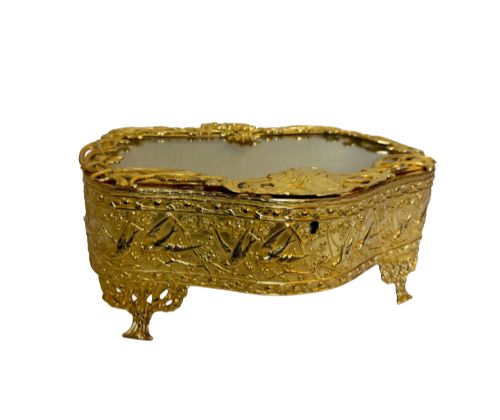
These gilt bronze glass boxes are heavy French caskets and display tables designed to hold jewels or perfumes, bringing nineteenth-century opulence to a dressing table.
Gilt Bronze Glass Box
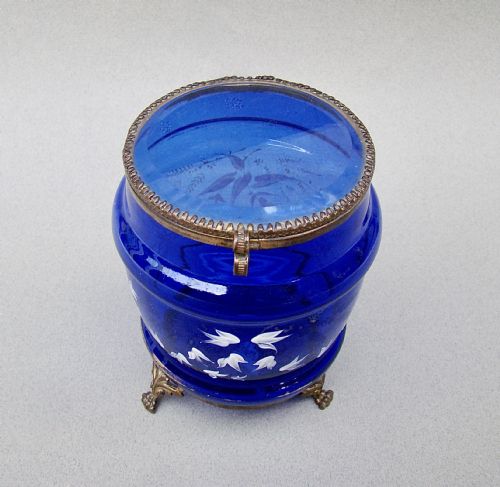
When you search for a gilt bronze glass box, you encounter nineteenth-century French caskets, trinket boxes, and bijouterie display tables spanning the Napoleon III, Second Empire, and Art Nouveau periods. These pieces combine heavy metal mounts with clear, coloured, or cut crystal glass to securely house personal treasures.
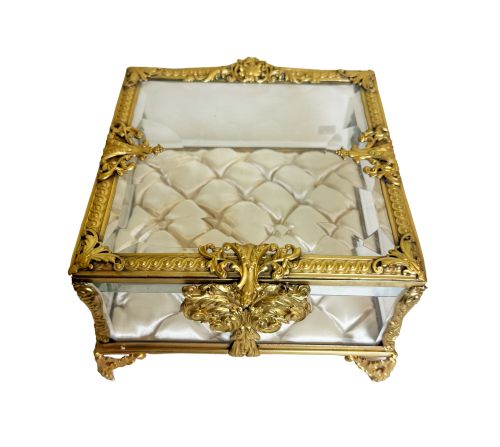
You are most likely to meet rectangular or oval trinket boxes mounted in ormolu and gilt bronze, often featuring bevelled glass panels. The selection also includes miniature novelties, perfume caskets, and occasional tantalus sets or display tables.
Originating predominantly from French workshops during the 1860s to 1900s, these containers served both practical vanity purposes and decorative display roles in period interiors. Their survival reflects the robust quality of their bronze frames and thick glass walls.
How they were made
Maker's workshops cast gilt bronze and ormolu mounts to frame heavy sheets of glass, cut crystal, or opaline, securing the panels tightly within metal channels. The structural integrity relies on precise casting and sturdy hinges that support thick lids without sagging.
Interiors frequently retain their original lining of silk or velvet to cushion jewellery and delicate trinkets against the hard glass and metal surfaces. Some examples incorporate hand-painted ceramic plaques or delicate gilt brass details such as eagles and carriage motifs.
Listings feature French caskets and tables from the 1860s to 1900, utilising ormolu, gilt bronze, cut crystal, and bevelled glass.
What varies in quality
The crispness of the bronze and ormolu casting dictates the upper tier of the range, where fine chasing provides sharp relief to foliage, scrolls, and figural mounts. Softer, shallower casting indicates standard commercial production rather than premier workshop output.
The thickness and clarity of the glass panels create a distinct separation between ordinary boxes and exceptional caskets, particularly when heavy cut crystal or signed Limoges enamel inserts are present. The preservation of original silk or velvet linings also elevates an individual piece.
The Gilt Bronze Glass Box Glossary
- Ormolu
- Gilded bronze produced by applying a mercury-gilt amalgam to cast bronze, yielding a rich golden surface that resists tarnish. This technique defines the metallic mounts of nineteenth-century French luxury goods.
- Bijouterie table
- A glass-topped display table designed to exhibit small valuables and jewellery at standing height. These furnishings often feature hinged lids and velvet-lined interiors.
- Opaline glass
- An opaque or translucent glass produced in pastel shades during the nineteenth century. It frequently appears in decorative trinket boxes and novelty containers.
- Tantalus
- A locking drink container frame that displays decanters while preventing unauthorised access to the contents. Nineteenth-century examples combined gilt bronze frames with heavy cut glass bottles.
- Bevelled glass
- Glass panes with angled edges cut and polished to a specific slope. This technique catches light and adds depth to the corners of box lids.
Gilt Bronze Glass Box: Frequently Asked Questions
What is a gilt bronze glass box?
It is a nineteenth-century French container made with heavy bronze or ormolu mounts framing glass panels, designed to hold trinkets, jewellery, or perfumes on a dressing table.
These pieces range from small hinged caskets to larger display tables, reflecting the decorative revivals of the Second Empire and Art Nouveau eras.
How do I date a French glass box?
Dating relies on stylistic clues, such as the flowing asymmetrical lines of Art Nouveau pieces versus the formal symmetry of Napoleon III and Louis XV revival mounts.
Material choices like Bristol blue glass or heavy cut crystal combined with cast ormolu markers typically point toward production between the 1860s and the turn of the twentieth century.
Were these boxes used for jewellery?
Yes, many were specifically constructed as trinket or jewellery boxes, often containing fitted, velvet-lined compartments to protect rings, necklaces, and pins.
Others served as perfume caskets to safely store fragile scent bottles upright within padded interiors.
How do I care for velvet linings?
Original silk and velvet interiors require gentle dry cleaning with a soft brush to remove dust without disturbing the fragile fabric or loosening the adhesive beneath.
Keeping the boxes out of direct sunlight prevents the coloured velvet and silk from fading over time.
How do I clean ormolu mounts?
Ormolu mounts should be cleaned with a dry or very slightly damp microfiber cloth to remove surface grime without stripping the delicate gilt surface.
Harsh metal polishes must be avoided entirely, as abrasive compounds will wear away the thin layer of gold.