


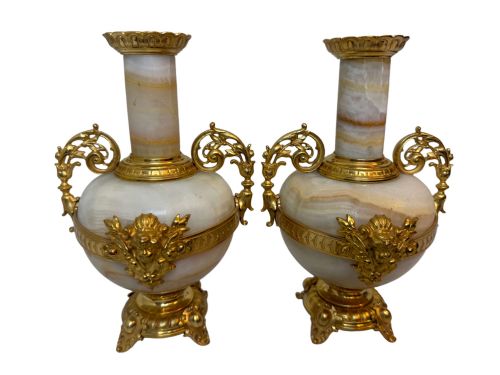


Gilt Brass Mantel Garniture
A gilt brass mantel garniture brings matched French symmetry and heavy metalwork to a fireplace, pairing a central clock with side candelabras or vases.
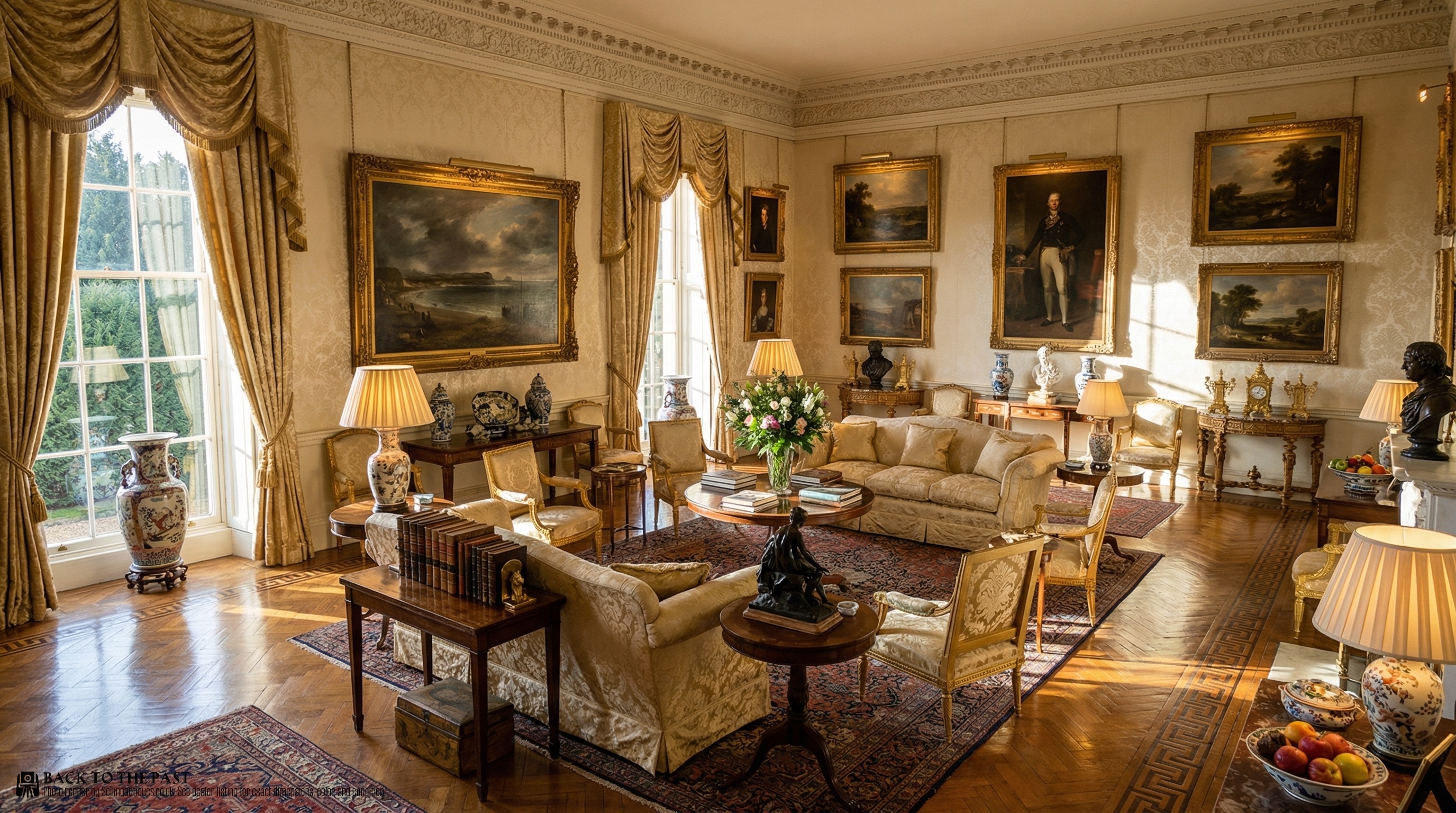
Gilt Brass Mantel Garniture
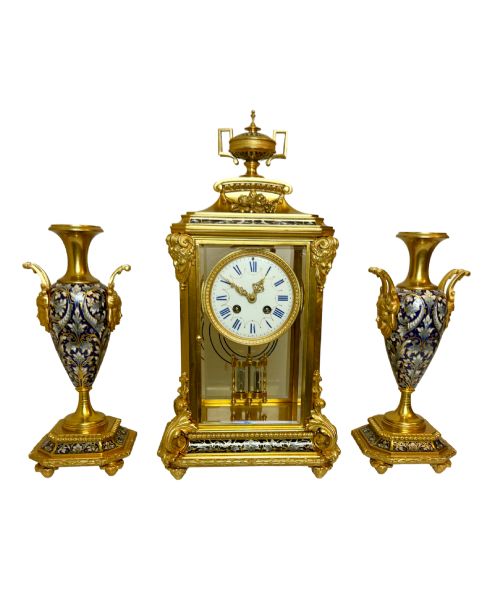
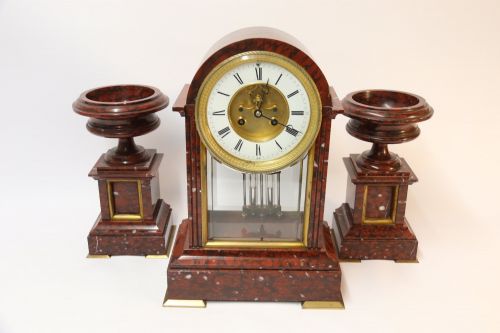
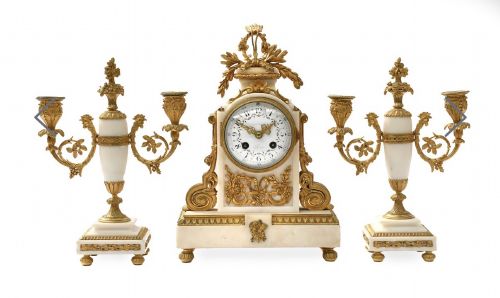
A gilt brass mantel garniture typically consists of a central clock flanked by a matching pair of side pieces, such as candelabras, urns or vases. When searching for a gilt brass mantel garniture, buyers encounter multi-piece sets designed to create a balanced, unified display upon a mantelpiece or shelf. Most examples originate from nineteenth-century France and span historical revivals like Louis XVI and Rococo.
The materials paired with the gilt metal frame define the visual weight of these sets. Listings frequently combine polished ormolu and brass with contrasting bodies of white, red or Sienna marble, onyx and enamel. Sets occasionally include matching side ornaments that repeat the motifs of the central clock.
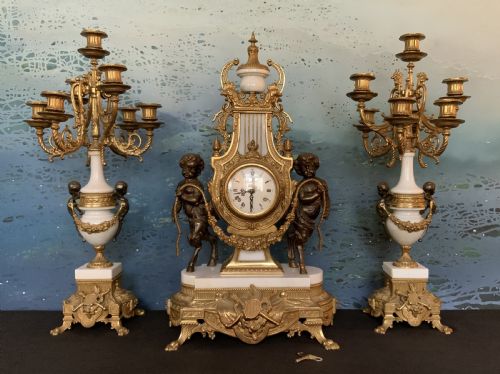
The forms range from compact boudoir clocks with delicate mounts to substantial architectural three-piece sets featuring bronze figures, cherubs or urns. Dating spans from the mid-nineteenth century through to the end of the Victorian era, reflecting varied French stylistic revivals.
Metalwork and stone foundations
The manufacture of these sets relied on cast bronze or brass finished with mercury gilding or ormolu, creating a bright metallic sheen. Foundries chased and burnished the metal mounts by hand to highlight high-relief scrolls, floral garlands and figural details.
Stone components such as white, red or black marble and onyx were precision-cut and turned to form the architectural bodies of the clocks and side vases. These heavy stone bases anchored the lighter metal mounts and provided a stable platform for complex eight-day striking clock movements.
Several Victorian sets incorporate cheerful bronze cherubs clinging to marble clock cases, seemingly assisting with the passage of time.
Judging the craftsmanship
Quality rests in the crispness of the bronze casting and the depth of the subsequent chasing. Superior sets show sharp, defined foliage and figures without the softness or pitting typical of hurried production.
The integration of the materials further separates standard pieces from finer works. In better examples, the gilt mounts fit the contours of the marble or onyx bodies precisely, and the clock movements bear the marks of respected French makers.
Samuel Marti·A.D Mougin·Vincenti of Paris·Deniere Paris·Japy Freres
The Gilt Brass Mantel Garniture Glossary
- Garniture
- A set of ornamental objects designed to match and be displayed together, most commonly a clock flanked by two candelabras or vases. This arrangement creates a balanced display on a mantelpiece.
- Ormolu
- Finely ground high-carat gold applied to a bronze base using a mercury amalgamation technique, producing a rich metallic golden surface. It is characteristic of fine French decorative metalwork.
- Champleve
- An enamelling technique where troughs or cells are hollowed out of the metal surface and filled with vitreous enamel before firing. The resulting coloured patterns sit flush with the metal partitions.
- Candelabra
- A branched candlestick holder designed to hold multiple candles simultaneously. In garniture sets, a pair of these matches the decorative style of the central clock.
- Movement
- The internal mechanical workings of a clock that drive the gear train and striking mechanism. Nineteenth-century French sets typically house eight-day spring-driven movements.
Gilt Brass Mantel Garniture: Frequently Asked Questions
What is a mantel garniture?
A mantel garniture is a matched decorative set designed for display on a fireplace shelf. It pairs a central timepiece with matching side ornaments like candelabras or vases.
The concept originated in France to create symmetrical interior decoration. The pieces share identical casting styles, materials and decorative motifs.
How do you wind these clocks?
Most period clocks use a dedicated winding key inserted into small holes on the dial face. Turning the key tensions the internal springs that power the movement.
Care must be taken not to overwind the springs. Many nineteenth-century French movements run for eight days per wind.
Are the side pieces always candelabras?
Side pieces vary according to the specific set design and intended room function. While candelabras with candle arms are common, many sets use solid decorative urns or vases instead.
All matching items use the same gilt brass mounts and stone bases as the central clock. This maintains visual continuity across the entire three-piece grouping.
How do you identify the maker?
Maker marks are typically stamped directly onto the brass backplate of the internal clock movement. Names or stamped medallions reveal the nineteenth-century French foundry responsible for the mechanism.
Signatures are rarely found on the exterior gilt mounts or marble bodies. Examining the movement interior offers the most reliable attribution.