


Gilded Porcelain Vase Set
These gilded porcelain vase set pieces bring gilded splendour to a room, offering matched arrangements built for mantelpieces and tables.
Gilded Porcelain Vase Set
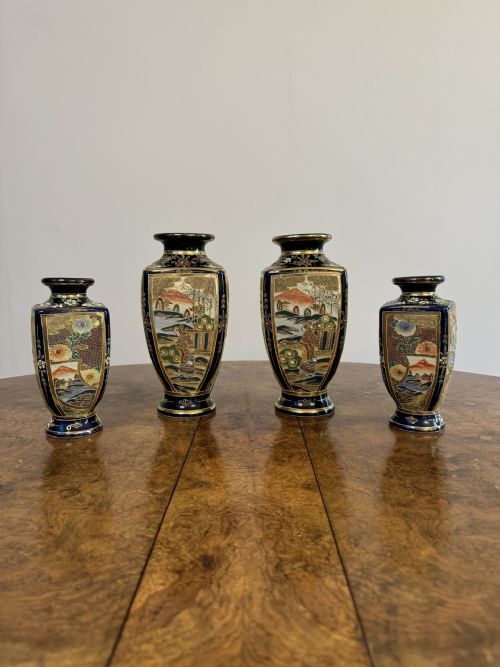
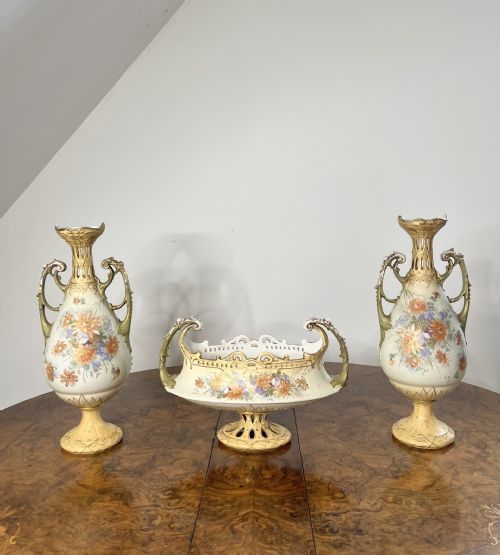
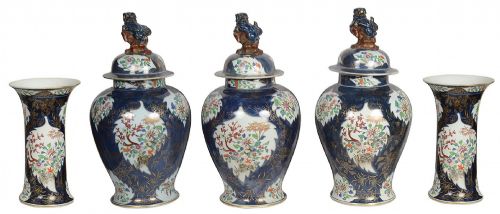
A gilded porcelain vase set brings together matching decorative vessels designed to sit as a coordinated group on a mantelpiece or central table. You will frequently encounter garniture sets of three or five pieces, alongside pairs of urns and clock garnitures originating from European and Japanese makers.
The selections span the nineteenth century, taking in Victorian and French Empire influences alongside Japanese Edo and Meiji period works. Pieces range from grand Paris porcelain urns and Royal Vienna garnitures to delicate Imari palettes and Chinoiserie motifs.
Materials and construction
These items rely on ceramic bodies formed from porcelain, ironstone, and earthenware, often finished with hand-painted scenes and intricate enamel work. Artisans applied gold leaf and gilt highlights to accentuate moulded contours and figurative panels.
Mounts in materials such as ormolu frequently complement the ceramic bodies, particularly on nineteenth-century French and continental garnitures. Makers utilised firing and glazing techniques that allowed rich polychrome palettes, including Famille rose and Imari designs, to fuse with the underlying ceramic.
Forms span tea service components, clock garnitures, centrepieces, and matched sets of lidded urns utilising ironstone, earthenware, and Carrara ware.
Distinguishing finer examples
The skill of the hand-painted decoration determines much of the distinction between standard and exceptional pieces, particularly in the precision of floral motifs, figures, and gilded detailing. Finer works display crisp brushwork and carefully applied gold leaf that adheres securely to the porcelain contours.
The completeness and harmony of a matched garniture set also influence its standing, as does the integration of supplementary elements like ormolu mounts. Original pairing and balanced proportions across all vessels in a group indicate superior workshop production.
Royal Vienna·Doulton Lambeth·Masons·Minton
The Gilded Porcelain Vase Set Glossary
- Garniture
- A set of matching vases or decorative vessels designed to be displayed together on a mantelpiece or cabinet. Typically comprising three, four, or five pieces of graduated or matching sizes.
- Imari palette
- A traditional Japanese decorative style utilising cobalt blue, iron red, and abundant gilt on a white porcelain ground. It heavily influenced European ceramic production during the eighteenth and nineteenth centuries.
- Ormolu
- Gilded bronze mounts and decorative trimmings applied to ceramic bodies. This technique was widely utilised by French and continental makers to add architectural structure and ornamental weight.
- Famille rose
- A major palette of Chinese ceramic enamels introduced in the eighteenth century, dominated by opaque pink or rose colours. The style was frequently emulated in later European and continental wares.
Gilded Porcelain Vase Set: Frequently Asked Questions
What is a vase garniture?
A vase garniture is a coordinated set of three, four, or five vessels made to be displayed together as a decorative unit. These sets traditionally occupy prominent positions on mantelpieces, sideboards, or large tables.
The matching designs create a balanced visual impact across the group, often featuring a central taller vase flanked by smaller matching companions or urns.
How do I display a garniture set?
Garniture sets work best when arranged symmetrically on a flat surface with adequate clearance to showcase each individual vessel. Placing the largest piece in the centre with the matching pairs or side vases flanking it maintains the traditional visual balance.
Ensure the surrounding furniture can support the combined weight of the ceramic and any metal mounts, keeping them away from heavy foot traffic to protect delicate gilding.
What is Paris porcelain?
Paris porcelain refers to the output of numerous independent studios and factories operating in and around Paris during the eighteenth and nineteenth centuries. These makers produced high-quality decorative items, often featuring rich gilding and detailed hand-painted scenes.
Without a single central royal factory stamp, Paris porcelain encompasses a diverse range of artistic styles, from neoclassical urns to ornate floral garnitures.
How do I identify Imari style?
Imari style ceramics are readily identified by their distinct colour scheme combining underglaze cobalt blue, iron red enamel, and extensive gilt detailing. The patterns often incorporate intricate floral and brocade motifs derived from Japanese porcelain traditions.
Edo and Meiji period Japanese pieces, as well as European adaptations, utilise this striking palette to create high-contrast decorative surfaces.