
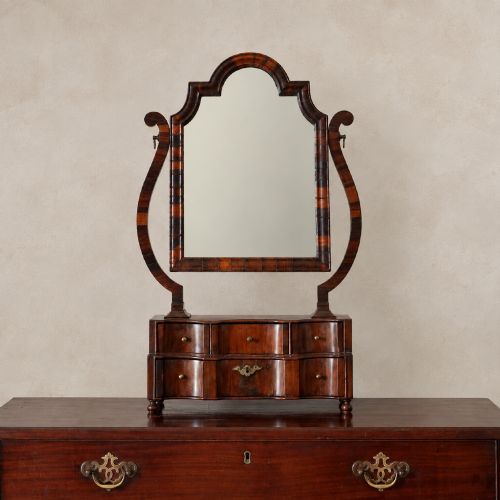
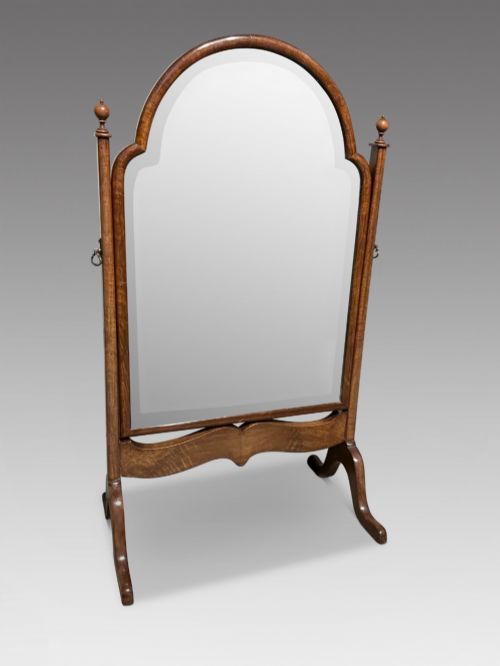


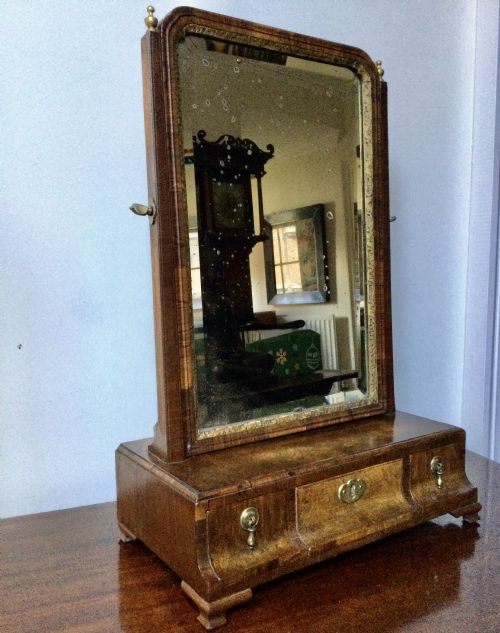
Georgian Walnut Swing Mirror
A Georgian walnut swing mirror sits upon the dressing table, offering a polished reflection framed in rich timber.
Georgian Walnut Swing Mirror
A georgian walnut swing mirror is a portable looking glass designed for the dressing table, pivoting between two upright supports. These items appear across various periods, most notably in the eighteenth century during the reigns of Queen Anne, George II, and George III.
The inventory includes alternative designations such as toilet mirrors, dressing glasses, and box mirrors, alongside later interpretations from the nineteenth and twentieth centuries. The primary form involves a rectangular or arched glass plate mounted in a frame above a small drawer base.
How they were made
Cabinetmakers constructed these frames using solid walnut and burr walnut veneers, often applied over secondary conifers or hardwoods. Boxwood inlay, laburnum, and gilding frequently appear as decorative embellishments on the surface.
Hardware consists of brass fittings, including side screws that permit the plate to tilt and small drawer pulls. The glass itself is silvered plate, held within shaped surrounds.
Some diminutive boxes hide tiny secret drawers behind the main compartment, meant for concealing private tokens.
What varies in quality
The refinement of the timber selection dictates much of the visual character, with figured burr veneers commanding attention over plain grain. The subtlety of boxwood stringing and the proportion of the base drawers relative to the mirror plate also determine the balance of the piece.
Originality of the glass plate, brass hardware, and secondary timbers influences the overall integrity. Later replacements alter the visual harmony established by eighteenth-century makers.
The Georgian Walnut Swing Mirror Glossary
- Toilet mirror
- A small table-standing glass used for personal grooming, typically equipped with small drawers in the base. These objects rested on chests of drawers or dedicated dressing tables.
- Burr walnut
- A prized wood veneer harvested from the warted growths of walnut trees, displaying intricate, swirling grain patterns. Cabinetmakers used it on prominent surfaces for decorative impact.
- Boxwood inlay
- Narrow strips of pale boxwood inserted into recesses within the darker walnut ground to form geometric borders or lines. This technique enhances the linear definition of the frame.
- Giltwood
- Wood carved and coated with a thin layer of gold leaf or metallic paint. It appears as an accent material on select mirror frames.
- Swing mirror
- A looking-glass plate hung on pivot pins between two vertical arms, allowing the user to adjust the angle of reflection.
Georgian Walnut Swing Mirror: Frequently Asked Questions
Where were these mirrors placed?
These dressing glasses sat upon chests of drawers, pier tables, or dedicated dressing tables in bedrooms and dressing rooms. Their portable nature allowed them to be moved to catch optimal light.
Because they were not fixed to furniture, they could be positioned wherever the user required during morning routines.
What is a box mirror?
A box mirror refers to a dressing glass where the base incorporates a compartment or small drawers, resembling a miniature chest. This configuration provided secure storage for small trinkets and pins.
The enclosed base also added weight and stability to support the pivoting mirror frame above.
How do I spot an eighteenth-century example?
Examination of the timber, construction joints, and backboards helps distinguish eighteenth-century pieces from later reproductions. Early examples utilise native hardwoods and hand-cut dovetails in the drawer construction.
The presence of original mercury glass, showing minor oxidation or speckling, also indicates considerable age.
Did walnut fall out of fashion?
Mahogany largely superseded walnut in British cabinetmaking around the middle of the eighteenth century as the primary timber of choice. Walnut frames continued to be made or imitated, but the height of production centred on the early decades.
Later nineteenth and twentieth-century revivals brought walnut back into favour for period-style reproductions.