
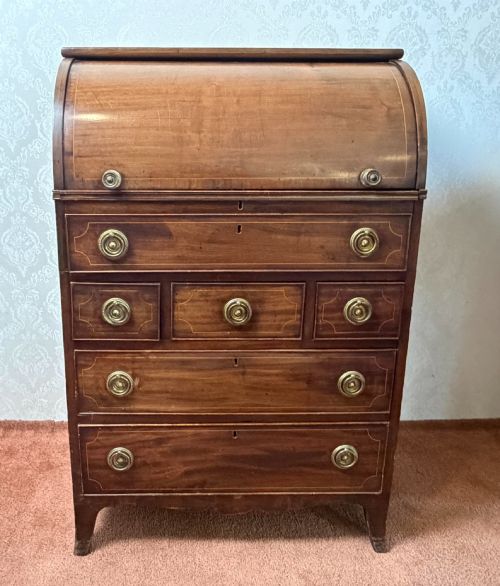
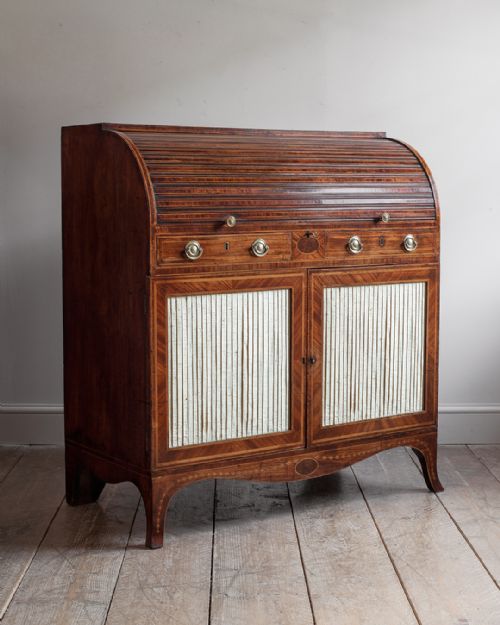
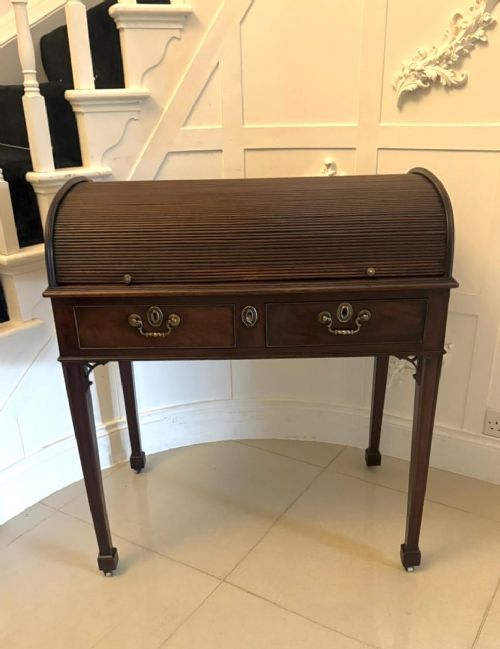
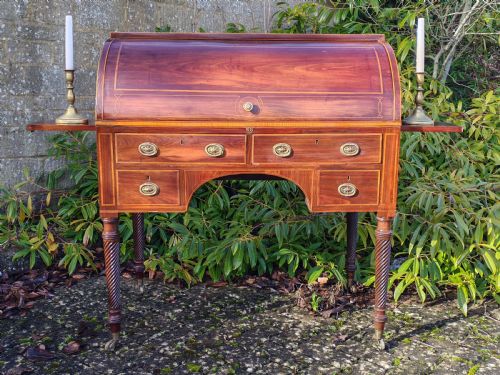
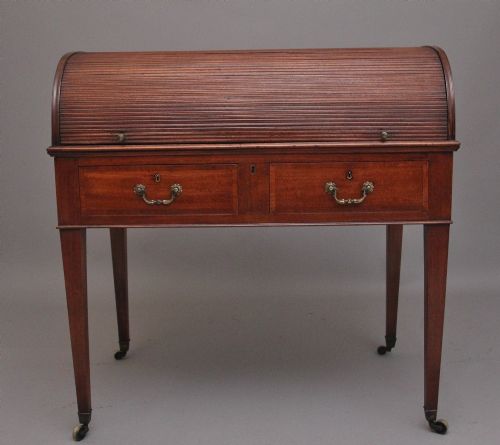


Georgian Tambour Desk
A georgian tambour desk brings together slatted wooden shutters and fitted writing compartments from the late eighteenth and early nineteenth centuries.
Georgian Tambour Desk
When you search for a georgian tambour desk, you are looking at writing furniture featuring flexible wooden slats that slide in tracks to enclose a fitted interior. These pieces appear primarily from the eighteenth century, George III period, and Regency eras, taking forms such as cylinder desks, writing tables, and bureaux.
The version you are most likely to meet on this page is a mahogany writing desk or cylinder bureau, often inlaid with satinwood or built with pull-out writing slides. Alongside standard desks, the record shows related variants including ladies writing tables, cylinder top cabinets, and occasional box forms.
Makers of the period applied these flexible fronts to compact writing furniture intended for refined domestic interiors. The survival of these pieces demonstrates the enduring appeal of concealed compartments and sliding tambour shutters.
Distinctions in quality
Quality in these desks rests on the precision of the tambour mechanism and the tightness of the slatted joints when closed. Smooth operation of the sliding shutters without binding or sagging separates superior cabinetwork from lesser examples.
The choice of secondary timbers and the subtlety of the satinwood inlay also distinguish finer productions. Well-figured mahogany veneers and intact internal fittings indicate higher workshop standards during the Georgian and Regency periods.
Listings feature pieces spanning the Georgian, George III, Regency, and Sheraton periods alongside nineteenth-century examples.
The Georgian Tambour Desk Glossary
- Tambour
- A flexible shutter formed of narrow vertical wooden strips glued to a backing fabric, allowing it to slide around a curved track. This mechanism conceals pigeonholes and small drawers.
- Cylinder desk
- A writing desk featuring a quarter-cylinder rolling shutter that encloses the writing surface and internal compartments. When pushed back, the cylinder disappears into the upper carcase.
- Satinwood
- A durable, lustrous hardwood with a yellowish gold colour used extensively for veneers and decorative inlay in late eighteenth-century furniture. It provides strong visual contrast against darker mahogany.
- Writing slide
- A pull-out board positioned above the drawers or beneath the writing surface to extend available workspace. These boards slide flush into the frame when not in use.
- George III period
- The stylistic era spanning the reign of King George III from seventeen sixty to eighteen twenty. Furniture from this span is characterised by classical proportions and refined cabinetmaking.
Georgian Tambour Desk: Frequently Asked Questions
How does a tambour shutter work?
A tambour shutter consists of small vertical strips of wood attached to a canvas backing. This construction allows the entire curtain to bend around a curved track and slide smoothly into the body of the desk.
Cabinetmakers used this method to hide pigeonholes and small drawers without needing doors that swing outward into the room.
What is the difference between a cylinder desk and a tambour desk?
A cylinder desk uses a solid, curved piece of wood that rotates on a pivot to open and close. A tambour desk uses multiple small slats joined together flexibly to achieve a similar curve.
Both forms serve the same purpose of concealing the writing surface and inner compartments when not in use.
What timbers were used to build these desks?
Makers relied heavily on mahogany as the primary structural and external timber. Satinwood was frequently employed for contrasting inlay, stringing, and decorative veneers.
Selected pieces also incorporate partridgewood, brass hardware, and fitted leather writing surfaces inside the compartments.
How do I care for the leather writing surface?
Keep the leather away from direct sunlight and excessive heat to prevent drying and cracking. Dust it gently with a dry, soft cloth and avoid using harsh chemical cleaners.
Conditioning can be applied sparingly if recommended by a professional restorer to maintain the suppleness of the material.
Were these desks made for ladies or gentlemen?
The records include forms designated as ladies desks, writing tables, and larger estate desks suited for general study. Smaller bureau formats and bonheur du jour pieces were often built for parlour or bedchamber use.
Scale and internal fittings generally indicate whether a piece was intended for portable correspondence or formal estate administration.