

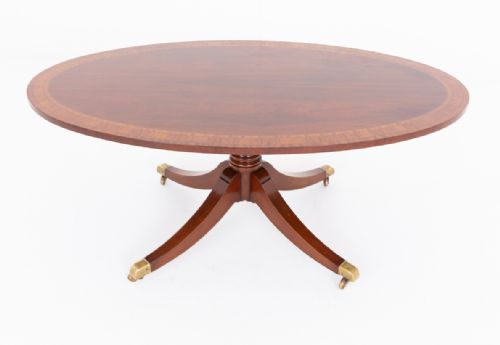
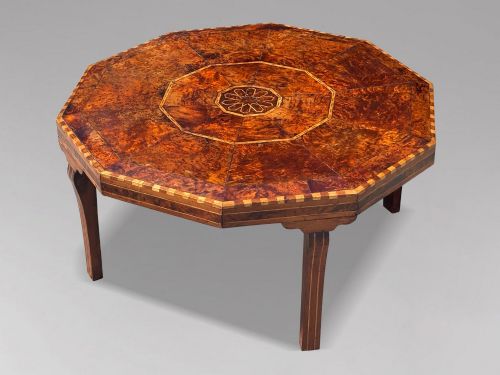


Georgian Style Centre Table
A georgian style centre table brings classical proportion and grand presence to a room, offering a versatile surface designed to anchor a large space.

What a Georgian Style Centre Table Is
A georgian style centre table is a freestanding piece designed to sit in the middle of a room rather than against a wall. The examples found here span from the Georgian period through nineteenth-century revivals, Edwardian interpretations, and early twentieth-century pieces.
The forms on this page include occasional tables and coffee tables, created in revival styles such as Sheraton, Chippendale, Victorian Rococo, and Regency. Walnut, mahogany, satinwood, and oak appear frequently across these variations.
How They Were Made
Cabinetmakers utilised dense timbers such as mahogany, walnut, and oak for the structural frames of these tables. Decorative surfaces often incorporated contrasting veneers like satinwood and boxwood, sometimes complemented by brass details and giltwood flourishes.
Inlaid decoration and serpentine shaping demanded high levels of joinery skill. Bleached oak and figured woods show the variety of finishes applied across the different revival periods represented in the workshop traditions.
Retail Price Guide 2026
Typical UK retail prices for georgian style centre table, calculated from the Sellingantiques database of over a million retail prices indexed since 2003. This retail price guide relies exclusively on Sellingantiques data; no external sources or auction records are used, so the figures do not describe the wider market.
One table arrives in bleached oak, proving that even formal classical shapes occasionally enjoy a sun-bleached holiday.
What Varies in Quality
The standard of a georgian style centre table rests upon the crispness of its carving and the choice of timber figure. Finer examples display meticulous grain matching in satinwood or mahogany veneers and precise execution of classical motifs.
Construction methods also separate standard production from superior craftsmanship. Heavier timbers and deliberate detailing in revival styles reflect the ambition of the original workshop.
The Georgian Style Centre Table Glossary
- Centre table
- A freestanding piece finished on all sides to stand in the middle of a room. These tables often serve as focal points for large reception spaces.
- Serpentine
- A curved line that undulates gently with a convex centre flanked by concave sides. This shape appears frequently on nineteenth-century table edges.
- Satinwood
- A durable, yellowish-gold timber valued for its lustrous sheen and smooth texture. It is often used for elaborate inlay work on revival pieces.
- Revival
- A stylistic movement that reinterprets historical designs from earlier centuries. Sheraton, Chippendale, and Regency revivals dominate these listings.
Frequently Asked Questions
What is a georgian style centre table used for?
These tables are built to stand freely in the middle of a room, providing a central surface for display or gathering. Historically they anchored large spaces, holding lamps, decorative objects, or books.
Today they function effectively as large coffee tables or focal points in spacious living areas and reception rooms.
How do I identify a revival piece?
Revival pieces borrow decorative vocabulary from earlier eras, such as Sheraton or Chippendale motifs, but were manufactured in later decades like the Victorian or Edwardian periods. Timber treatment and construction techniques often reveal the true age of the piece.
Looking closely at the secondary woods and joinery helps distinguish nineteenth or twentieth-century craftsmanship from eighteenth-century originals.
Which woods are most common?
Mahogany appears frequently across both original and revival pieces, valued for its rich colour and stability. Satinwood, walnut, and oak also feature prominently, often enhanced with boxwood stringing.
Different periods favoured distinct timbers, with satinwood particularly prominent in late nineteenth-century revival pieces.
How do I place one in a modern room?
A georgian style centre table works best when given enough space to be walked around freely. Its classical proportions provide a strong visual anchor against contemporary furnishings.
Keep the surrounding floor space open to let the craftsmanship of the base and legs remain visible.