
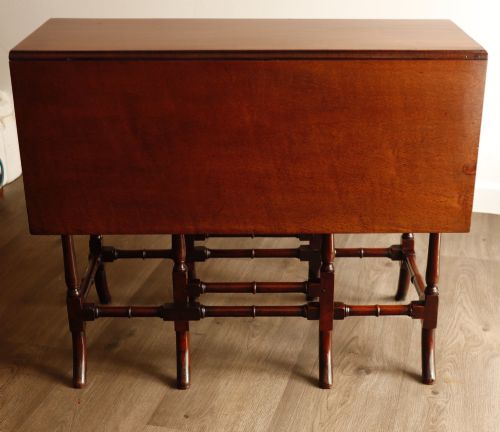
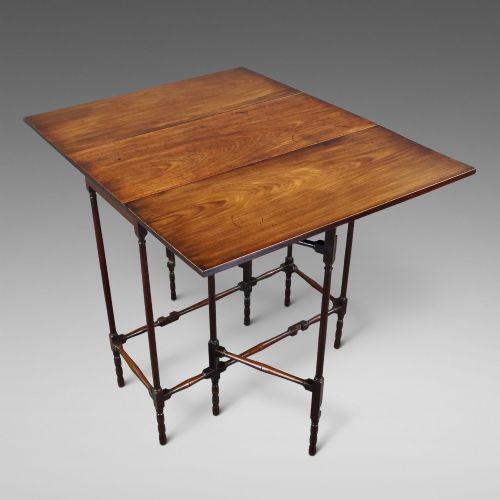


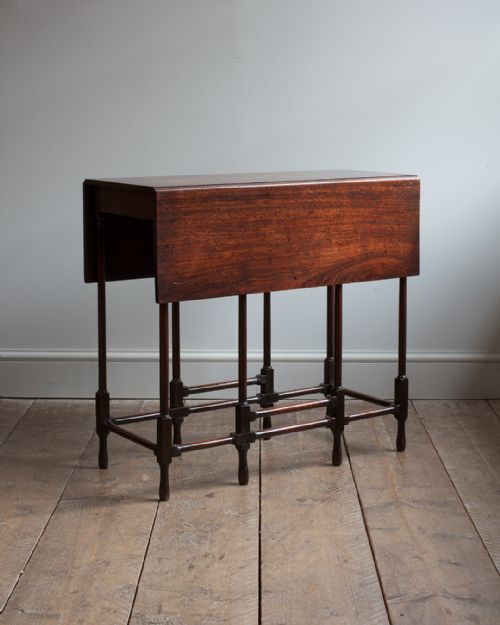


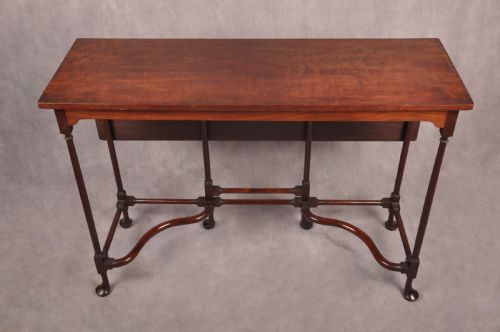


Georgian Spider Leg Gateleg
When you want a Georgian spider leg gateleg, you are after a slender timber drop-leaf table that tucks into a corner yet opens for tea.
Georgian Spider Leg Gateleg
A Georgian spider leg gateleg is a slender timber drop-leaf table designed with exceptionally thin turned supports that fold inward when the leaves drop.
The pieces you meet on this page span the eighteenth century, George III, nineteenth century, Victorian and Edwardian periods, appearing as occasional tables, tea tables, drop leaf tables and side tables.
Most examples are constructed from mahogany, though timber, paint, brass and iron also appear across the broader range of listings.
How they were made
Cabinetmakers utilised dense mahogany to achieve the incredibly thin, spindle-like turned legs that give these tables their name without sacrificing structural stability.
Drop-leaf and gateleg mechanisms required precise joinery, utilising hinged flaps and swing-out legs of timber, sometimes accented with brass fittings.
Surface finishes range from polished timber to painted treatments, reflecting the evolving tastes of the Georgian, Chippendale and Edwardian periods.
Mahogany is the dominant material seen across these listings, spanning the eighteenth century, George III, and Edwardian eras.
What varies in quality
Quality rests upon the crispness of the turning on the slender legs and the tightness of the joints where the gateleg swings.
The choice of mahogany timber dictates the visual depth of the top, with finer grain patterns and rich natural colour separating standard pieces from exceptional ones.
Proportion matters immensely; the best examples maintain a delicate balance between the small table top and the skeletal, spider-like base.
The Georgian Spider Leg Gateleg Glossary
- Gateleg table
- A table with hinged flaps or leaves supported by legs that swing out like a gate. This construction allows the table to expand significantly when needed.
- Spider leg
- A descriptor for exceptionally slender, delicate turned wooden legs found on light tables. They provide minimal visual weight whilst supporting the top.
- Drop-leaf table
- A table featuring a fixed centre section and two hinged flaps that drop down on either side. It is designed to save space in smaller rooms.
- Pembroke table
- A small rectangular table with two hinged drop leaves on the opposite sides. They frequently include small drawers and slender legs.
- Chippendale
- A style of eighteenth-century English furniture characterised by carved detail and classical motifs. It heavily influences the finer mahogany spider tables.
Georgian Spider Leg Gateleg: Frequently Asked Questions
What is a spider leg table?
A spider leg table is a delicate drop-leaf or gateleg table supported by exceptionally thin, turned wooden legs. They originated to provide a light, movable surface for tea and correspondence.
Because the legs are so slender, the table occupies very little visual space in a room. They suit small spaces where a heavy dining table would overwhelm the floor plan.
How do you use a gateleg table?
You use a gateleg table by lifting the drop leaves on either side and swinging out the hinged legs from beneath to support them. This transforms a narrow side table into a wider surface.
When not in use, the leaves drop down and the legs swing back against the frame, allowing the table to rest flat against a wall.
Are these tables sturdy?
These tables rely on dense hardwoods like mahogany to remain stable despite their thin frames. The swinging gateleg provides a solid prop for the raised leaf.
While they handle everyday items like teacups and books with ease, they are not built for heavy weight or leaning. Treat the delicate turned joints with care.
How do I date a spider leg table?
You date a spider leg table by examining the timber, the turning style of the legs, and the construction of the drop-leaf mechanism. Eighteenth-century examples feature distinct mahogany grain and hand-turned spindles.
Later Victorian and Edwardian revivals often replicate these Georgian and George III styles. Look closely at the hardware and wood seasoning to determine the true age.