
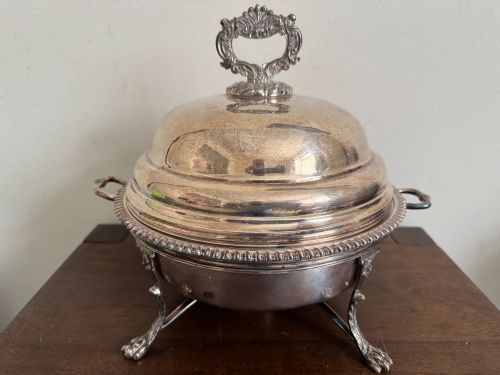


Georgian Silver Entree Dish
These pieces of georgian silver entree dish bring heavy silver weight and Old Sheffield Plate warmth to a dining table, combining formal Regency style with practical service.
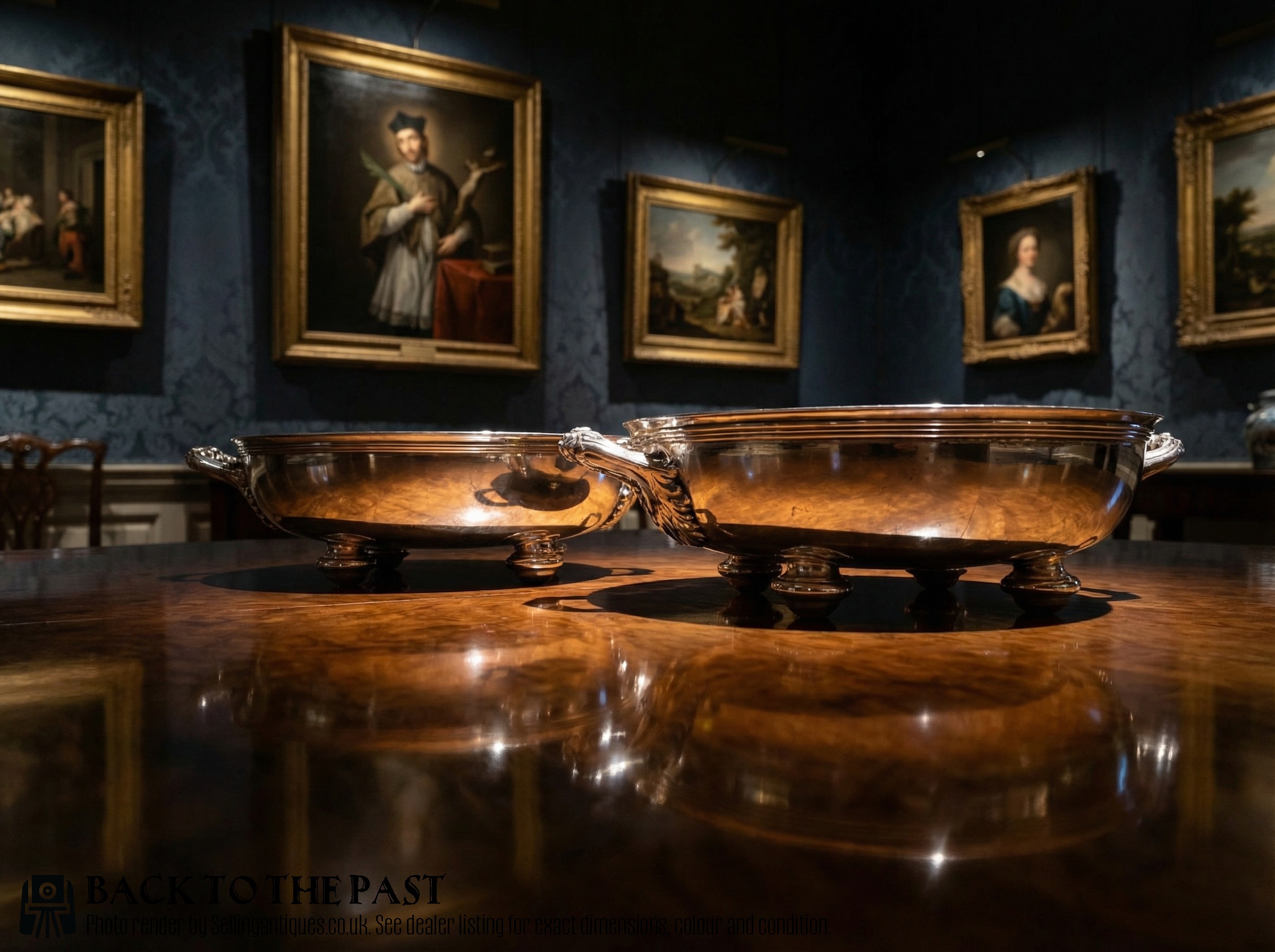
Georgian Silver Entree Dish
A georgian silver entree dish provides a grand way to serve meals, appearing in forms such as lidded serving dishes, warming dishes, and sauce tureens. These items belong to the wider category of serveware and tableware, designed for elaborate dining rooms.
You are most likely to meet pieces from the nineteenth century and the Georgian period, including items bearing Regency and Georgian styles. Makers and manufacturers produced these in solid silver, sterling silver, Old Sheffield Plate, and silver plate, often paired with copper or wood elements.
The selection ranges from single warming dishes and supper dishes with lampstands to pairs of entree dishes by named makers. Surviving examples demonstrate the formal dining customs of the period through lidded covers and twin handles.
How they were made
Silversmiths and manufacturers worked with sterling silver and solid silver for high-status pieces, while others utilised Old Sheffield Plate, fusing a layer of silver onto a copper base. This plated technique allowed makers to achieve the look of solid silver at a different scale of production.
Craftsmen applied decorative elements such as gadrooned rims and armorial crests to the metal surfaces. Wooden components also appear on certain handles or stands, providing a contrast to the gleaming silver and copper.
Listings feature items from the Georgian period and the nineteenth century, utilising silver, Old Sheffield Plate, copper, and wood.
What varies in quality
Quality rests in the weight of the metal, the crispness of the gadrooned rim, and the integrity of the original plating over the copper base. Finer examples retain their matching covers and lampstands, showing complete service sets rather than assembled parts.
The reputation of the maker, such as Paul Storr, Matthew Linwood, or Cresswick, separates standard production items from masterworks. Engraved crests and clear London hallmarks indicate pieces commissioned for notable households.
Matthew Linwood·Cresswick·Paul Storr
The Georgian Silver Entree Dish Glossary
- Entree dish
- A covered vessel designed to hold a course served before the main meat or as a main dish itself. These typically feature removable lids for easy serving at the table.
- Old Sheffield Plate
- An early form of plated metal created by fusing a thin sheet of sterling silver to a thicker copper ingot. This technique was widely used before electroplating became common.
- Gadroon
- A decorative, ornamental carved or embossed border consisting of repeating curved wedges or convex curves. This motif frequently edges the rims of Georgian serveware.
- Tureen
- A deep, large bowl with a lid used for serving soups, sauces, or stews. Sauce tureens represent smaller versions intended for gravies and condiments.
- Lampstand
- A metal stand incorporating a burner or heating element placed beneath a dish or tureen. These kept food warm during long dinner service.
Georgian Silver Entree Dish: Frequently Asked Questions
What is a georgian silver entree dish used for?
These dishes held warm courses at the dining table, keeping food covered until the moment of service.
Today, collectors use them as decorative centrepieces or for actual dining, particularly when hosting formal dinner parties.
How do I tell solid silver from Old Sheffield Plate?
Solid silver pieces bear hallmarks indicating the assay office, standard, and date of manufacture. Old Sheffield Plate often reveals a thin line of reddish copper where the silver layer has worn away at the edges.
Plate pieces feel different in weight and show the characteristic fused copper core upon close inspection of the rims.
What periods do these dishes come from?
The listings span the Georgian era, the nineteenth century, and the Regency style period, with some pieces dating into the 1920s.
Designs transition from restrained Georgian elegance to the more exuberant Regency and Victorian interpretations.
How do I care for silver plated tableware?
Clean plated and sterling items with a soft cloth and a gentle, non-abrasive silver polish formulated for antiques. Avoid harsh chemical dips that strip the character from the metal.
Store them in dry conditions, and keep Old Sheffield Plate away from dampness to protect the exposed copper edges.