
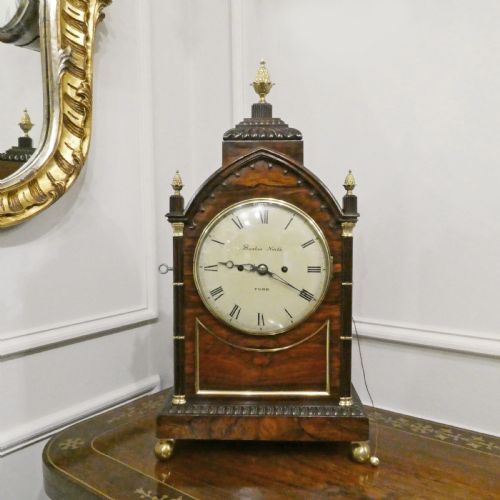
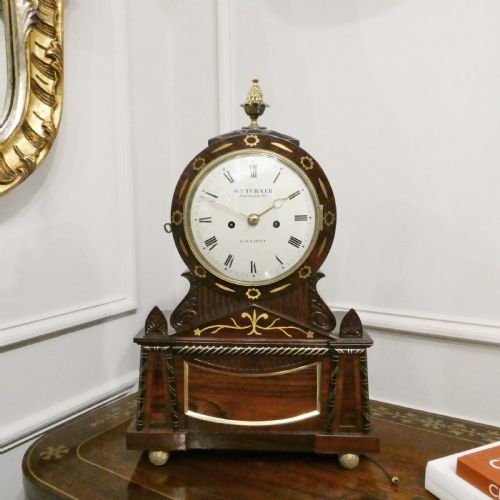


Georgian Rosewood Clock
A georgian rosewood clock brings rich grain and precise timekeeping to a room, holding the eye with warm timber and brass detail.
Georgian Rosewood Clock
When you search for a georgian rosewood clock, you find timepieces designed to stand on brackets, mantelpieces, or hang upon walls. The examples seen on this page span the Georgian, Regency, and William IV periods, alongside later 19th century and Victorian pieces.
You are most likely to meet bracket clocks and mantel clocks fashioned from rosewood. These forms include drum head designs and fusee library clocks, as well as barometers and wall clocks.
The origin of these items centres on London and regional makers such as York and Reading. They represent the domestic horology of the early 19th century.
How they were made
Craftsmen built these clocks using rosewood timber, often enhancing the surfaces with brass inlay and mother-of-pearl. Ebonised wood also appears alongside the primary rosewood cases.
Movements rely on fusee mechanisms and silvered metal dials protected by glass panels. Gilt brass and steel components complete the internal and external structure of the timepieces.
Listings feature rosewood, brass, mother-of-pearl, and ebonised wood across Georgian, Regency, and Victorian periods.
What varies in quality
The standard of a georgian rosewood clock rests in the fineness of the rosewood grain and the precision of the brass inlay. Cases featuring careful brass work and well-figured timber stand apart from simpler examples.
The maker's signature adds weight, with established London and provincial names appearing on the silvered metal dials. The integration of movement types, such as fusee mechanisms, defines the horological merit.
Barber & North of York·Turner of London·Seller of Reading·Arnold and Frodsham·Ganthony of London·Plumbly & Tupman·John Houghton
The Georgian Rosewood Clock Glossary
- Bracket clock
- A portable clock designed to sit on a bracket or shelf. These clocks often feature carrying handles on top.
- Fusee
- A conical pulley used in clock movements to maintain equal power as the mainspring unwinds. This mechanism improves timekeeping accuracy.
- Drum head clock
- A timepiece featuring a circular case resembling a drum head resting on a wooden plinth. This form appears frequently in Regency designs.
- Silvered metal dial
- A clock face treated to achieve a silvery finish, usually engraved with numerals and the maker's name. It provides a clear surface for reading the time.
Georgian Rosewood Clock: Frequently Asked Questions
What is a fusee movement?
A fusee movement uses a conical pulley to equalise the pull of the mainspring. This ensures the clock maintains steady power as the spring runs down.
Such mechanisms are a hallmark of better quality British clocks from this era.
Where were these clocks placed?
Bracket clocks and mantel clocks sat upon wooden shelves, brackets, or fireplace mantels in principal rooms. Wall clocks and barometers hung directly on parlour or library walls.
Their portable nature allowed owners to move them between rooms as needed.
How do I spot Regency style?
Regency pieces often incorporate bold brass inlay, geometric shapes, and rich rosewood veneers. The influence draws upon classical symmetry and clean lines.
Details like brass feet and side frets frequently accompany this aesthetic.
What materials make up the cases?
Cases are constructed predominantly from rosewood, sometimes paired with ebonised wood for contrast. Inlays of brass and mother-of-pearl decorate the exterior surfaces.
Glass protects the dial, while brass and steel form the hardware.