

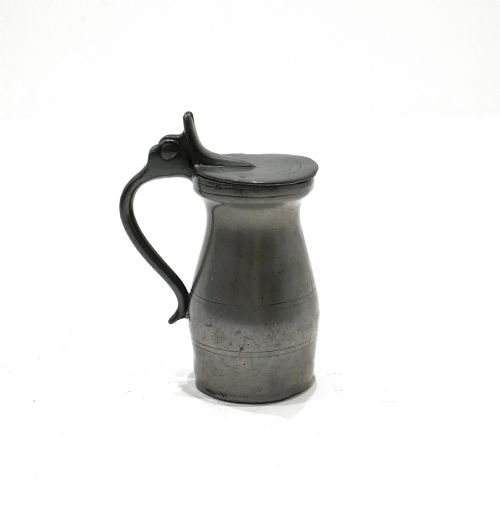
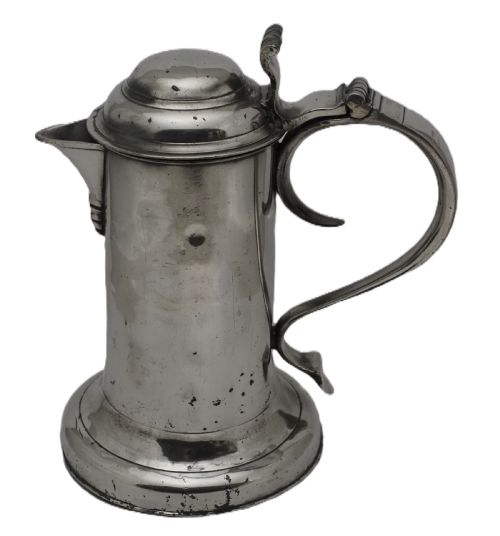


Georgian Pewter Flagon
A georgian pewter flagon brings tactile eighteenth-century weight and domestic utility straight to your table.
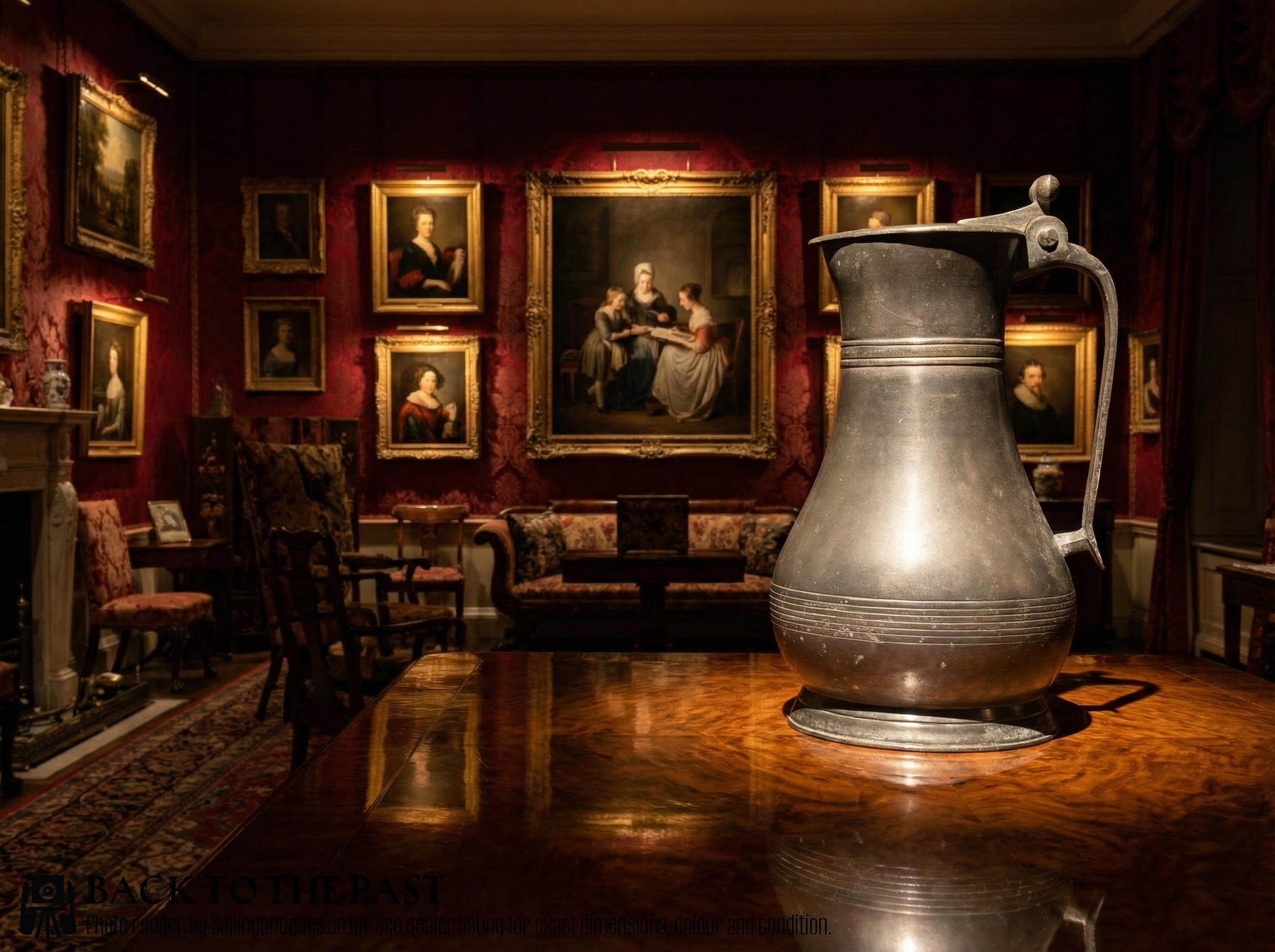
Georgian Pewter Flagon
A georgian pewter flagon stands as a robust vessel designed for holding liquids, frequently shaped as spire flagons, church flagons, ale jugs, or capacity measures originating across England, Ireland, Scotland, and the Channel Islands. These pieces date from the eighteenth century, spanning periods around seventeen-fifty and eighteen-hundred, reflecting the utilitarian and ecclesiastical drinking customs of the era.
You will encounter regional variations on this page, including Jersey and Guernsey measures alongside English spired forms and Scottish tappit hens. Each item demonstrates the heavy, durable character typical of eighteenth-century metalware made for daily or ceremonial service.
Assessing quality in a georgian pewter flagon
Quality rests in the crispness of maker's marks, ownership stamps, and cast crests, which confirm the workshop origin and verification of capacity. Pieces retaining their original flat lids, thumbpieces, and spouts without extensive replacement metalwork demonstrate superior preservation.
The thickness of the metal walls and the balance of the handle relative to the body dictate the structural integrity and aesthetic harmony of the vessel.
Georgian Pewter Flagon Retail Price Guide 2026
Typical asking prices for georgian pewter flagon among the pieces listed under this phrase on Sellingantiques today, from the lower quarter to the upper quarter. They describe what is for sale here now, not the wider market.
Current listings exclusively feature pewter objects spanning the eighteenth century, including English, Scottish, Irish, and Channel Island origins.
John Heaney of Dublin·Robert Iles of London·John de St Croix
The Georgian Pewter Flagon Glossary
- Spire flagon
- A tall drinking vessel characterised by a tapering lid resembling a spire. This form is particularly typical of eighteenth-century English ecclesiastical and domestic pewter.
- Tappit hen
- A traditional Scottish pewter measuring jug featuring a lid and a distinctively shaped body. The capacity usually corresponds to a Scots pint.
- Flat lidded
- A descriptor for vessels featuring a hinged cover with a flat top rather than a domed profile. This style appears frequently on early eighteenth-century measures and flagons.
- Spirit measure
- A small vessel designed for portioning specific volumes of alcohol. These range from half gill capacities upwards.
Georgian Pewter Flagon: Frequently Asked Questions
How do I clean a georgian pewter flagon?
Wash the vessel gently using warm water and mild soap, then dry it thoroughly with a soft cloth to protect the surface.
Avoid abrasive metal polishes or harsh scrubbing pads, which can strip away the historic grey patina accumulated over centuries.
Were these flagons used for church services?
Many large examples served ecclesiastical functions, holding sacramental wine for communion in parishes across England and Ireland.
Other smaller pieces were made for domestic ale consumption or commercial tavern measures.
What is a tappit hen?
A tappit hen is a specific Scottish form of pewter measure with a heavy lid and generous liquid capacity.
These stout vessels were standard in Scottish taverns and households during the eighteenth century.
How can I tell where a flagon was made?
Inspect the body and handle for touchmarks, maker stamps, or regional capacity hallmarks stamped into the metal.
Geographic styles, such as the specific Jersey or Guernsey measure forms, also point directly to Channel Island origins.