



Georgian Marble Console Table
A georgian marble console table anchors a room with heavy stone and carved timber, offering a steady surface designed to stand flat against a wall.
Georgian Marble Console Table
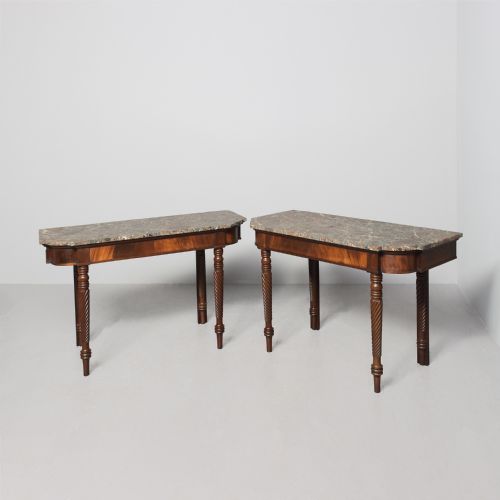
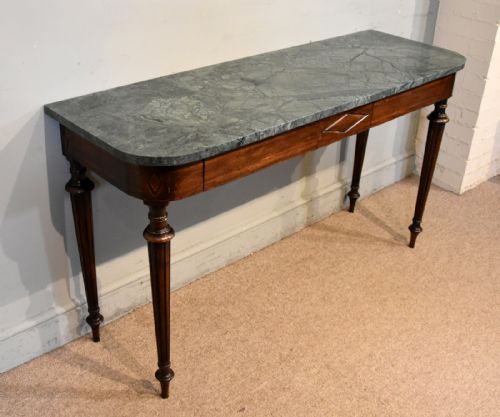
When searching for a georgian marble console table, buyers encounter heavy timber frames topped with thick stone slabs designed to sit flush against a wall. These pieces function as decorative ledges or serving surfaces in reception rooms, halls, and dining spaces.
The versions most common on this page span the eighteenth and nineteenth centuries, alongside later revival pieces produced in the twentieth century. Forms range from straight-front mahogany designs to serpentine shapes and demi-lune formats paired with rouge or white marble.
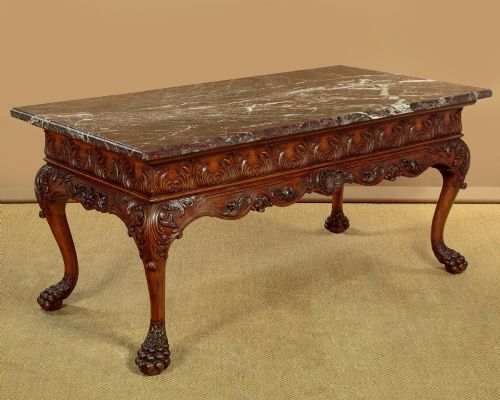
Makers and workshops from various regions applied distinct regional traits, including Irish carved oak frames with lion masks and Italian giltwood structures. Side tables and hall tables frequently overlap with these console designs, sharing identical proportions and stone tops.
Materials and Construction
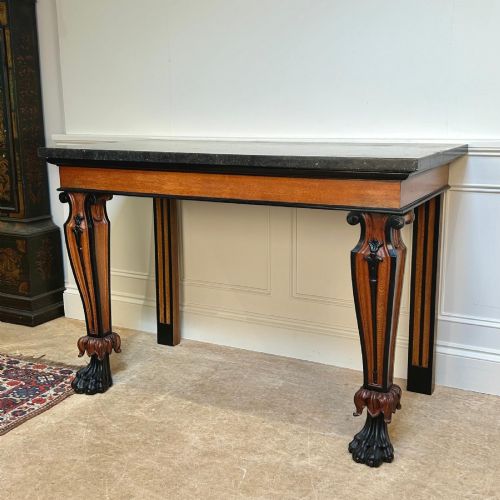
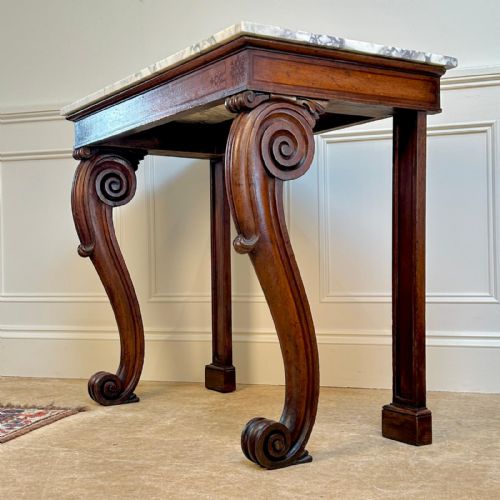
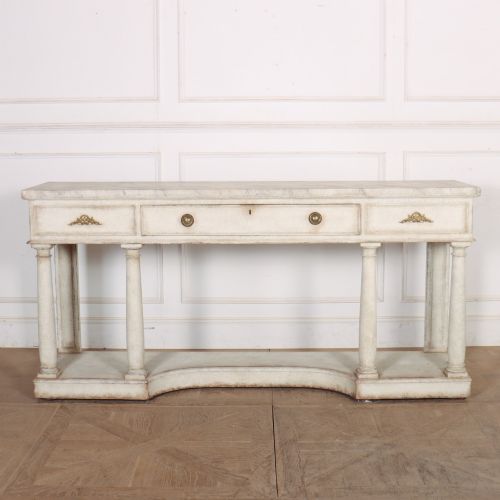
Makers utilised solid native and imported timbers, including mahogany, oak, walnut, rosewood, and ebony, to construct the load-bearing legs and aprons. Giltwood and painted finishes appear frequently, often applied over carved softwood or hardwood bases to create ornate decorative surfaces.
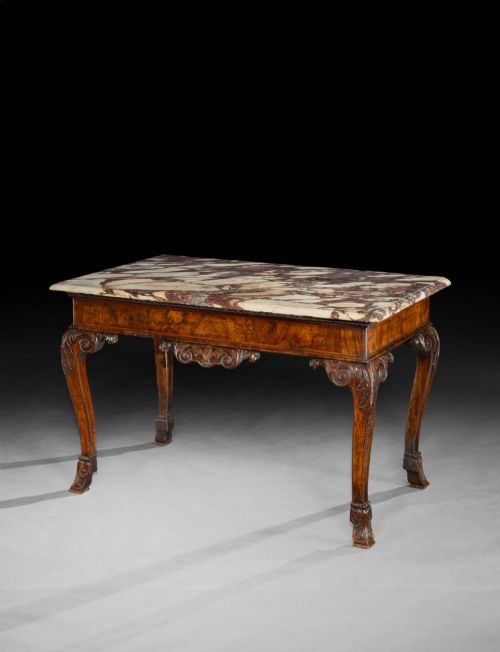
Heavy marble slabs form the upper surfaces, resting directly upon the timber frames or secured within moulded wooden lips. Carvers shaped the wooden components by hand, adding details such as paw feet, lion masks, and classical motifs suited to the period.
Several tables feature carved wooden paws that grip the floor as if holding down a nervous beast.
Distinctions in Quality
The standard of a piece depends heavily on the depth and crispness of the hand-carved wood details across the aprons and legs. Crisp relief work on walnut or giltwood indicates a higher tier of craftsmanship than shallow, mechanical shaping.
The integration between the heavy stone top and the wooden base dictates structural integrity. Superior examples feature marble slabs selected for rich veining and fitted precisely to the timber frame without excessive packing or shims.
The Georgian Marble Console Table Glossary
- Console table
- A table designed to be fixed against a wall, traditionally supported by two front legs and secured at the rear by brackets.
- Demi-lune
- A half-moon shape used for table tops and frames, allowing the furniture to sit compactly against flat wall spaces.
- Giltwood
- Timber coated with a thin layer of gold leaf or metallic paint over a prepared gesso ground.
- Serpentine front
- A furniture front curved in a wave-like form, featuring a convex centre flanked by concave ends.
- Breaks-front
- A piece of furniture where the central section projects forward from the flanking wings.
Georgian Marble Console Table: Frequently Asked Questions
Where should I place a console table?
These tables suit hallways, reception rooms, and dining spaces where floor space is limited. Because they stand flat against a wall, they provide a display surface without blocking main walkways.
Pairs of tables often anchor either side of a fireplace or a large doorway, balancing the proportions of a long wall.
How do I care for the marble top?
Stone surfaces require simple dusting with a soft cloth and immediate wiping of liquid spills to prevent staining. Acidic substances like citrus juice or wine can etch polished marble.
Avoid harsh chemical cleaners or abrasive scouring pads, which dull the natural polish over time.
Are these tables designed to be free-standing?
Traditional console tables rely on the wall for ultimate stability, often requiring fixing brackets to prevent tipping. While some larger examples balance well on four robust legs, many historical designs expect wall support.
Checking the base construction reveals whether a piece was built as a true console or as a side table.
How do I distinguish eighteenth-century pieces from later revivals?
Examination of the timber tool marks, joint construction, and backboards helps reveal the age of a piece. Eighteenth-century frames exhibit hand-cut joinery and period-specific carving styles, whereas twentieth-century revivals display cleaner machine cuts.
Comparing the wear patterns on the feet and edges provides further clues to the manufacturing era.