


Georgian Footstool Frame
A georgian footstool frame provides a solid timber foundation for traditional upholstery, combining structural elegance with period character.
Georgian Footstool Frame
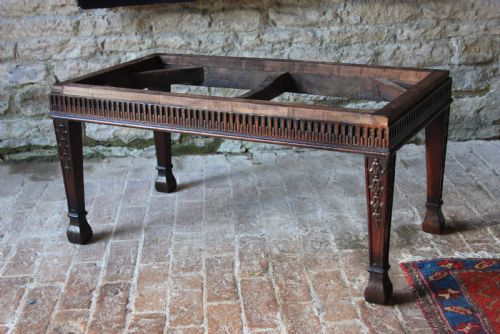
A georgian footstool frame encompasses sturdy timber structures designed to support upholstered seats, often featuring distinct period styling. Buyers searching for a georgian footstool frame seek authentic woodwork that anchors a traditional room scheme or serves as a project for re-upholstery.
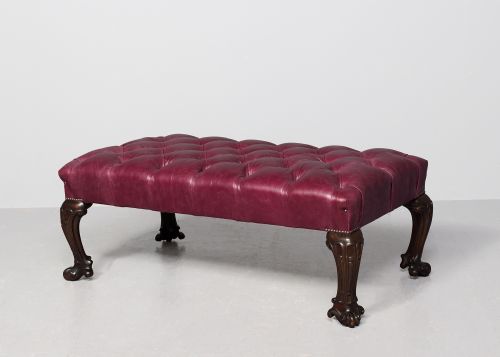
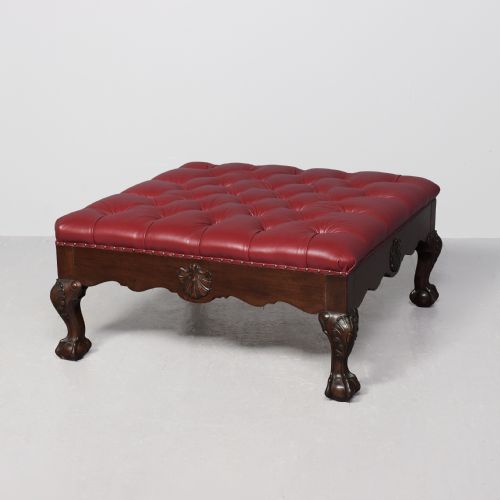
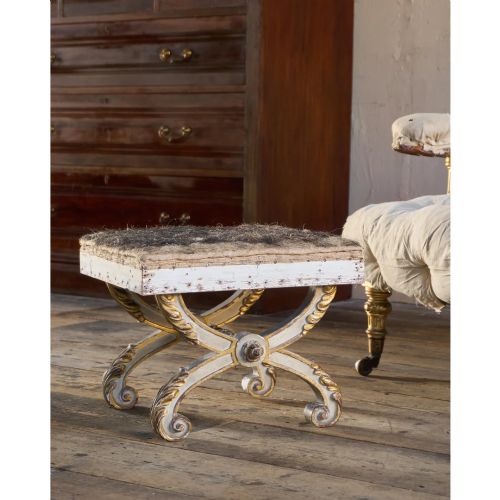
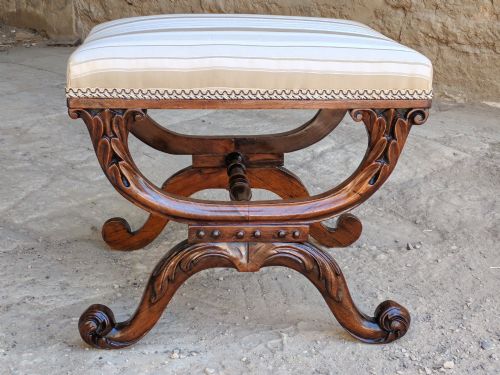
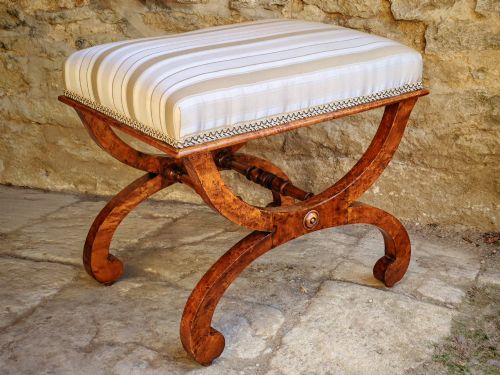
The selection here includes pieces spanning the Georgian era, Regency period, and later revivals up to the early twentieth century. Common forms range from long rectangular stools to curule X-frames in mahogany, rosewood, and oak.
Origin details in the inventory reflect both English cabinet-making traditions and nineteenth century Irish craftsmanship. These frames showcase the enduring appeal of classic seating forms adapted for domestic comfort over centuries.
How they were made
Makers utilised dense cabinet timbers such as mahogany and rosewood for structural integrity, often incorporating carved details or Burr maple veneers. Joinery methods relied on traditional tenon and mortise joints to ensure stability across heavy daily use.
Surface treatments preserved the natural grain of the wood whilst achieving a rich patina over decades of handling. Where upholstery survives, materials such as hide, wool, kilim, and fabric are secured over webbing and stuffing.
A sturdy X-frame stool offers an unexpected test of balance for anyone attempting to sit on it after a hearty Georgian dinner.
What varies in quality
Quality in a georgian footstool frame rests upon the crispness of timber carving, the selection of figured wood veneers, and the integrity of the underlying joinery. Superior examples demonstrate balanced proportions and confident execution in revival styles like Chippendale or Grand Regency.
The distinction between standard production and exceptional work lies in the subtlety of the timber turning and the preservation of original framing elements. Lesser pieces show utilitarian construction, whilst finer stools reflect the ambition of notable cabinet-makers.
Miles & Edwards
The Georgian Footstool Frame Glossary
- Curule X-frame
- A cross-legged stool design derived from ancient Roman magistrate seats, offering robust structural support and architectural presence. This form appears frequently in Regency and nineteenth century seating.
- Mahogany
- A durable tropical hardwood prized for its deep reddish-brown colour and stable working properties. It served as the primary timber for high-end furniture throughout the eighteenth and nineteenth centuries.
- Kilim
- A flat-woven textile originating from the Middle East and southeastern Europe, utilised historically as a durable and decorative upholstery covering. These wool covers introduce geometric patterns to traditional footstools.
- Hide
- Untanned or dressed cattle leather used to provide a hard-wearing, wipeable surface on seating. Buttoned hide upholstery is a common feature on larger nineteenth century frames.
- Rosewood
- A heavily grained, dark timber with distinct aromatic qualities, favoured for luxury furniture during the Regency period. Its rich figuring enhances smaller decorative stools.
Georgian Footstool Frame: Frequently Asked Questions
What is a georgian footstool frame?
A georgian footstool frame is a wooden structural base built to support an upholstered seat, originating either in the eighteenth century or later revival periods.
These pieces range from simple low benches to elaborate X-framed stools designed to match larger drawing-room suites.
How were these frames upholstered originally?
Original upholstery typically involved webbing, horsehair stuffing, and heavy textile or leather coverings secured with brass tacks.
Many surviving frames retain later nineteenth-century fabric, wool, or buttoned hide rather than their initial eighteenth-century coverings.
How do I date a footstool frame?
Dating relies on identifying timber species, tool marks, joinery techniques, and stylistic cues such as Regency curves or Chippendale carving.
Comparing the secondary woods and construction methods helps distinguish eighteenth-century pieces from later revival items.
Where should I place a stool in a room?
These low stools function effectively in front of fireplaces, beneath windows, or paired with armchairs as extended seating.
Their compact scale allows them to sit neatly under tables or move easily across living spaces as needed.