

Antique Stool for Upholstery
These antique stool for upholstery pieces offer a practical foundation for bespoke fabric choices across diverse historical periods.
Antique Stool for Upholstery
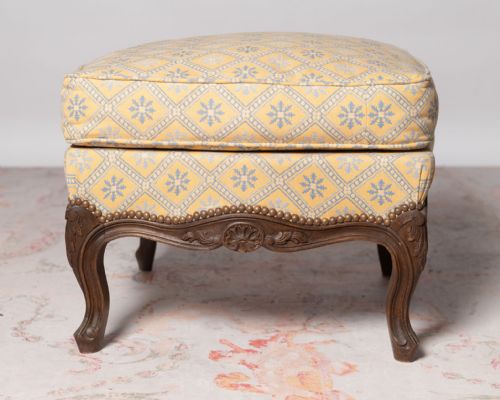
An antique stool for upholstery encompasses low footstools, substantial ottomans, window seats, and centre stools designed to carry fabric surfaces. Buyers evaluating this phrase encounter timber frames originating from the Georgian, Regency, and Victorian eras, alongside later revival pieces.
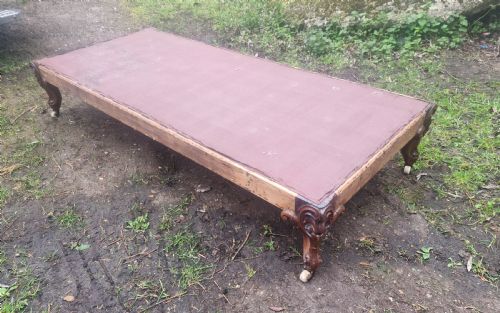
The selection frequently presents mahogany, walnut, and rosewood frameworks that await new textile coverings. Many examples survive stripped to the webbing or retain older tapestries, velvets, and damasks ready for replacement.
Construction and Materials
Cabinetmakers utilised hardwoods such as mahogany, walnut, and oak to build sturdy structural frames, often integrating carved details, spiral turnings, or brass castors. These timbers provide the rigid support necessary for traditional spring or webbed upholstery methods.
Surfaces are finished with textiles including chenille, tweed, leather, and gros-point needlework fixed over padding. The combination of dense wood frames and layered fabric creates the functional durability expected from period seating.
Listings incorporate walnut, mahogany, oak, and rosewood frames paired with textile coverings such as velvet, damask, and tapestry.
Evaluating Build and Proportion
Quality rests in the precision of the timber framing, the elegance of the leg proportions, and the integrity of any carved ornamentation. Superior examples display balanced joinery and well-drawn silhouettes rather than simple box construction.
The distinction between standard pieces and finer examples often lies in secondary woods, refined turning work, and the original detailing such as brass castors or inlaid accents.
Harry and Lou Epstein·Howard and Sons·Hallett and Sons·Gillows
The Antique Stool for Upholstery Glossary
- Gros-point
- A heavy needlepoint stitch used historically for durable upholstery tops. It provides a textured surface suitable for heavy-use stools.
- X-frame
- A structural base formed by intersecting curved or straight wooden members resembling the letter X. This form appears frequently on formal revival and neoclassical stools.
- Centre stool
- A large freestanding stool designed to sit in the middle of a room rather than against a wall. These pieces often feature substantial mahogany or rosewood frames.
- Gout stool
- An adjustable footstool engineered to elevate and support the foot at a custom angle. They commonly incorporate mechanical ratchets or pivots.
- Damask
- A reversible figured fabric traditionally woven from silk, wool, or linen. It is frequently seen on formal nineteenth-century and revival seating.
Antique Stool for Upholstery: Frequently Asked Questions
What periods do these stools come from?
The listings span from the seventeenth century through the Georgian, Regency, and Victorian eras into early twentieth-century revivals.
Buyers will find foundational timber designs representing changing aesthetic movements across these centuries.
Are these stools ready for new fabric?
Many pieces arrive stripped or wearing worn historical textiles specifically intended for reupholstering.
This allows a buyer to select modern or period-appropriate fabric to match an interior scheme.
What wood types were used?
Makers predominantly employed dense hardwoods including mahogany, walnut, rosewood, and oak for the structural frames.
These durable timbers supported the heavy padding and webbing required for daily use.
How do I identify a window seat?
Window seats typically feature elongated rectangular proportions designed to fit narrow spaces beneath glazing.
They often incorporate matching arm supports or elegant fluted legs distinct from standard square footstools.