
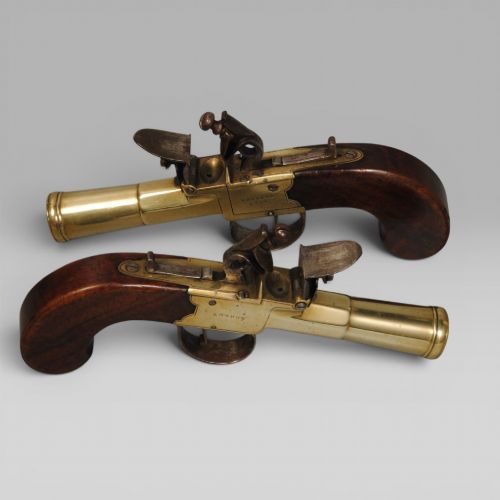

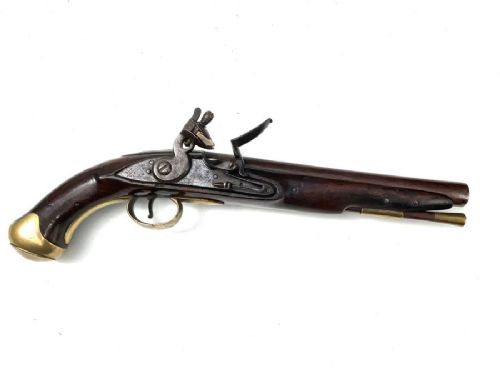


Georgian Flintlock Pistol
A georgian flintlock pistol combines mechanical ingenuity with hand-forged steel and timber, offering a tangible connection to eighteenth-century craftsmanship.
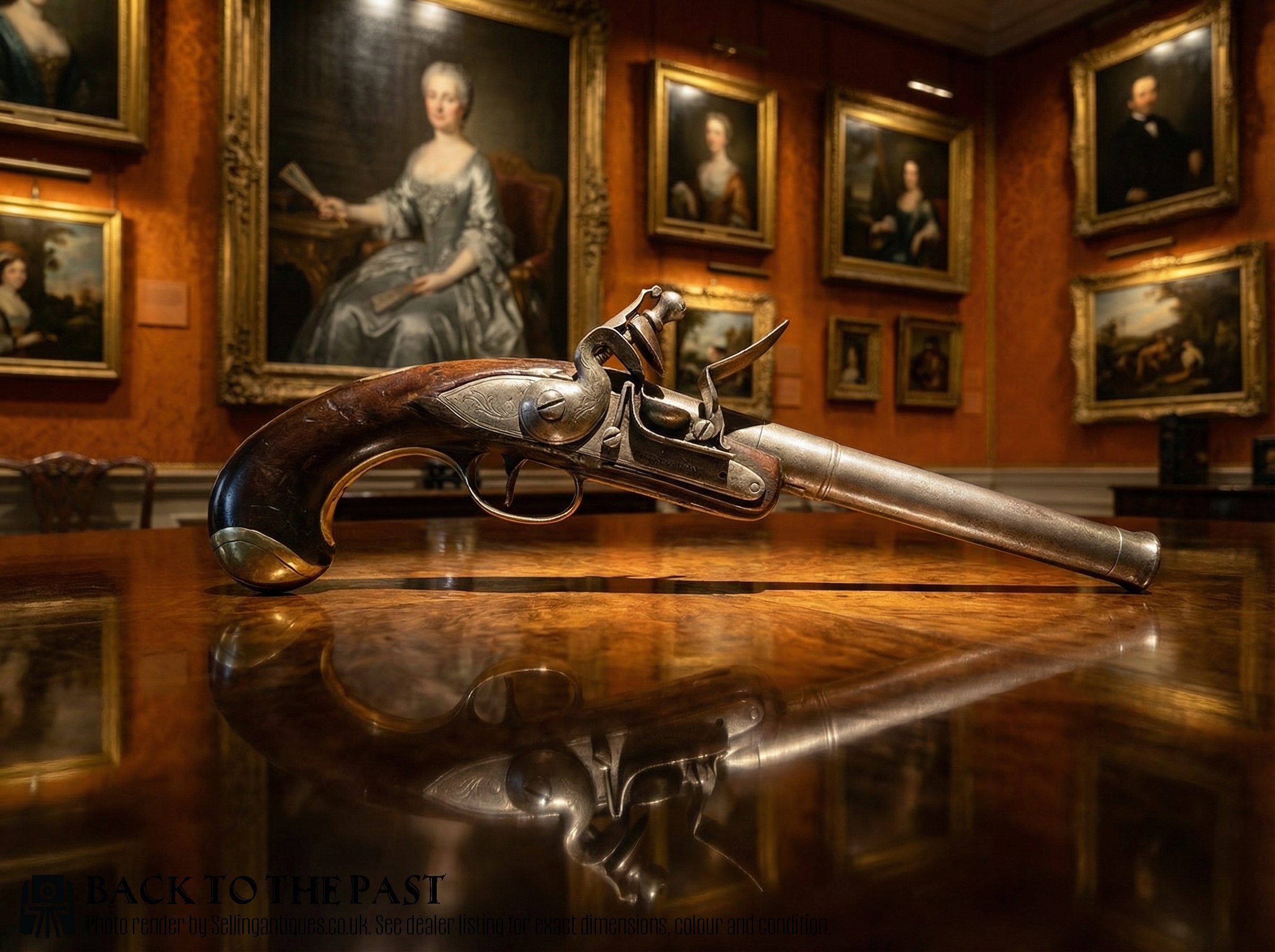
Georgian Flintlock Pistol
Originating largely from British workshops in London, Birmingham, and provincial centres, these pieces date from the eighteenth and early nineteenth centuries. Scottish highland and continental examples also appear, reflecting diverse regional military and civilian requirements of the period.

Materials and Construction
Makers utilised forged steel and iron for barrels, lock mechanisms, and internal springs, paired with brass for furniture such as trigger guards, side plates, and butt caps. Stocks were predominantly turned from dense hardwoods, walnut, and mahogany, chosen for strength and grain.
Fine decorative detailing involved silver wire inlay, cast silver grotesque butt caps, and engraved lockplates bearing maker signatures or government proof marks. Barrels on specialised pocket pistols were frequently manufactured with integral screw-off designs for ease of loading.
Georgian Flintlock Pistol Retail Price Guide 2026
Typical asking prices for georgian flintlock pistol among the pieces listed under this phrase on Sellingantiques today, from the lower quarter to the upper quarter. They describe what is for sale here now, not the wider market.
Mail coach inspectors required specialised pocket pistols to deter highwaymen during long, chilly night journeys.
Assessing Quality
Quality in a georgian flintlock pistol is defined by the crispness of the lock mechanism, the depth and clarity of barrel maker signatures, and the overall harmony of proportion between metal and wood. Master gunsmiths signed their work on the lockplate or barrel, elevating standard utility pieces to items of distinction.
The degree of enrichment heavily influences desirability, from plain military issue sidearms bearing Tower stamps to civilian pocket pistols adorned with silver wire inlay, engraved brass, and cast mountings. Untouched condition with original surfaces preserved on both walnut stock and steel components represents the upper tier.
Harrison of London·John Campbell of Doune·T. Potts·Henry Nock·H.W. Mortimer & Son·Thomas Henshaw·Timothy Hughes·John Rimes
The Georgian Flintlock Pistol Glossary
- Flintlock
- An ignition mechanism utilising a piece of flint held in a cock to strike a steel frizzen, creating sparks to ignite the priming powder. This system dominated personal firearms throughout the eighteenth century.
- Cannon barrel
- A barrel shaped like a small cannon, tapering outward towards the muzzle with decorative reeding. This form is particularly common on eighteenth-century pocket and turn-off pistols.
- Turn-off
- A barrel designed to be unscrewed from the breech for easier loading from the front without a ramrod. It allows a tight fit of the ball against the powder charge.
- Proof marks
- Official stamps applied to barrels and actions to certify that the piece has successfully undergone pressure testing with gunpowder. These marks help identify the testing facility and date.
- Frizzen
- The vertical steel plate struck by the flint during the ignition cycle. Its movement exposes the priming powder in the pan to the resulting sparks.
Georgian Flintlock Pistol: Frequently Asked Questions
How do I care for a flintlock pistol?
Keep the metal lightly oiled with a traditional gun oil to prevent active rust on the steel components. Store the piece in a dry environment away from direct heat sources to protect the aged walnut or mahogany stock.
Avoid aggressive cleaning of the metal surfaces, as patination and original finish contribute significantly to historical character. Period baize-lined cases offer suitable protection for display and storage.
Can these pistols still be fired?
Most antique pieces are sold as historical collectors' items rather than functioning firearms. Evaluating the internal spring tension and structural integrity requires professional inspection by a qualified gunsmith before any attempt at use.
Firing antique black powder arms carries inherent risks due to centuries of material fatigue. Modern legislation in many regions also regulates the use and possession of operational antique weaponry.
What is a turn-off barrel?
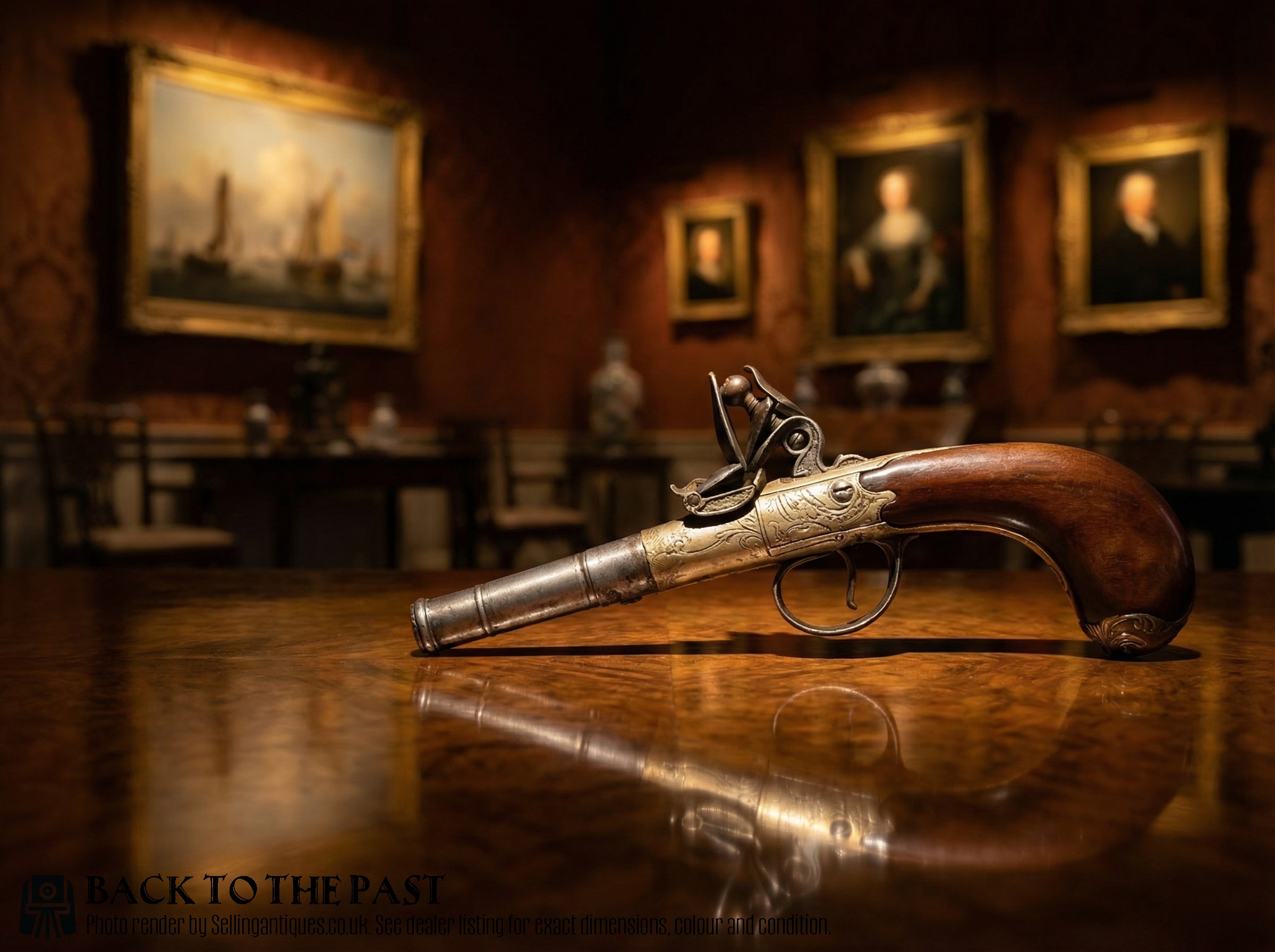
A turn-off barrel unscrews entirely from the frame, allowing the lead ball to be loaded directly into the breech chamber. This design eliminates the need for a ramrod and ensures a tight seal upon firing.
Such barrels are typical of eighteenth-century pocket pistols, offering compactness for concealment while maintaining a heavy projectile weight.
How do military and civilian pistols differ?
Military issue arms bear standardised government inspection marks, such as Crown and Tower stamps, and feature robust brass or iron furniture built for service durability. They prioritize functional reliability over decorative embellishment.
Civilian and duelling arms frequently showcase finer carpentry, engraved lockplates, silver wire inlays, and specialised barrel treatments tailored to personal preference and social status.