


Georgian Drop Dial Clock
A georgian drop dial clock brings purposeful maritime and municipal timekeeping into a domestic interior through a distinctive wall-mounted form.
Identifying these pieces
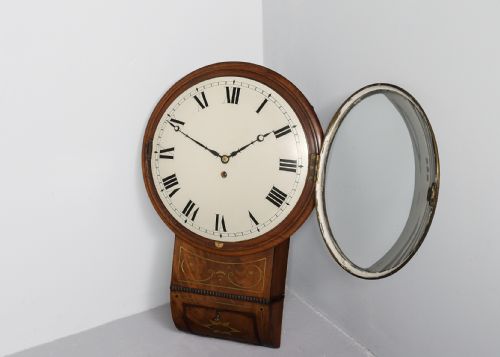
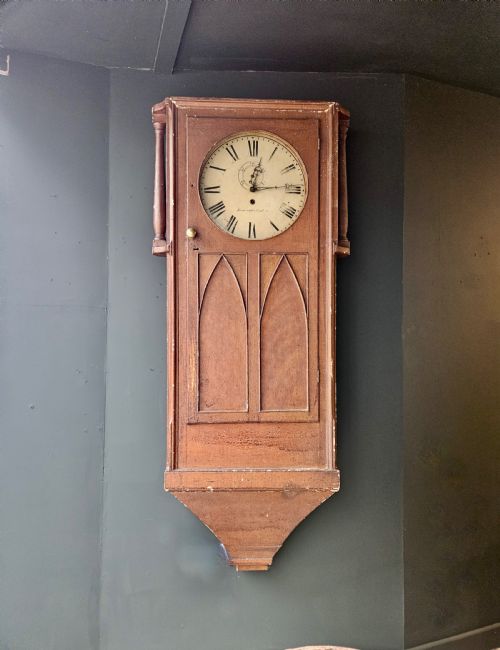
A georgian drop dial clock combines a circular dial hood above an extended lower case designed to house a swinging pendulum. These wall clocks appear primarily in mahogany cases, reflecting the dominant cabinet timber of the period.
Most examples follow either standard wall clock proportions or the classic tavern clock format with a chisel bottom case. The dial itself is frequently convex, projecting forward beneath glass to improve legibility from angles across a room.
Examples span the Georgian, Regency, and early nineteenth-century periods, often originating from prominent English makers working in London and regional centres like Liverpool.
Materials and construction
Cabinet makers constructed the wall cases from solid mahogany, frequently utilising figured veneers on the surrounding bezel and trunk doors. Brass feature in the movement components, bezel surrounds, and occasional side viewing apertures.
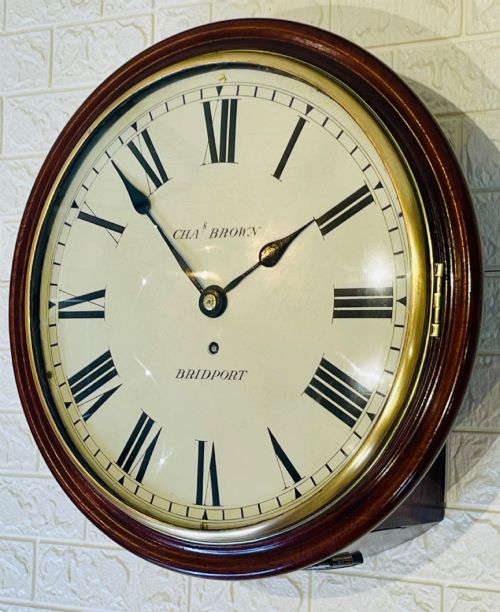
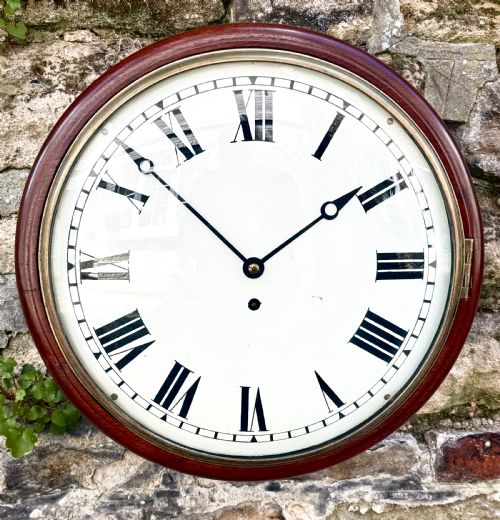
Movements rely upon a fusee mechanism driven by a cord or chain connected to a spring barrel, ensuring an even pull across the power reserve. Dials are fashioned from wood, painted iron, or convex metal plates, lettered with Roman numerals by hand.
Retail Price Guide 2026
Typical UK retail prices for georgian drop dial clock, calculated from the Sellingantiques database of over a million retail prices indexed since 2003. This retail price guide relies exclusively on Sellingantiques data; no external sources or auction records are used, so the figures do not describe the wider market.
Some provincial makers proudly signed wooden dials in sprawling script, ensuring everyone in the tavern knew who kept the minutes.
Distinguishing quality
Quality rests upon the crispness of the cabinet joinery, the figuring of the mahogany timber, and the untouched character of the painted or wooden dial. Signature engraving on the movement backplate elevates an example, particularly when signed by a documented London or provincial maker.
The integrity of the fusee movement, including original wheel-cutting and minimal replacement parts, determines mechanical merit. Cases that retain their correct proportions, side door ears, and pendulum hold-fasts command greater appreciation among collectors.
John Thwaites·Borrell of London·Condliff of Liverpool·Charles Shapland·Daniels Liverpool·Viner of London·Webster of London
The Georgian Drop Dial Clock Glossary
- Drop dial
- A clock form featuring a circular upper dial head joined to an elongated lower trunk that houses the pendulum. This configuration became standard for municipal and domestic wall timepieces.
- Fusee
- A conical grooved pulley connected to the mainspring barrel by a cord or chain. It equalises the declining power of the spring as it unwinds, ensuring consistent timekeeping.
- Convex dial
- A clock face curved outward toward the viewer rather than sitting flat. This shape reduces glare from windows and allows visibility from multiple angles in a large room.
- Chisel bottom
- A lower case style that tapers sharply to a point at the base of a wall clock. This vernacular shape is frequently associated with tavern clocks.
- Tavern clock
- A large dial wall clock popular in public houses and coaching inns during the eighteenth century. They typically feature bold wooden dials and long trunks beneath.
Frequently Asked Questions
Where were these clocks hung?
These wall clocks were originally placed in halls, stairwells, and public rooms where clear visibility and reliable timekeeping were paramount.
In contemporary interiors, they function best mounted at eye level on substantial walls where their architectural cases can command adequate space.
How does a fusee movement work?
A fusee uses a conical drum linked to the mainspring by a cord or chain to regulate the driving force delivered to the gear train.
As the spring uncoils and loses tension, the chain moves to a wider part of the cone, maintaining steady torque and improving accuracy.
Why do some have wooden dials?
Wooden dials appeared on earlier tavern clocks and regional wall timepieces before painted metal surfaces became widespread across the trade.
They were carved from solid timber, gessoed, and painted black or cream with bold numerals designed for viewing across a bustling room.
How do I date a drop dial clock?
Dating relies on stylistic clues within the mahogany case, the shape of the lower trunk door, and the form of the dial surround.
Signed movements by recorded makers also help narrow the timeline, particularly when combined with characteristic Georgian or Regency cabinet details.