
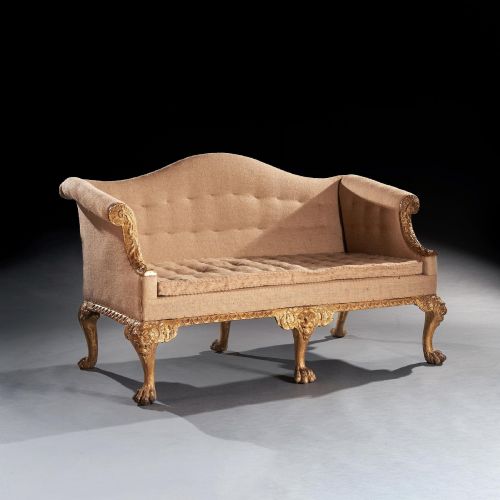


Georgian Camel Back Sofa
A Georgian camel back sofa brings classic upholstery and a sweeping arched silhouette to a room, offering both traditional charm and lasting comfort.
Georgian Camel Back Sofa
A georgian camel back sofa displays a continuous curving crest rail that mimics the gentle hump of a camel, paired with high upholstered arms and an exposed wooden underframe. These seating pieces emerge primarily from the eighteenth and nineteenth centuries, alongside later revival interpretations that mimic earlier Georgian proportions.
The form encompasses authentic period examples as well as later nineteenth century and Edwardian revivals executed in the Chippendale, Hepplewhite, and George II manners. Buyers frequently encounter serpentine fronts, upholstered bodies, and show-wood frames supported on cabriole or straight legs.
Makers and workshops of the eighteenth century establish the foundational vocabulary of these settees, whilst subsequent revival eras recreate the distinctive camel back outline using mahogany, giltwood, and various decorative fabrics.
How they were made
Frames rely principally on solid mahogany or carved wood, occasionally finished with giltwood details, providing a sturdy structural skeleton beneath the stuffing and top covers. Joinery techniques from the eighteenth and nineteenth centuries ensure rigid stability without modern mechanical fasteners.
Upholstery involves traditional stuffing methods layered beneath exterior textiles such as damask, velvet fabric, and general upholstery fabric. Brass elements, including castors or decorative tacks, frequently accent the wooden feet and structural seams.
The inventory records both eighteenth-century originals and nineteenth-century revival pieces executed in Chippendale, Hepplewhite, and George II styles.
What varies in quality
The crispness of the wood carving on the frame determines much of the visual distinction, separating finely articulated lion mask hairy paw feet or intricate rail mouldings from simpler, softer execution. Original timber surfaces and authentic period joinery carry more weight among collectors than later reconstituted frames.
Proportion and line dictate the success of the camel back silhouette, where a balanced, flowing arch and well-set arms create an elegant presence. The choice of covering material, from period-appropriate damask to heavy velvet, reflects the overall investment in the piece.
Giles Grendey
The Georgian Camel Back Sofa Glossary
- Camel back
- A sofa or settee featuring a distinct undulating crest rail that rises in a smooth, central curve resembling a camel's hump. This continuous line defines the upper profile of the upholstered back.
- Serpentine
- A furniture front or crest rail that curves outward at the centre and inward toward the ends in a graceful 'S' shape. This contour adds visual movement to the base or back of the seating.
- Cabriole leg
- A furniture leg that curves outward at the knee and inward at the ankle, typically terminating in a pad, claw and ball, or hairy paw foot. The design derives from classical Chinese furniture forms popularised in European cabinetmaking.
- Giltwood
- Timber that has been coated with a thin layer of gold leaf or gilt paint to create a rich, metallic surface. This treatment highlights carved details on high-status eighteenth-century frames.
- Hepplewhite manner
- A lightweight, elegant furniture style named after cabinetmaker George Hepplewhite, characterised by tapering legs, shield backs, and delicate carved motifs. Revival versions interpret these refined eighteenth-century proportions in later seating.
Georgian Camel Back Sofa: Frequently Asked Questions
What is a georgian camel back sofa?
A georgian camel back sofa is a traditional upholstered settee distinguished by an arched, undulating crest rail and exposed wooden legs. These pieces draw on eighteenth-century cabinetmaking styles and subsequent revival periods.
The design prioritises a continuous curving silhouette, often paired with upholstered arms and a serpentine front rail. They function as formal yet comfortable seating within traditional interiors.
How do I date a camel back sofa?
Dating requires examining the timber species, secondary woods, framing construction, and the specific style influences present in the carved legs and stretcher system. Eighteenth-century examples display period joinery and hand-carved details, whereas nineteenth-century and Edwardian pieces often utilise revival proportions.
Comparing the curve of the back and the treatment of the feet against documented pieces helps establish whether a settee originates from the georgian era or a later nineteenth-century revival workshop.
Where should I place a camel back sofa?
These sofas suit formal reception rooms, drawing rooms, or spacious hallways where their sculptural back profile can be appreciated from multiple angles. Their traditional proportions make them effective focal points against panelled walls or neutral backdrops.
Because the curved back creates a strong visual line, placing the settee away from walls or positioning it where the silhouette stands clear enhances its decorative impact.
What fabrics work best on these sofas?
Traditional upholstery materials such as damask, silk velvet, and woven textile fabrics complement the historical character of a georgian camel back sofa. These tactile surfaces highlight the sweeping lines of the upholstered back and arms.
Choosing patterns or solid colours appropriate to the eighteenth or nineteenth-century style ensures the covering harmonises with the exposed mahogany or giltwood frame.