
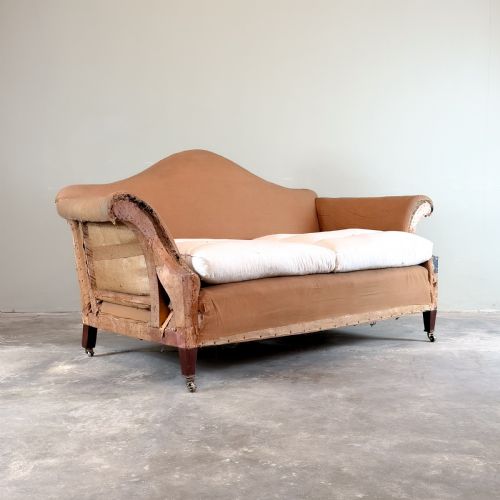
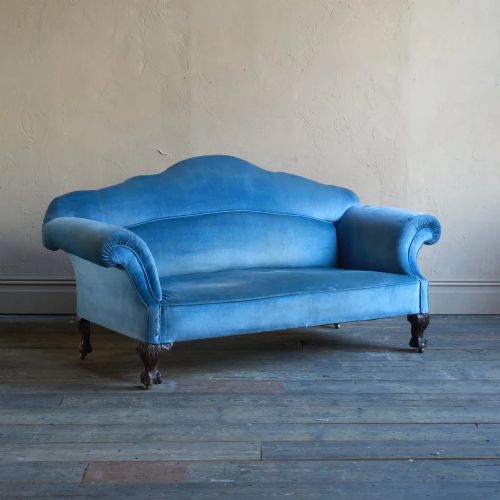


Antique Camelback Couch
An antique camelback couch is a graceful seating form with a distinct arched back, offering enduring elegance and traditional comfort for a formal room.
Antique Camelback Couch
An antique camelback couch presents a continuous arched wooden frame and upholstered body, designed primarily for formal reception rooms. Buyers encounter various iterations spanning from the eighteenth century through the Edwardian period, often reflecting regional revivals.
The selections on this page highlight traditional forms such as the serpentine front and styles rooted in Georgian or Chippendale aesthetics. Makers across these decades utilised sturdy timbers like mahogany alongside softer hardwood frames to support the curved back profile.
Settees and two-seater sofas dominate the category, frequently pairing the signature arched back with scrolled arms and substantial upholstery. These pieces demonstrate the evolution of domestic seating from structured eighteenth-century proportions to later Edwardian interpretations.
Materials and construction
Cabinetmakers constructed the foundational frames of these couches using dense hardwoods such as mahogany and walnut, ensuring structural integrity beneath the upholstery. Joinery techniques relied on traditional pegged and doweled joints to withstand the outward tension of the arched back.
Upholstery methods utilised natural stuffing materials held by jute webbing, layered beneath surface textiles like damask and velvet. Exposed woodwork on legs often featured carved details, including ball and claw motifs or straight supports.
Brass tacks frequently secured the outer fabric edges to the wooden rails, adding a decorative linear trim. Frame construction prioritized durability, concealing internal bracing that allowed the sweeping camelback silhouette to maintain its tension over centuries.
Some Edwardian makers hid spare brass tacks inside the seat lining, a quiet nod to future upholsterers.
Factors determining quality
The integrity of the underlying hardwood frame dictates the longevity and structural soundness of each couch. Subtle nuances in the hand-carved leg details and the symmetry of the serpentine front profile separate standard workshop productions from finer output.
The crispness of the arched wooden crest and the proportions of the arms reveal the skill of the original maker. Condition of the internal stuffing and the fidelity of subsequent upholstery choices also influence the overall standard of preservation.
The Antique Camelback Couch Glossary
- Camelback
- A seating form defined by a continuous, undulating curve along the top rail that resembles a camel's hump. This profile emerged in the eighteenth century and remained popular through subsequent revival periods.
- Serpentine
- A shape involving a gentle, continuous horizontal wave line with a convex centre flanked by concave sides. This contour frequently appears on the front seat rail of formal couches.
- Chippendale
- A style of furniture originating in the eighteenth century, characterised by carved mahogany, cabriole legs, and intricate fretwork. Revival versions appeared frequently during the Victorian and Edwardian eras.
- Damask
- A reversible, figured fabric woven on a jacquard loom with patterns formed by contrasting warp and weft threads. It is a common traditional textile choice for formal upholstery.
- Jute
- A strong, coarse vegetable fibre spun into durable yarns utilised for webbing and support foundations beneath couch upholstery. It provides the necessary tensile strength for traditional seat construction.
Antique Camelback Couch: Frequently Asked Questions
How do I identify a true period camelback couch?
Examine the timber construction beneath the upholstery, looking for hand-cut joinery, aged patination on exposed mahogany or walnut, and traditional hand-forged fixings. Period pieces exhibit construction methods consistent with eighteenth or nineteenth-century cabinetmaking rather than modern machine tooling.
The overall proportions and the subtle rise of the arched back provide further clues. Earlier examples tend to display more restrained, organic curves compared to later revival pieces.
Were these couches used for sleeping?
These couches were designed strictly for formal sitting in parlours and drawing rooms, maintaining an upright posture rather than a reclined position. The rigid internal frame and high, curved back encourage formal social gathering.
Using them primarily for heavy lounging can strain the traditional webbing and internal frame supports. They function best as statement seating in domestic interiors.
How do I care for antique upholstery fabrics?
Protect delicate textiles like damask and velvet by avoiding direct sunlight, which fades natural fibres and weakens historic weaves over time. Regular, gentle suction using a low-power vacuum attachment removes dust without abrading the surface pile.
Professional textile conservators should handle deep cleaning or structural fabric repairs. Maintaining stable indoor humidity prevents the wooden frames from drying out and destabilising the upholstery tension.
What is the difference between a settee and a sofa?
Historically, a settee denotes a narrower, lighter two-seater wooden or upholstered bench seat developed during the seventeenth and eighteenth centuries. A sofa generally describes a larger, fully upholstered piece designed to accommodate multiple people with greater cushion depth.
In marketplace terminology, the terms often overlap, particularly for nineteenth-century and Edwardian seating forms. Both share the characteristic camelback profile depending on the specific maker's design.