
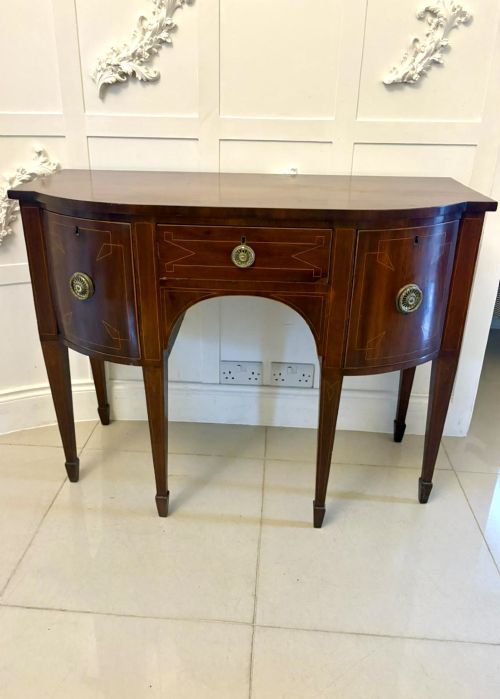
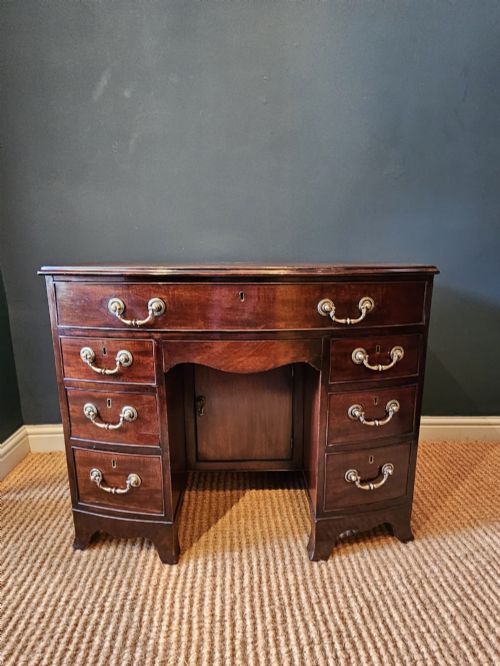

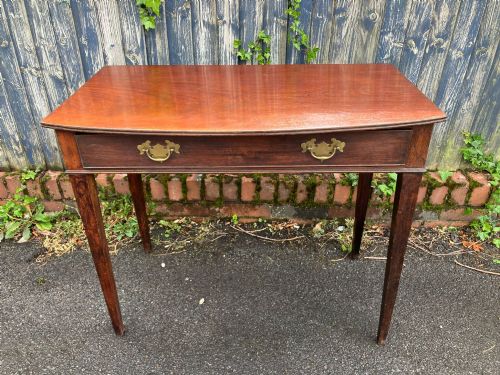


Georgian Bowfront Desk
These georgian bowfront desk pieces combine curved fronts with practical writing surfaces, offering a classic form that suits both traditional and modern rooms.
Georgian Bowfront Desk
A georgian bowfront desk typically presents as a curved front surface designed for writing or storage, appearing across periods from George III to the Regency era and into later revivals. Buyers searching this phrase most frequently encounter side tables, writing tables, and sideboards adapted for writing tasks, often featuring mahogany timbers.
The form spans formal Georgian cabinet-making and later 19th-century interpretations, alongside Edwardian and 1920s reproductions that maintain the characteristic curved outline. These pieces originate from workshops working in Georgian and Regency styles, employing traditional proportions and drawer configurations.
Makers utilised the curved bowfront to soften the angles of a room while providing functional depth in the centre of the piece. Surviving examples demonstrate how cabinet-makers balanced storage requirements with the elegant sweep of the mahogany facade.
Materials and construction
Construction relies heavily on solid mahogany and flame mahogany veneer, chosen for rich grain patterns and durability. Workshops applied boxwood inlay and boxwood stringing to accent the curved drawer edges and borders.
Secondary materials include brass for hardware and leather for writing surfaces inset into the top. Pine appears in secondary framing and drawer linings on select pieces.
Cabinet-makers shaped the curved front rails from solid timber or built up laminated constructions to achieve the bow shape without warping. Fine dovetailing secures the drawer construction, reflecting period joinery standards.
Several pieces include hidden writing slides designed for standing correspondence, proving that hurried emails existed long before electricity.
Judging quality in these pieces
Quality rests on the selection of timber veneers and the crispness of the boxwood stringing and inlay work. Superior pieces display carefully matched grain across the curved drawer fronts, creating a continuous visual flow.
The proportion of the bow sweep and the refinement of the leg turning or bracket feet dictate the architectural success of the piece. Finer examples retain original brass pulls and well-fitted writing slides that operate smoothly within the carcase.
The Georgian Bowfront Desk Glossary
- Bowfront
- A convex curved front facade that projects outward in the centre. This shape softens room lines and adds internal depth to drawers.
- Flame mahogany
- A veneer cut from the fork of a mahogany tree where the branch meets the trunk. It yields a distinctive flickering flame pattern across the wood surface.
- Stringing
- Thin inlaid lines of contrasting wood, such as boxwood, set into the primary timber. It creates delicate borders around drawer fronts and tabletops.
- Secretaire
- A desk or chest of drawers featuring a fitted drop-front writing drawer. It conceals small pigeonholes and letter compartments inside.
Georgian Bowfront Desk: Frequently Asked Questions
How do I spot a later reproduction?
Later pieces from the Edwardian period or the nineteen-twenties often reveal machine-sawn timber marks and standardised hardware fixings. The secondary woods inside the drawers may differ significantly from period Georgian pine or oak linings.
Examine the construction of the drawer joints and the uniformity of the veneer work. Period pieces exhibit hand-cut dovetails and subtle irregularities absent in twentieth-century factory production.
Can I use this daily for writing?
Many of these pieces were built specifically for correspondence and administrative tasks, making them suitable for light modern laptop or paperwork use. Leather inserts provide a durable writing surface that withstands regular use.
Protect the polished mahogany top from moisture and heat by using coasters and desk pads. Ensure that pull-out writing slides are fully supported before resting weight upon them.
What distinguishes George III from Regency pieces?
George III pieces often display restrained classical proportions with straight tapered legs or bracket feet, accompanied by subtle boxwood stringing. Regency items tend toward bolder architectural elements, sabre legs, and richer brass mounts reflecting a shift in taste.
Cabinet-makers of the Regency period also favoured distinct mahogany grain selections and heavier mouldings. Comparing the leg style and edge profiles helps clarify the manufacturing era.
How do I clean the mahogany surface?
Dust the wood regularly with a soft, dry lint-free cloth to prevent particulate accumulation on the polish. Avoid silicone-based sprays that build up residue and dull the antique finish over time.
Apply a microcrystalline wax periodically to nourish the timber and protect the surface from minor scuffs. Keep the piece away from direct sunlight and radiators to prevent the mahogany from splitting.