





Antique Bowfront Side Table
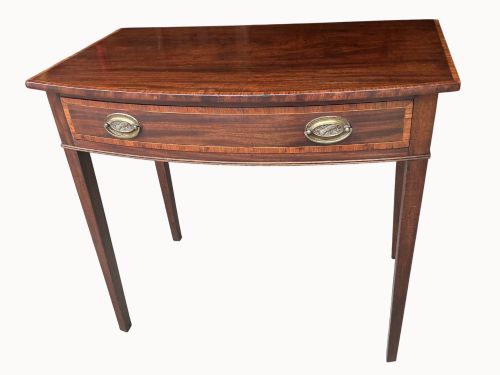
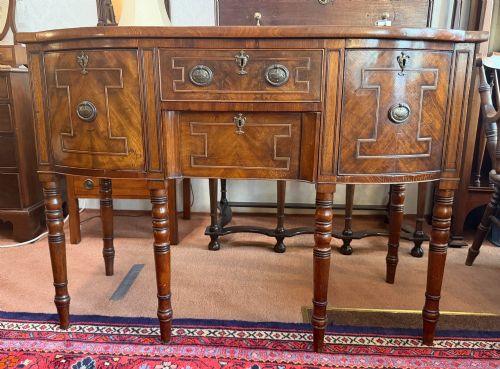
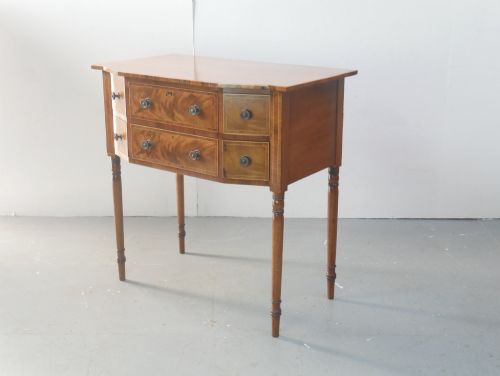
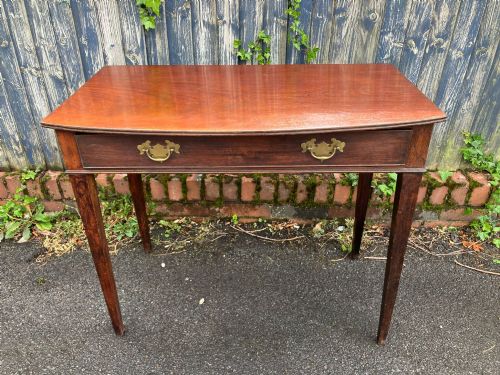
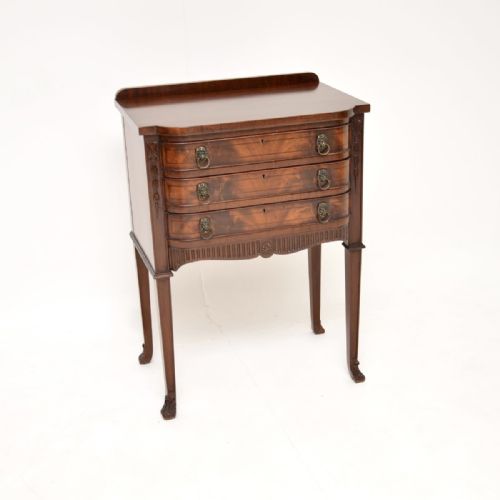
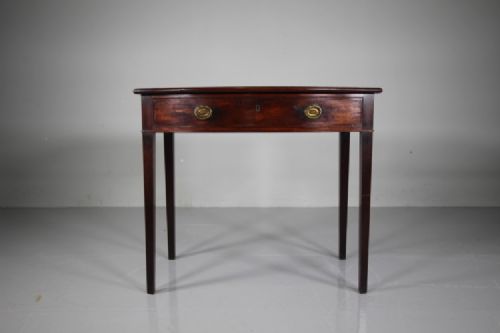
These antique bowfront side table examples offer curved fronts and compact proportions, bringing understated Georgian elegance and practical surface space to any room.
Identifying your antique bowfront side table
An antique bowfront side table presents a characteristic curved front that softens the linear feel of a room while providing useful surface space. Most pieces encountered here stem from the Georgian period, alongside later revivals stretching into the twentieth century.
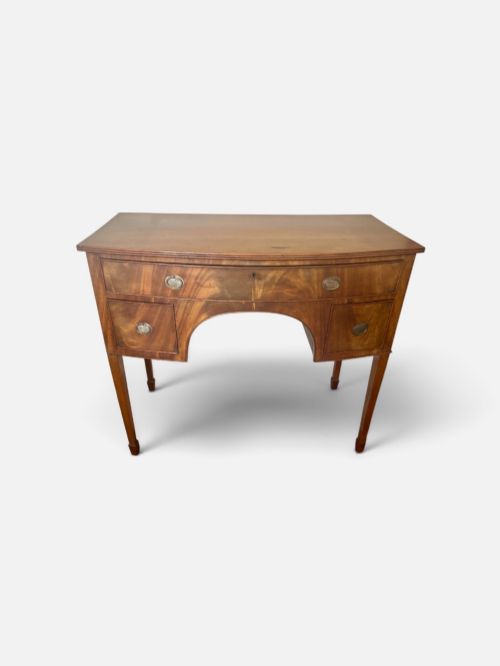
Makers shaped these surfaces primarily as side tables, though the inventory also captures work tables, writing tables, and kneehole configurations featuring multiple drawers. Woods vary from rich mahogany to burr walnut, often enhanced by contrasting stringing or ebonised details.
The profile ranges from restrained George III and George IV designs to Sheraton influences and later Queen Anne revival interpretations. Buyers find both simple single-drawer formats and more complex multi-drawer kneehole layouts among the current and archived selections.
Construction and materials
Cabinet makers built these tables using solid timbers and veneers, with mahogany serving as the dominant choice alongside burr walnut. Workshops frequently incorporated boxwood inlay, ebonised wood, and bone to create crisp decorative borders and escutcheons.
Hardware such as brass handles and pulls added functional contrast to the dark timber surfaces. Joinery techniques relied on traditional drawer construction and frame assembly to support the curved front profile without warping.
Retail Price Guide 2026
Typical UK retail prices for bowfront side table, calculated from the Sellingantiques database of over a million retail prices indexed since 2003. This retail price guide relies exclusively on Sellingantiques data; no external sources or auction records are used, so the figures do not describe the wider market.
Listings span Georgian, 1800, and 1930 periods, incorporating mahogany, walnut, brass, bone, and boxwood inlay.
Judging the range
Quality reveals itself in the harmony of the timber figure and the precision of the curved front profile. Master cabinet makers selected richly grained mahogany or burr walnut and maintained seamless alignment along the sweep of the drawers.
Subtle details separate standard examples from finer commissions, including the sharpness of boxwood inlay, the integration of bone accents, and the handling of ebonised mouldings. The sophistication of the leg joinery and internal drawer architecture further distinguishes the maker's hand.
The Antique Bowfront Side Table Glossary
- Bowfront
- A convex curved cabinet front that projects outward in the centre. This shape softens room geometry and provides additional internal depth.
- Stringing
- Thin inlaid lines of contrasting wood, such as boxwood, used to edge drawer fronts and tabletops. It creates a refined linear border.
- Kneehole
- A desk or table configuration featuring a central recess for the legs, flanked by banks of drawers. This layout allows a comfortable seating position.
- Ebonised
- Wood treated to imitate ebony, usually through staining or painting. It provides dark, dramatic contrast against lighter timbers.
Frequently Asked Questions
What is an antique bowfront side table used for?
These tables served various domestic functions, from holding lamps and decorative objects in a hallway to acting as writing surfaces in a parlour. Their compact footprints made them adaptable for placement against walls where straight-edged furniture might feel too rigid.
Today, they continue to function effectively as console surfaces or bedside tables, offering hidden storage within their drawers for small household items.
How do I date an antique bowfront side table?
Dating relies on examining the secondary timbers, construction methods, and stylistic cues present in the piece. Georgian and Regency examples often display hand-cut dovetails and specific leg turning or tapering characteristic of the period.
Later twentieth-century revivals, such as those from the 1930s, incorporate machine-sawn elements or different interior linings while mimicking earlier aesthetic traditions.
Are all bowfront side tables mahogany?
Mahogany is the most frequent timber encountered across these listings, favored for its rich grain and structural stability. However, workshops also utilised burr walnut, particularly in later twentieth-century interpretations.
Inlays and decorative accents frequently introduce secondary materials like boxwood, ebonised wood, and bone to highlight the primary wood selection.
What is the difference between a side table and a writing table?
Side tables typically feature a shallow drawer or plain frieze designed primarily for display and surface utility against a wall. Writing tables are engineered with slightly deeper clearance or integrated compartments to accommodate writing materials and seated tasks.
Both forms utilise the curved bowfront profile to maintain visual softness within a domestic interior.