





Fusee Drop Dial Clock
A fusee drop dial clock is a reliable timekeeper designed for public spaces and domestic halls, sought after for its precise movement and classic wall-mounted case.
Fusee Drop Dial Clock
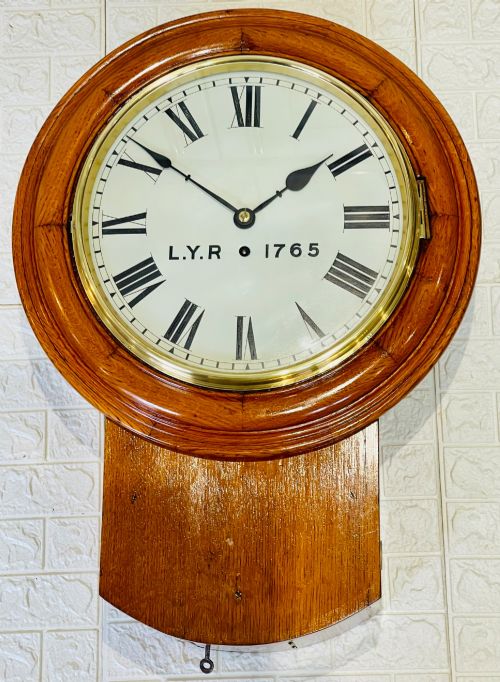
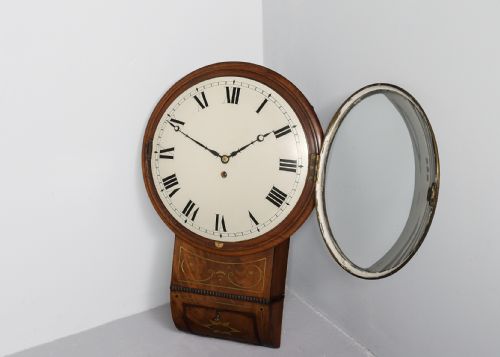
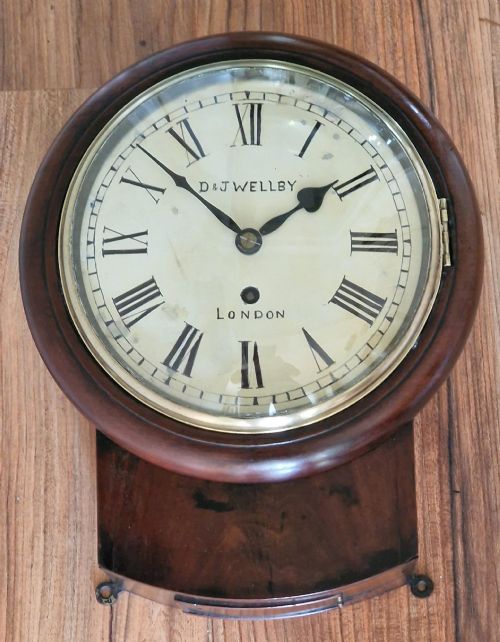
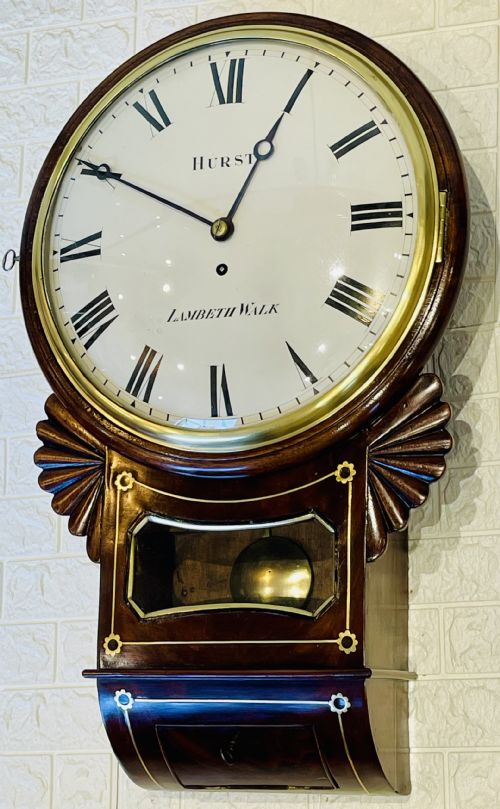
A fusee drop dial clock combines a circular dial section with an extended lower wooden case designed to house the pendulum swing. These wall clocks appear frequently from the Georgian, Regency, and Victorian periods, with regional examples originating from railway networks and provincial makers.
The form spans simple single-fusee timepieces alongside twin-fusee models capable of striking bells on the hour. Cases range from compact eight-inch provincial models to large railway station installations in mahogany, rosewood, and oak.
How They Were Made
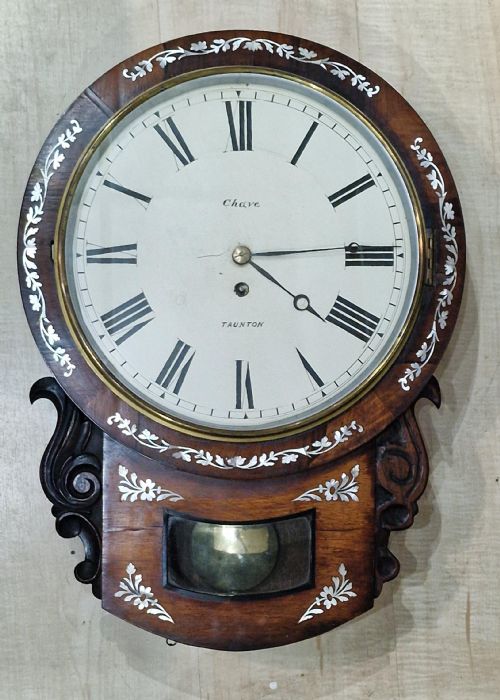
Clockmakers housed the mechanical movements inside sturdy timber cases constructed from mahogany, rosewood, or oak, frequently incorporating brass inlay, side-winding mechanisms, and mother-of-pearl accents. The dial faces utilised painted wood, convex glass, and brass bezels to protect the hands from dust and damage.
The core mechanism relies on a fusee cone and a fine chain or cord to equalise the declining power of the mainspring as it unwinds. This deployment of leverage ensures consistent force reaches the escapement throughout the running cycle.
Listings feature woods including mahogany, rosewood, oak, and brass inlay across Georgian, Regency, and Victorian periods.
What Varies in Quality
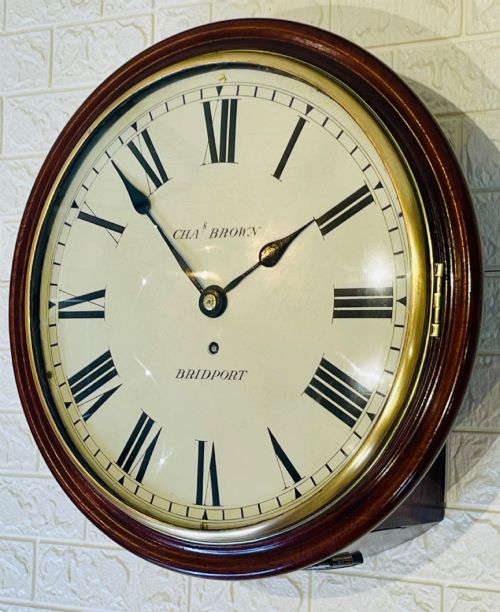
Quality rests upon the execution of the mechanical movement and the craftsmanship evident in the cabinetwork. Finer examples display signed dials from notable London or provincial makers, substantial brass plates, and crisp carving to the mahogany or rosewood surrounds.
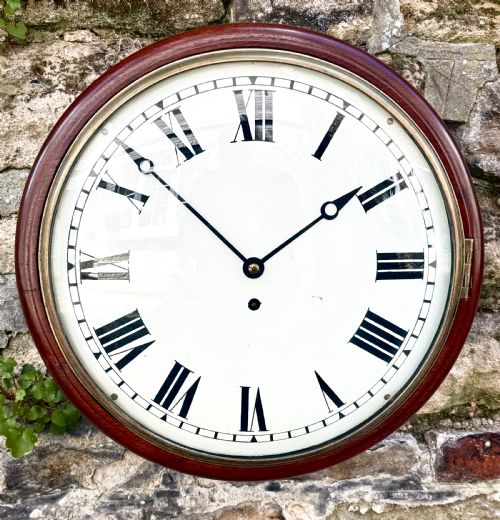
Simpler station or office clocks prioritise robust utility over decorative inlay, whereas domestic drawing-room pieces incorporate refined wood veneers, convex wooden dials, and bell-striking trains.
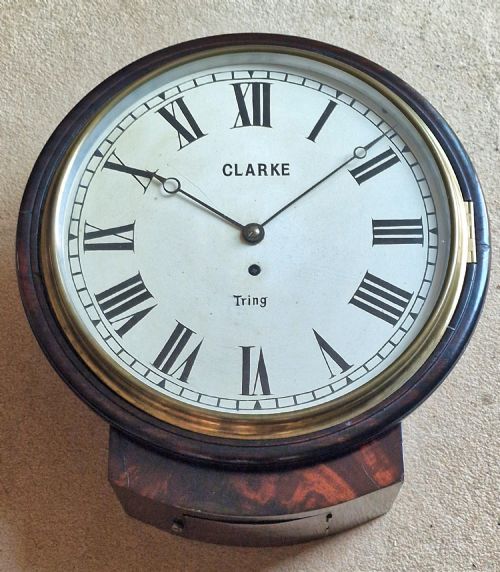
George Clarke Tring·D and J Wellby·Joseph Mansfield·Thwaites and Reed·Barrauds Cornhill London·James Tupman London·Gillett and Johnston Croydon·L J Meyer Bristol
The Fusee Drop Dial Clock Glossary
- Fusee
- A conical pulley used in mechanical clocks to maintain even power delivery as the mainspring unwinds. This ingenious component compensates for the dropping tension of the spring.
- Drop dial
- A clock case featuring a circular upper dial that extends downward into a trunk to accommodate the pendulum. This configuration became standard for British wall clocks.
- Convex dial
- A clock face curved outward toward the viewer to reduce glare and improve legibility from various angles. These dials appear frequently on Regency and Victorian wall pieces.
- Twin fusee
- A movement featuring two separate fusee cones and trains, typically separating the timekeeping function from the striking mechanism. This allows the clock to chime hours on a bell.
- Chisel bottom
- A lower case design terminating in a pointed or angular drop base rather than a traditional rounded box. This stylistic detail occurs on specific provincial nineteenth-century models.
Fusee Drop Dial Clock: Frequently Asked Questions
What is a fusee drop dial clock?
A fusee drop dial clock is a wall-mounted timepiece featuring a circular face and a lower wooden trunk that encloses the pendulum. These clocks were widely used in railway stations, offices, and homes during the Georgian and Victorian eras.
Their defining characteristic is the fusee movement, which uses a conical pulley to ensure accurate timekeeping as the spring unwinds.
How do you wind a fusee wall clock?
Winding requires inserting a key into the small hole on the clock face and turning it carefully until resistance indicates the spring is fully wound. Most single-fusee models require winding once a week.
Care must be taken not to overwind the mechanism, ensuring the chain remains correctly seated on the conical fusee pulley.
Where were these clocks originally used?
Many examples served utilitarian roles in railway networks such as the Great Western Railway and regional stations across Britain. Others hung in public offices, boardrooms, and domestic entrance halls where reliable time was essential.
Railway clocks often featured company lettering and inventory numbers painted directly onto the dial or case.
How do I date a fusee clock?
Dating relies on stylistic details, timber choices, dial materials, and the signature of the maker inscribed on the movement or face. Georgian and Regency examples often feature mahogany cases and wooden or painted convex dials, while later Victorian versions frequently incorporate broader brass bezels and robust oak housings.
Makers' records and trade directories help narrow down the active years of provincial and London clockmakers.