

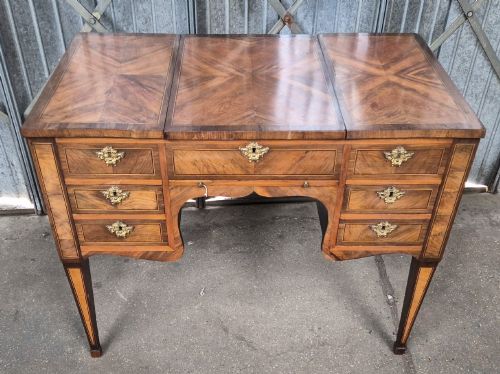

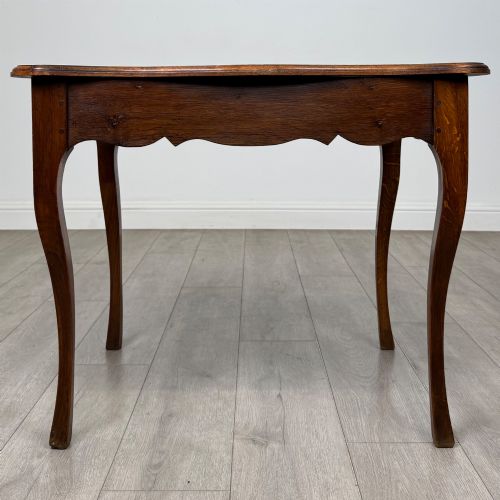
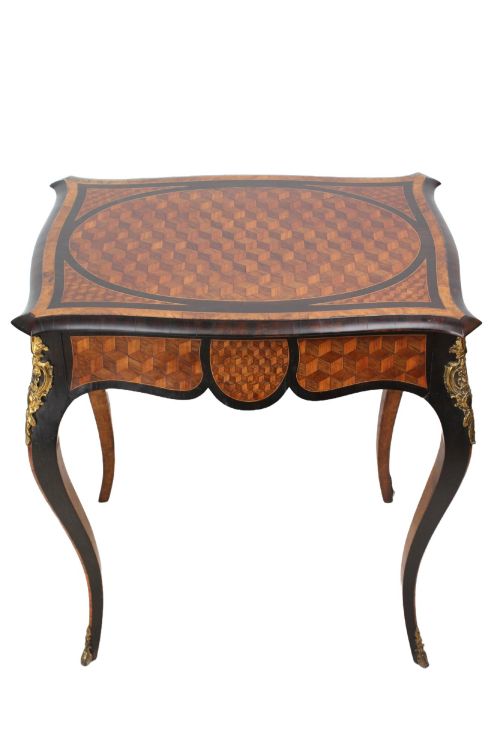
French Style Writing Table
A french style writing table brings continental elegance into a room while offering a practical surface for letters and notes.
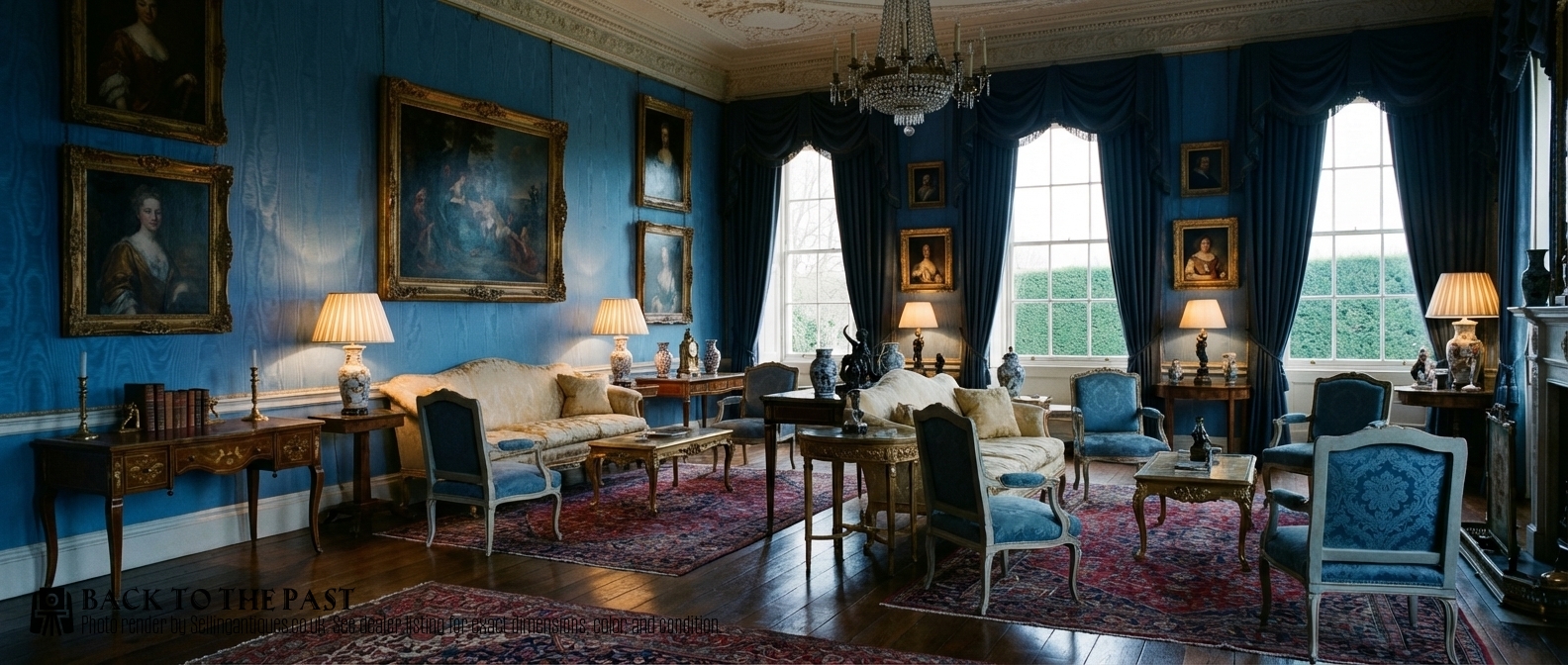
French Style Writing Table
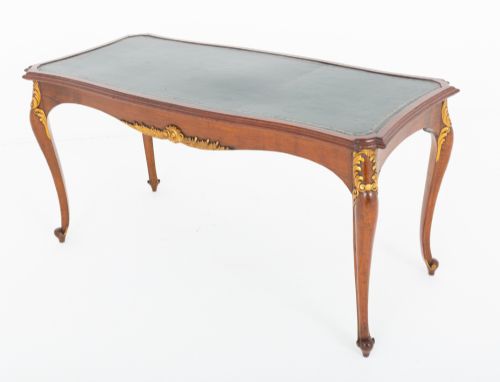
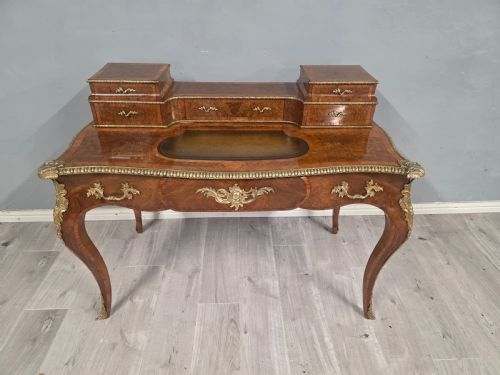
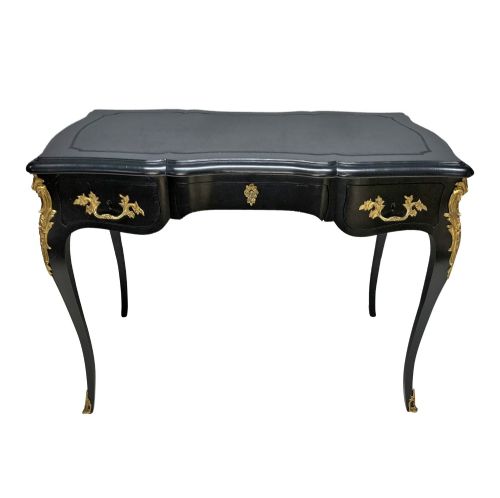
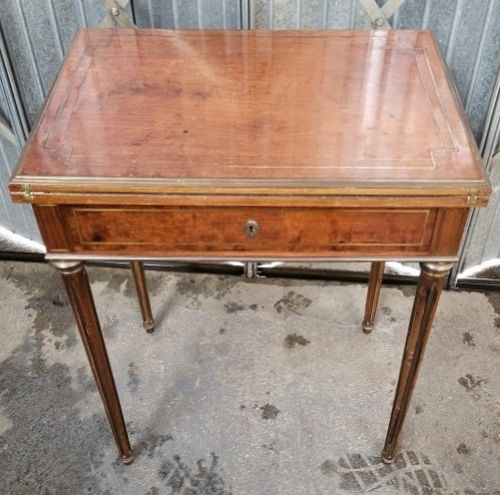
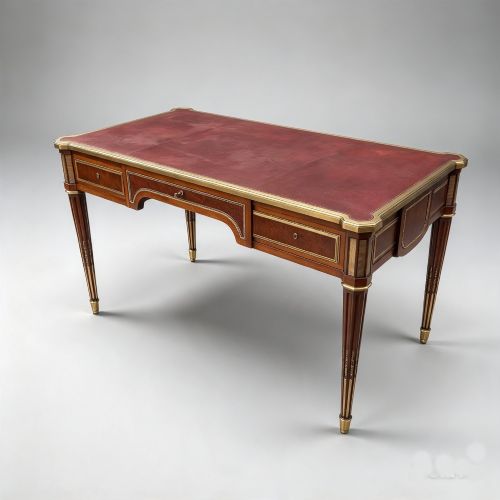
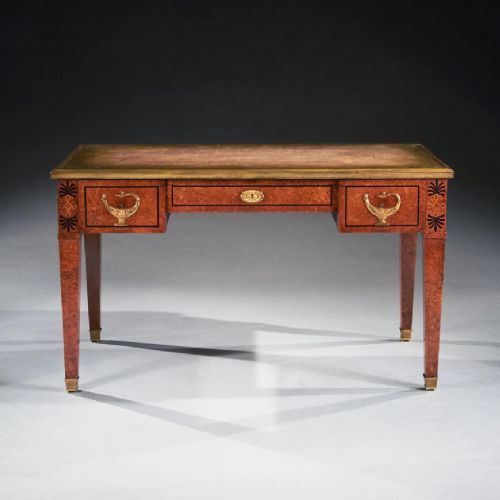
A french style writing table typically manifests as a bureau plat, a freestanding desk designed to sit in the centre of a room rather than against a wall. These pieces frequently emerge from nineteenth-century revivals of earlier court tastes, particularly the flowing curves of Louis XV and the restrained geometry of Louis XVI.
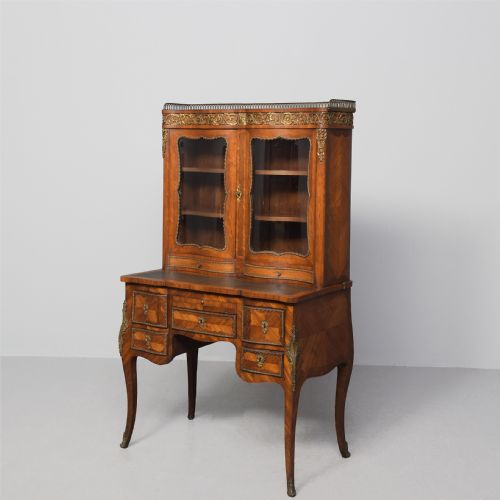
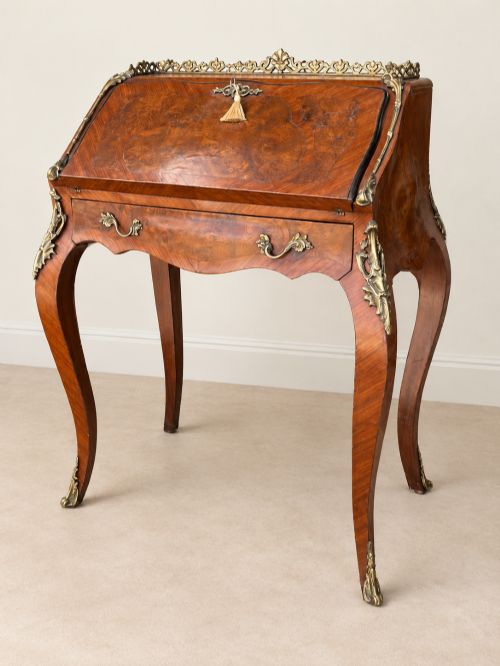
Makers drew heavily on eighteenth-century prototypes, producing refined variants such as kidney-shaped ladies desks, cylinder desks, and freestanding centre tables. While eighteenth-century originals exist, the vast majority encountered here date from the Victorian and Edwardian eras when continental cabinet-making techniques were widely imitated.
The underlying carcase frequently employs foundational timbers like oak, mahogany, or walnut, which are then shaped to match provincial or courtly aesthetics. Alongside dedicated writing desks, buyers will discover related forms including console tables, side tables, and games tables adapted for domestic correspondence.
Materials and Construction
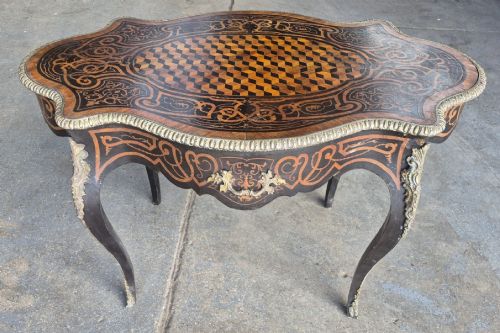
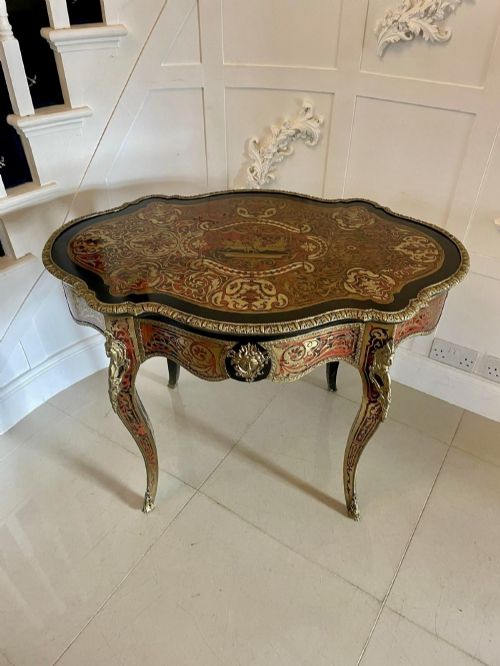
Construction relies upon a marriage of dense structural hardwoods and decorative exotic veneers applied to the carcase surfaces. Craftsmen utilised kingwood, rosewood, tulipwood, satinwood, and amboyna, often arranging them in intricate parquetry or floral marquetry patterns across the top and drawer fronts.
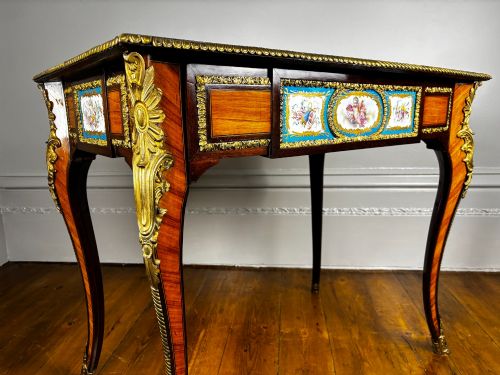
Cast gilder's bronze and ormolu mounts punctuate the design, framing drawer edges, highlighting cabriole legs, and protecting vulnerable corners. These gilt mounts require precise chiselling after casting to achieve sharp definition against the polished wood.
Writing surfaces are traditionally lined with tooled leather inserts, providing a durable and tactile plane for penwork. Ebonised finishes and vernis martin panels occasionally appear, demonstrating varied continental finishing traditions adapted by both French workshops and British makers.
French Style Writing Table Retail Price Guide 2026
Typical asking prices for french style writing table among the pieces listed under this phrase on Sellingantiques today, from the lower quarter to the upper quarter. They describe what is for sale here now, not the wider market.
Listings feature writing tables spanning the Victorian and Edwardian eras alongside nineteenth-century French revivals.
Assessing Craftsmanship
Quality rests principally on the precision of the veneer work and the crispness of the bronze or ormolu mounts. Finer pieces feature continuous, unbroken patterns of marquetry that align across drawers and carcase frames, executed in genuine exotic timbers rather than stained substitutes.
The execution of the gilt bronze mounts separates workshop tiers significantly. Superior examples display deep, hand-chiselled detail with clean undercutting, whereas lesser pieces rely on softer, shallower castings that lack three-dimensional depth.
Structural integrity and internal timber selection complete the hierarchy. High-grade tables maintain dovetailed drawer construction using secondary hardwoods throughout the interior, ensuring the desk remains stable and true when positioned freestanding.
JAS Shoolbred·Francois Linke·Edwards & Roberts·CH. Jeanselme & Co·Durand·S&H Jewell
The French Style Writing Table Glossary
- Bureau plat
- A freestanding double-sided writing table fitted with one or more drawers in the frieze. This form remained popular throughout the eighteenth and nineteenth centuries for use in the centre of a room.
- Ormolu
- Gilt bronze mounts applied to furniture edges, corners, and legs for decorative effect. The technique involves applying a gold amalgam to cast bronze before firing.
- Marquetry
- Decorative veneer work arranged in pictorial or geometric patterns using various coloured woods. Craftsmen cut contrasting timbers together to ensure tight joints.
- Parquetry
- Geometric wood inlay forming repetitive patterns such as cubes, lozenges, or squares. It provides a structured decorative surface on tabletops and drawer fronts.
- Cartonnuer
- A set of tiered document pigeonholes or compartments designed to sit atop a desk. They often feature matching leather-bound file boxes.
- Cabriole leg
- A furniture leg that curves outward and then tapers inward, mimicking an animal's limb. It is a defining feature of Louis XV revival pieces.
French Style Writing Table: Frequently Asked Questions
Where should a bureau plat go?
A bureau plat is designed as a freestanding piece meant to occupy the centre of a study or drawing room. Because the back is finished with the same care as the front, it does not need to anchor against a wall.
Positioning it centrally allows light to fall across the leather writing surface from the side while displaying the marquetry and ormolu mounts from all angles.
How do I care for leather desk tops?
The leather insert requires gentle cleaning using a slightly damp cloth without harsh detergents. Applying a specialised leather wax periodically preserves the suppleness and maintains the gold tooling.
Avoid placing damp items or unsealed ink wells directly on the leather to prevent staining the skin and the underlying wooden bed.
Are these desks comfortable for daily writing?
Nineteenth-century writing tables were built for shorter periods of correspondence rather than modern computer work. Kneehole clearance can be lower than contemporary desks due to the presence of frieze drawers.
Checking the height from the floor to the underside of the drawer frame ensures it accommodates a standard chair comfortably.
How do I distinguish original pieces from later copies?
Examination of the timber shrinkage, hand-cut dovetails, and the wear patterns on the underside reveals the age of the construction. Nineteenth-century revival pieces exhibit appropriate tool marks and material ageing consistent with their period of manufacture.
Mounts should be cast independently and secured with threaded pins or screws rather than modern fixings.