


French Style Games Table
A French style games table brings continental elegance to a room, offering a folding or dual-purpose top designed for card play.
French Style Games Table
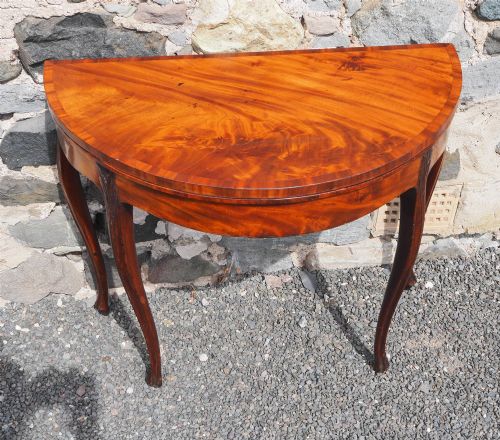
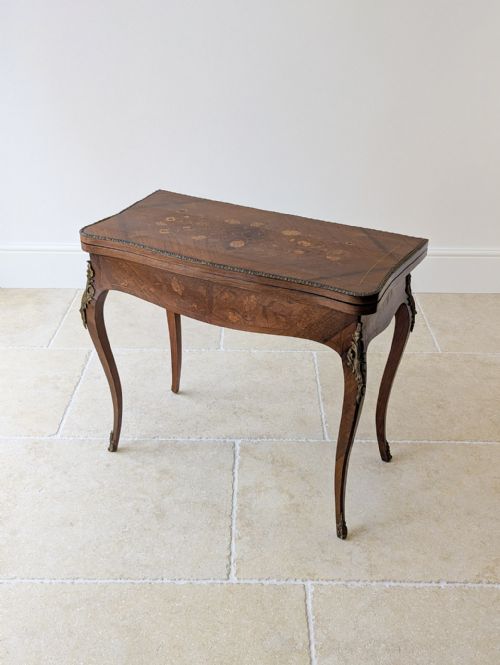
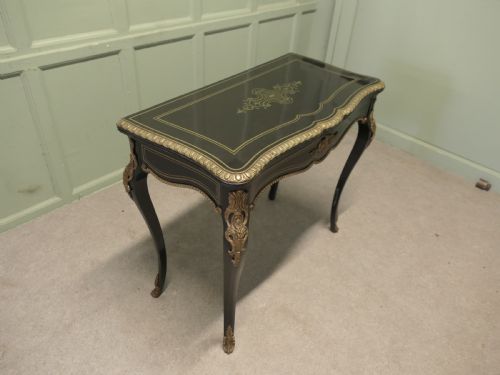
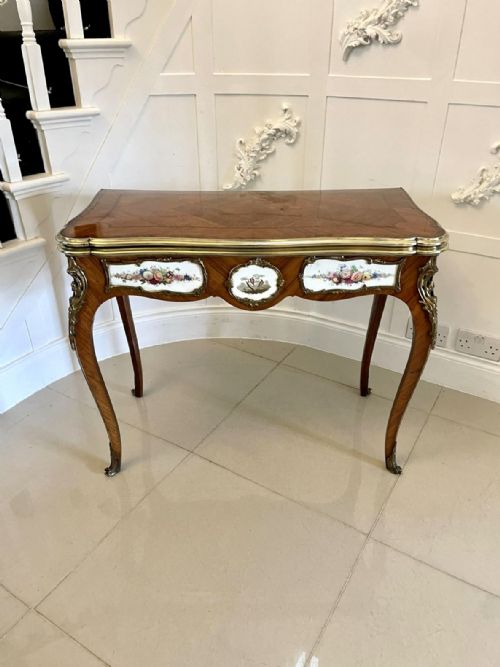
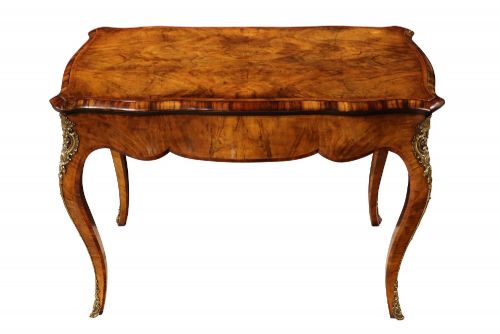
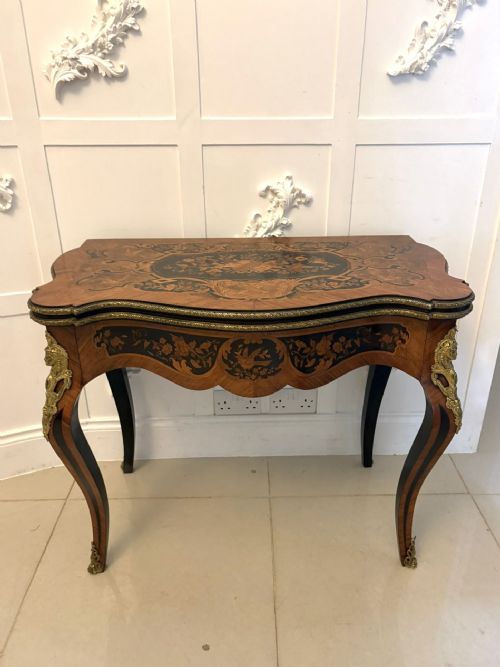
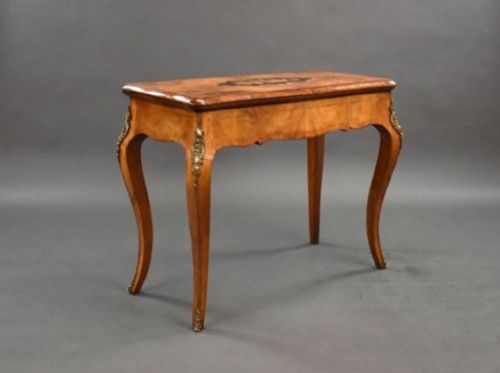
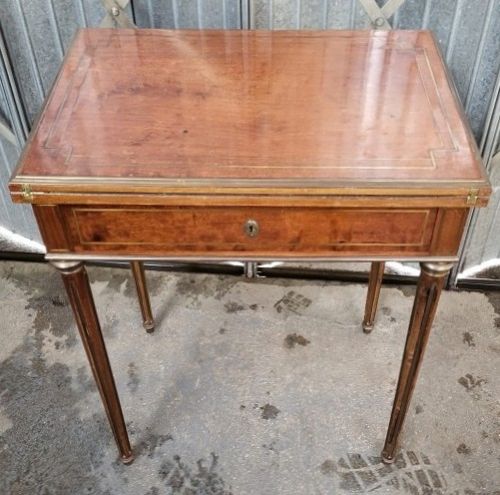
When you search for a French style games table, you encounter diverse pieces spanning the eighteenth, nineteenth, and early twentieth centuries. The selection on this page relies heavily on nineteenth-century interpretations of Louis XV and Louis XVI aesthetics, alongside Victorian revivals. These items function primarily as card tables, side tables, and console tables that fold or adapt for social gatherings.
Most examples lean towards the curvilinear forms of the Louis XV style or the disciplined geometry of the Louis XVI manner. Makers utilised forms such as demi-lune, serpentine, and circular tops to suit drawing rooms and boudoirs. These dual-purpose objects serve equally well closed against a wall or opened for play.
What varies in quality
The degree of refinement in the marquetry and the crispness of the gilt bronze mounts separate standard production from exhibition pieces. Superior examples display seamless timber matching across the fold-over leaves, ensuring the grain aligns precisely when opened.
The intricacy of the underlying mechanism dictates everyday usability and enduring value. Heavier brass inlay, meticulous parquetry, and substantial ormolu detailing indicate workshops that invested significant labour into the finished piece.
A tiny brass gallery rail kept the stakes from sliding into the rug when high-stakes gambling interrupted an eighteen-century evening.
G T Morant·Joseph-Emmanuel Zwiener·Maison Millet·Edwards & Roberts·Francois Linke
The French Style Games Table Glossary
- Ormolu
- Gilt bronze mounts applied to furniture for decorative enrichment and edge protection. This technique involves coating cast bronze with a finely ground gold-mercury amalgam and heating it.
- Kingwood
- A dense, richly figured tropical timber prized for its contrasting dark and golden brown stripes. Cabinetmakers utilised it extensively for high-end French revivalveneered surfaces.
- Boulle
- A method of marquetry using brass and tortoiseshell inlaid in opposing counter-forms. Named after André-Charles Boulle, it reappeared frequently in nineteenth-century French revival furniture.
- Marquetry
- The art of applying small pieces of veneer to a structure to form decorative patterns or pictorial scenes. Craftsmen cut various exotic woods to fit tightly together within the surface design.
- Parquetry
- Geometric mosaic woodwork arranged in repeating patterns such as cubes or chequers. It differs from marquetry by strictly employing straight-lined geometric motifs.
- Bouillotte table
- A small circular occasional table with a raised gallery rim designed to prevent counters from rolling off during card games. They often feature marble tops and brass railings.
French Style Games Table: Frequently Asked Questions
What is a French style games table used for?
These tables provide a dual-purpose surface for domestic entertaining, functioning as console or side furniture when closed. Opening the hinged top reveals a baize-lined or polished wooden playing surface intended for cards and parlour games.
Their adaptable design allowed nineteenth-century hosts to transition easily from formal display to social recreation within the drawing room.
How do I tell Louis XV and Louis XVI styles apart?
Louis XV pieces exhibit asymmetrical curves, cabriole legs, and flowing Rococo ornamentation that emphasise organic movement and playful asymmetry. The wood framing often swells and twists without straight lines.
Louis XVI furniture introduces neoclassical restraint, featuring straight tapered legs, fluting, and rectangular or symmetrical geometric proportions inspired by antiquity.
Can I use these tables every day?
Historic folding tables accommodate gentle daily use provided you operate the hinges and leaf supports with care. Most historical examples were built for active entertaining rather than static display.
Placing them away from direct sunlight and extreme humidity protects delicate veneers and prevents the wood from warping over time.
What woods were commonly used in these pieces?
Walnut, mahogany, and kingwood form the structural foundation of the majority of these listings. Cabinetmakers overlaid these with exotic veneers to create striking visual contrast.
Ebonised wood, rosewood, and amboyna also appear frequently, often paired with brass inlay or gilt bronze mounts to enhance the decorative scheme.