
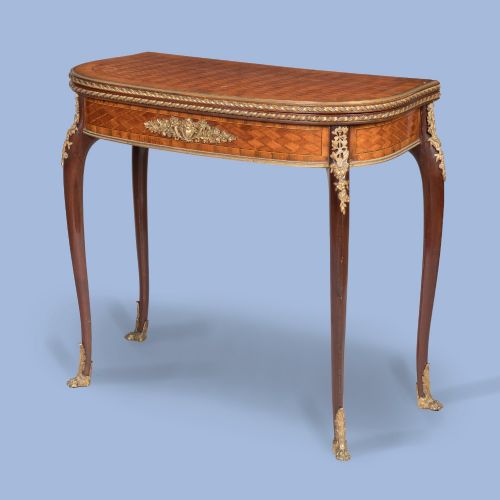
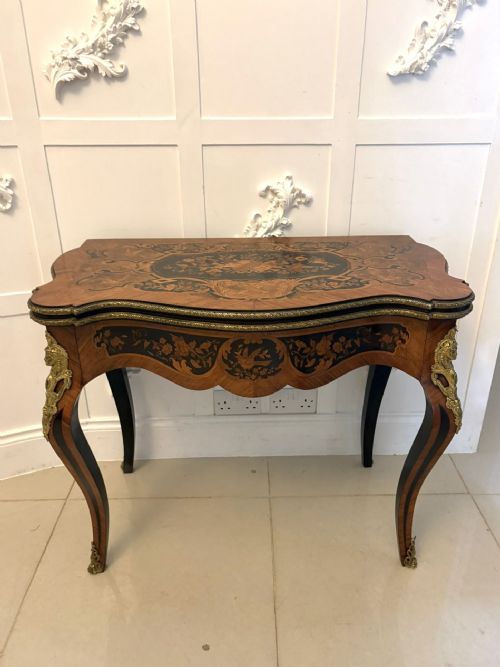


Brown Kingwood Card Table
These brown kingwood card table pieces are versatile folding tables crafted for parlour games, bringing French revival elegance and intricate marquetry into modern reception rooms.
Brown Kingwood Card Table
A brown kingwood card table is primarily a Victorian creation influenced by continental French designs, frequently seen in the Louis XV style and revival forms. These items combine the practical function of a games surface with decorative console or side table capabilities when closed.
The selection ranges from mid nineteenth century examples dating around eighteen fifty to later nineteenth century pieces from eighteen ninety. Makers and workshops across this period employed rich timber veneers and detailed mounts to satisfy demand for revival furniture.
Forms include folding games surfaces alongside related console and centre tables sharing similar timber work and decorative mounts. Such pieces suit drawing rooms and reception spaces where decorative timber and folding utility are equally valued.
Materials and construction methods
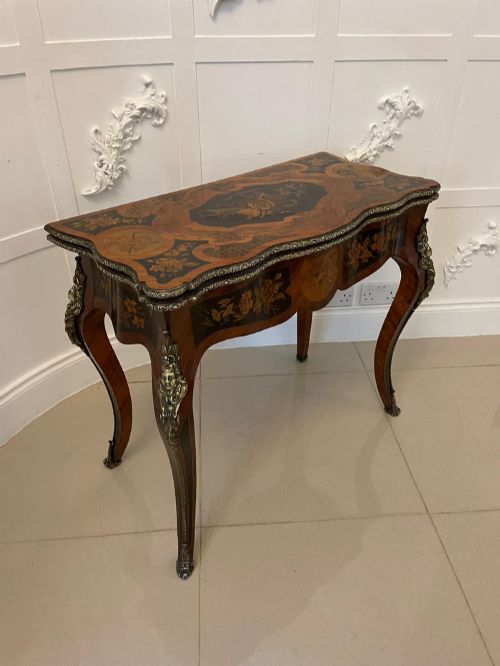
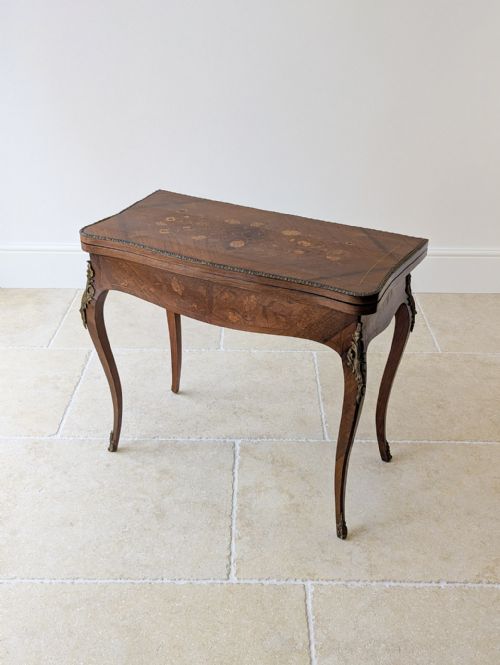
Makers utilised kingwood as the primary visible timber, often paired with rosewood and walnut across crossbanded and parquetry surfaces. Marquetry inlays create floral or geometric patterns across the folding tops, demonstrating precision in veneer selection and cutting.
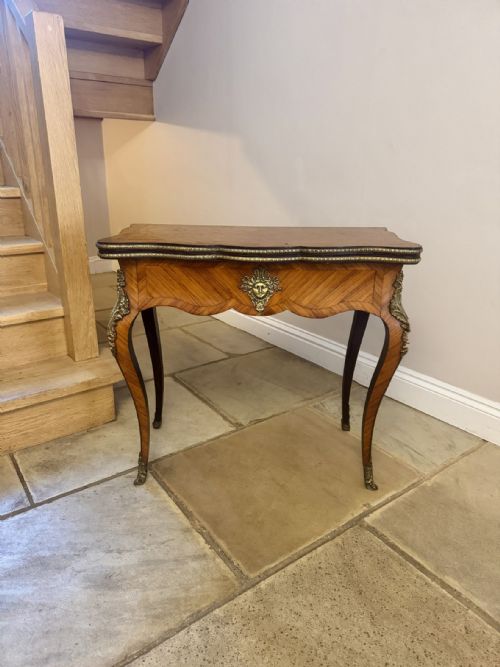
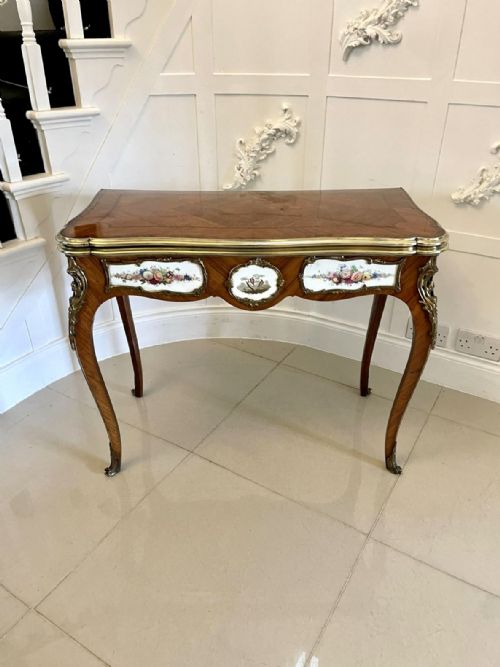
Ormolu and gilt bronze mounts decorate the angles, aprons, and legs, echoing French chateau aesthetics. Brass inlay and porcelain plaques occasionally supplement the gilt mounts, adding colour contrast to the polished wood ground.
Card tables often conceal shallow well compartments beneath their folding tops, originally designed for storing counters, markers, and decks of playing cards.
Distinctions in quality and execution
Quality manifests in the crispness of the ormolu chasing and the complexity of the wood inlay, where tighter geometric parquetry or detailed floral marquetry demands greater workshop skill. The precision of the folding mechanism and the alignment of the timber grain when the top is open also separate standard production from superior examples.
Attribution to documented makers such as François Linke, Henry Dasson, or G T Morant introduces a distinct tier of craftsmanship. These pieces demonstrate more refined bronze casting and superior timber selection compared to anonymous workshop output.
G T Morant·François Linke·Henry Dasson
The Brown Kingwood Card Table Glossary
- Kingwood
- A dense, heavy Brazilian timber displaying rich brown tones and distinct grain patterns, favoured for fine cabinet making.
- Ormolu
- Gilded bronze used for decorative mounts and accents on furniture, cast and chased by hand.
- Marquetry
- Decorative patterns formed by fitting together small pieces of veneer of different woods and materials.
- Parquetry
- Geometric mosaic woodwork used for ornamenting floors or furniture surfaces, particularly tabletops.
- Crossbanding
- A strip of veneer running parallel to the edge of a tabletop, grain perpendicular to the main surface.
Brown Kingwood Card Table: Frequently Asked Questions
How were these tables used originally?
These tables served as ornamental side or console furniture when closed against a drawing room wall. Opening the hinged top revealed a baize or wood surface intended for card games and social gatherings.
During the nineteenth century, hosts relied on such folding tables to quickly transform reception spaces for evening entertainment without permanently cluttering the room.
How do I identify Louis XV style pieces?
Louis XV revival pieces display characteristic cabriole legs, serpentine aprons, and asymmetrical floral or scroll motifs in the ormolu mounts. The overall silhouette avoids straight lines in favour of flowing curves.
Makers working in this manner during the Victorian era drew inspiration from eighteenth century French furniture, combining kingwood veneers with gilt bronze fittings.
Can I use this table daily?
Daily use is entirely feasible provided the folding mechanism is handled with care and the polished wood surface is protected from moisture and direct heat. Regular dusting with a dry cloth maintains the finish.
Positioning the table away from direct sunlight preserves the rich brown tones of the kingwood veneer and prevents the timber from drying out.
What is the difference between marquetry and parquetry?
Marquetry involves cutting and assembling veneers to create pictorial designs, such as flowers, foliage, or scrolls, across the tabletop. It requires artistic precision in matching wood grains and colours.
Parquetry relies on geometric arrangements like cubes, chequers, or lozenges, creating a structured pattern using contrasting timber species.