


French Striking Carriage Clock
When you choose a french striking carriage clock, you acquire a portable mechanical timepiece housed in brass and glass that chimes the hours independently on a bell or gong.
French Striking Carriage Clock
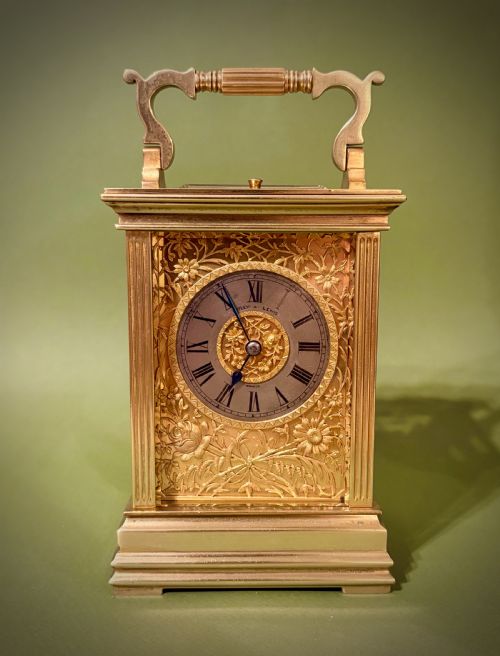
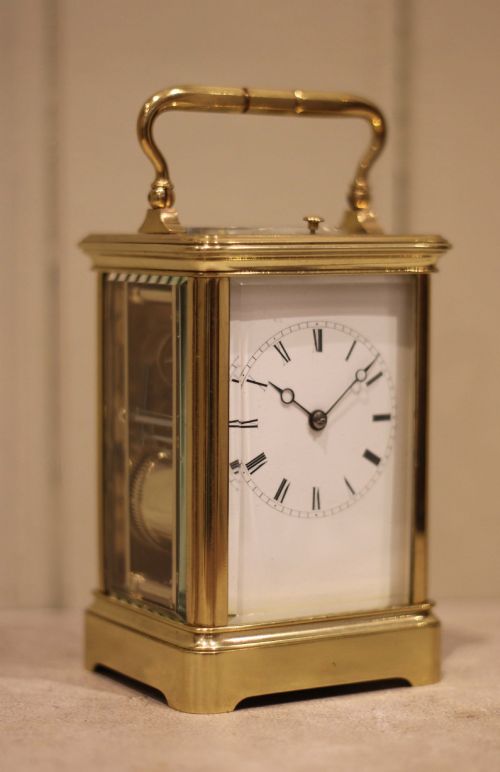
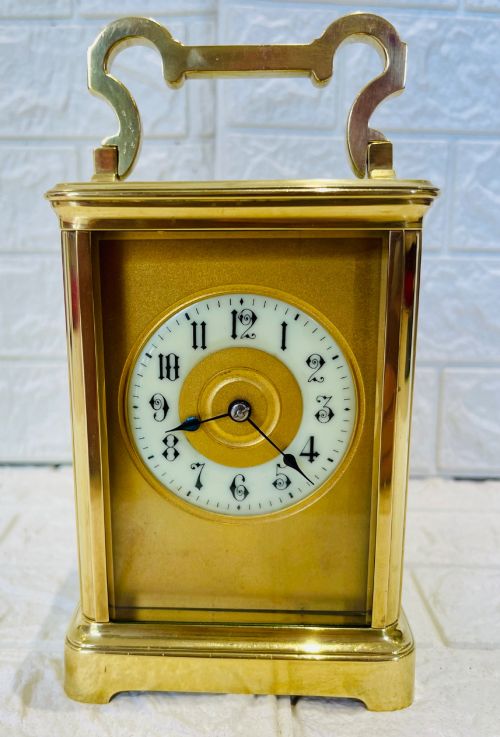
A french striking carriage clock is a portable timepiece designed for travel during the nineteenth century, featuring an eight-day mechanical movement enclosed within heavy brass framing and bevelled glass panels. These domestic instruments sit upright on short feet, often equipped with a hinged handle on top for carrying between rooms or on journeys.
The versions most commonly met on this page date from the Victorian era and the latter half of the nineteenth century, originating from Parisian workshops and retailers. They range from plain brass cases to elaborate formats with enamel dials, inset panels, and fitted leather travel cases.
Many examples include repeating mechanisms that chime the last hour or quarter-hour on demand when a button on top is pressed. Others incorporate additional complications such as alarm functions, grand sonnerie striking, or miniature bracket mantel clock formats.
Materials and construction
Brass and gilt brass form the primary structural chassis of these timepieces, providing the rigid framework necessary to hold the heavy gear trains and escapements in alignment. Molten brass was cast and subsequently machined, polished, or fire-gilded to create the polished metallic surfaces visible on the exterior framing and interior plates.
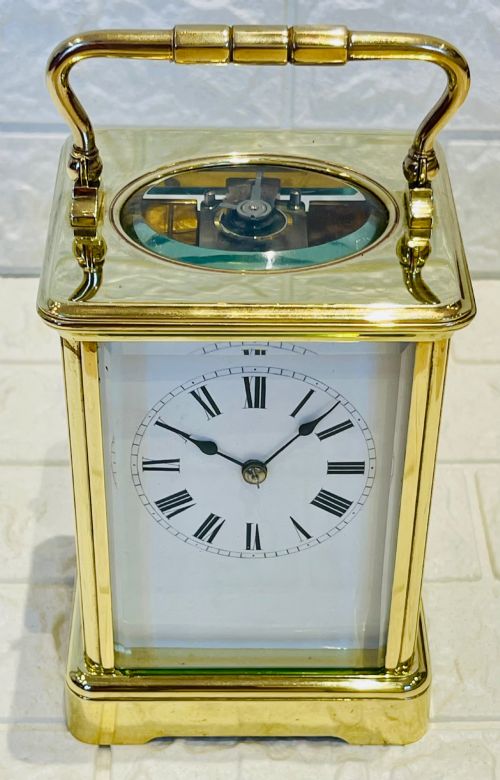
Bevelled glass panels inserted into the top, sides, and back door allow the escapement and gear train to remain visible during operation. Enamel provides the contrasting white surface for the chapter rings and dial faces, fused onto copper plates at high heat.
Steel components form the pinions, springs, and arbors within the movement, while leather and ebonised wood construct the protective outer travel cases accompanying select pieces.
Some travel cases include little glass windows in the leather lid so owners could check the time without unbuckling the leather.
Distinctions in manufacture and finish
The refinement of the movement plates, the complexity of the striking train, and the presence of signed maker signatures separate standard production pieces from masterwork examples. Pieces originating from known workshops display superior gear cutting, jewelled lever escapements, and precise finishing on internal components.
Case architecture also dictates quality, moving from simple one-piece brass housings to heavily engraved gorge cases, pillared frames, or multi-piece cases with original gilding. The inclusion of complications such as alarm mechanisms, petite sonnerie, or enamel side panels elevates the manufacturing standard.
Henri Jacot·Drocourt·Paul Garnier·AD Mougin·J.W. Benson·Henry Marc
The French Striking Carriage Clock Glossary
- Gorge case
- A distinctively stepped brass carriage clock case style characterised by multiple curved mouldings around the top and base. This architectural shape is frequently found on mid-nineteenth-century pieces.
- Repeating mechanism
- A complication operated by pressing a button on the top of the case, causing the clock to repeat the last struck hour or quarter-hour on demand. This allows the user to check the time in the dark.
- Grande Sonnerie
- A striking system that automatically chimes the hours and the current quarter-hours on every passing quarter, often accompanied by a silent or repeating option via a lever underneath the base.
- Platform escapement
- The small self-contained assembly mounted on top of the movement containing the balance wheel and hairspring, replacing the traditional pendulum for portability. This innovation allows the clock to keep time while moving.
- Doucine case
- A case featuring outward-curving ogee mouldings on the top cornice and base plinth. This French profile adds architectural depth to the brass framework.
French Striking Carriage Clock: Frequently Asked Questions
What is the difference between striking and repeating?
A striking mechanism chimes the hours automatically as the hands reach each hour point, using an internal rack or count wheel to govern the count. A repeating mechanism allows you to trigger that chime manually at any moment by pressing a button on the top plate.
Many clocks combine both functions into a single movement, letting the piece strike on the hour while retaining the ability to sound the last hour on demand.
Why does my carriage clock gain or lose time?
Mechanical clocks are sensitive to temperature changes, surface levelness, and age within their gear trains. Adjustments can usually be made using the small regulator square visible on the platform escapement.
Moving the regulator lever slightly towards fast or slow alters the effective length of the hairspring to correct the daily rate. Ensure the clock rests on a stable, level surface for consistent performance.
Can these clocks travel today?
While originally built for travel in horse-drawn carriages and trains, antique movements require careful handling in modern transit. Securing the platform escapement or locking the balance prevents excessive wear on the delicate pivots during long journeys.
Many surviving pieces retain their original fitted leather or wooden travel cases designed specifically to protect the glass panels and brass frame from impact.