



French Revival Centre Table
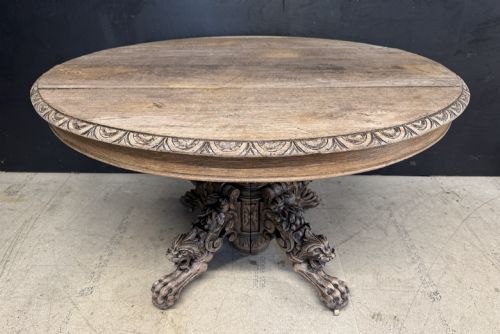
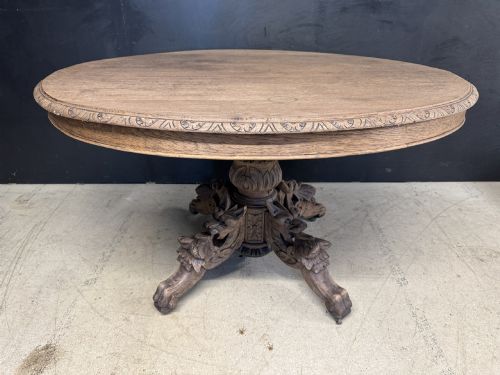
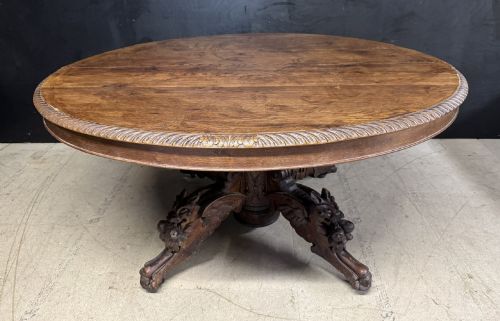
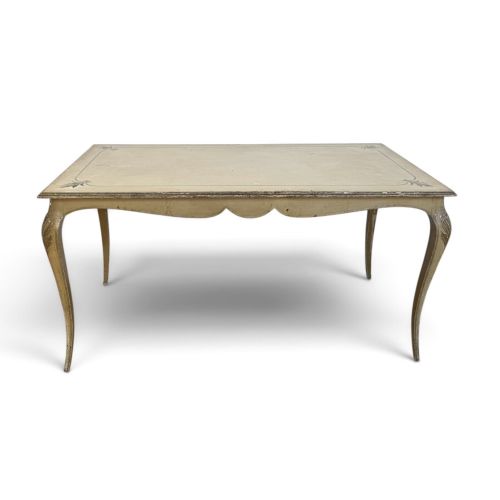
A french revival centre table brings ornate continental flair into a room, offering a freestanding display surface rooted in nineteenth century craftsmanship.
French Revival Centre Table
A french revival centre table stands as a decorative freestanding piece designed to occupy the middle of a room rather than sit against a wall. The examples found here primarily emerge from the nineteenth century, including Victorian interpretations and later twentieth century iterations from the nineteen thirties.
Buyers will frequently encounter forms categorized as centre tables, occasional tables, side tables, or coffee tables, alongside related items such as desks, writing tables, and tazzas. These pieces adopt specific aesthetic frameworks, predominantly drawing from Louis XV revival, French rococo revival, and renaissance revival vocabularies.
Originating largely from French and Victorian British workshops, these tables fulfill both functional and decorative roles. Their construction prioritises visual impact from every angle, making them suitable for central placement within principal reception rooms.
Materials and construction methods
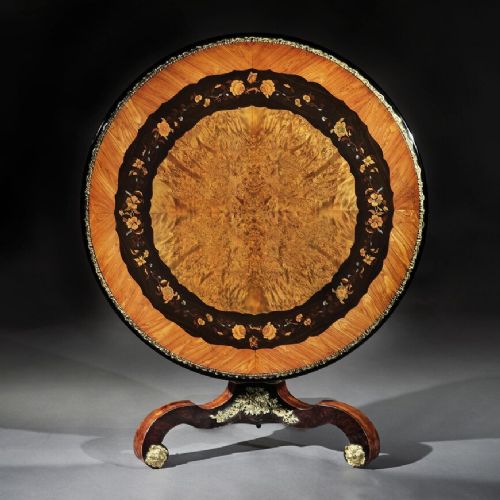
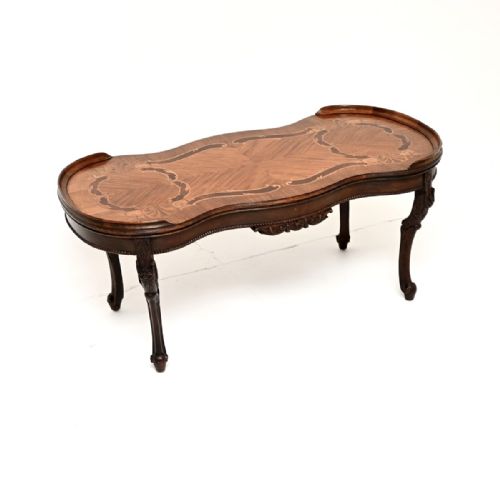
Cabinet makers utilised dense hardwoods such as walnut, kingwood, rosewood, satinwood, and mahogany as foundational timbers, frequently applying burr veneers to create richly figured surfaces. Ebonised wood also appears, providing a dark, dramatic substrate for metallic inlay.
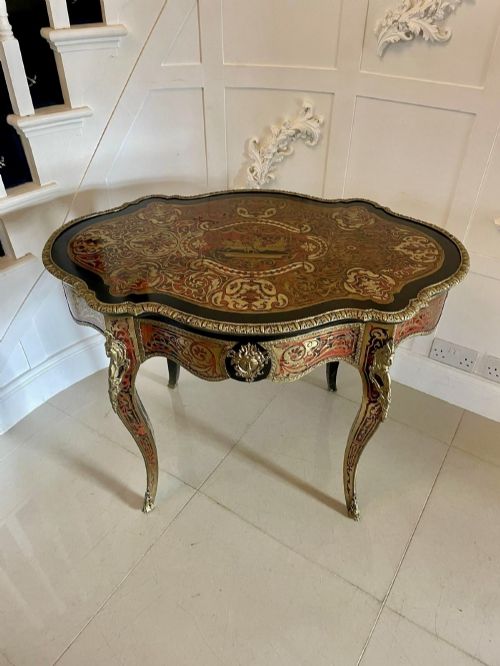
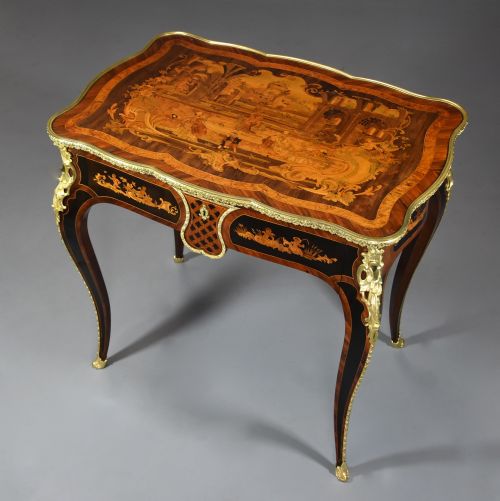
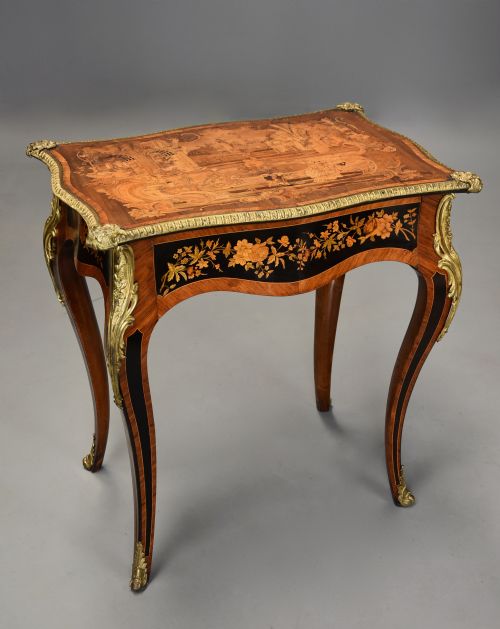
Marquetry and parquetry inlay formed geometric and floral patterns using contrasting timbers, while Boulle work integrated brass and tortoiseshell elements into elaborate designs. Ormolu and gilt bronze mounts embellished the structural edges, legs, and aprons.
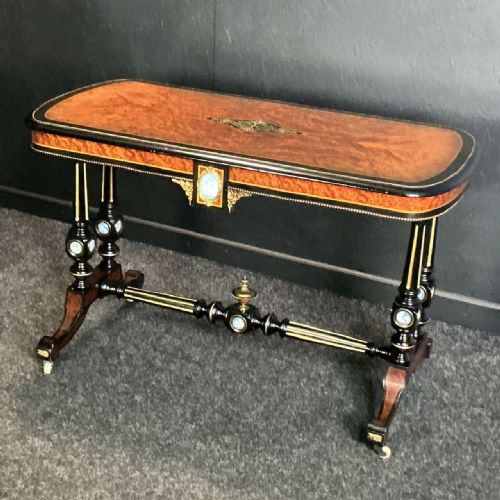
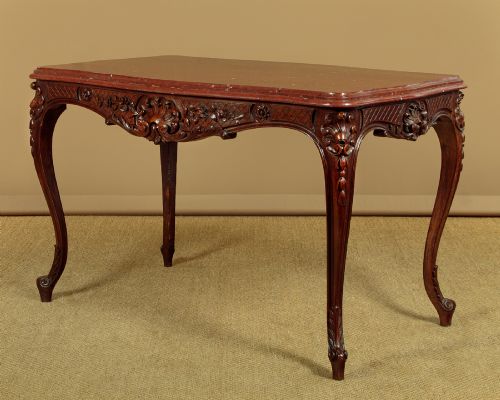
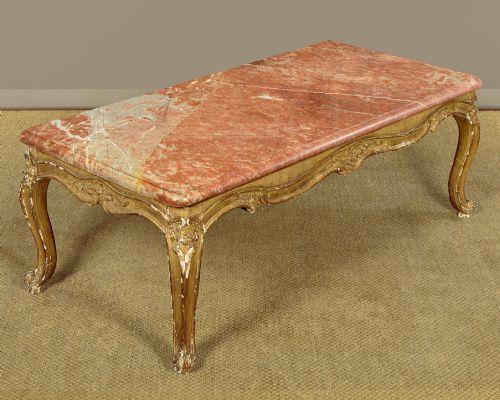
Heavy stone elements, specifically rouge marble and inset Sevres porcelain plaques, provided durable and luxurious upper surfaces on selected tables. Bronze casting yielded figural supports and decorative cherub motifs.
Listings feature woods such as walnut, kingwood, rosewood, and mahogany, alongside ormolu mounts and marble tops.
Evaluating the standard of execution
The sophistication of the marquetry and the precision of the parquetry set distinct tiers of execution among these tables. Hand-cut timber veneers fitted with microscopic exactness indicate superior workshop output compared to simpler, repetitive geometric patterns.
The quality of metalwork marks another major divergence in the category. Finely chased ormolu mounts with crisp relief and secure pinning demonstrate higher artisan involvement than cast metal components with softer details.
The choice of secondary materials, such as the inclusion of heavy rouge marble tops or hand-painted porcelain plaques, elevates a piece. Structural integrity in the underframe and the retention of original surface polishes complete the assessment of execution.
Edward Holmes Baldock·Joseph Emmanuel Zwiener·Holland and Son
The French Revival Centre Table Glossary
- Ormolu
- Gilded bronze or brass applied as decorative mounts to furniture edges and legs. This technique creates bright metallic highlights that contrast against dark woods.
- Marquetry
- The art of applying pieces of veneer to a structure to form decorative patterns and pictorial designs. Craftsmen use varied timber tones to achieve tonal depth.
- Boulle
- A form of marquetry consisting of brass and tortoiseshell inlay developed during the reign of Louis XIV. It resurfaced frequently in nineteenth century revival pieces.
- Gueridon
- A small round table, typically supported by a central column or multiple legs. The style draws directly from seventeenth and eighteenth century French precedent.
- Tazza
- A wide, shallow cup or vessel raised on a stem and foot. In this context, it appears as an ornamental bronze or ormolu centrepiece.
French Revival Centre Table: Frequently Asked Questions
Where should a french revival centre table be placed?
These pieces function best when positioned in the middle of a room where their finished backs and detailed surrounds remain fully visible. They serve as natural focal points for reception spaces or large hallways.
Because they lack a designated front or back, they allow light and movement to circulate around them freely in an interior layout.
How do I care for marble and wood surfaces?
Polished timber surfaces require regular dusting with a dry cloth and occasional feeding with appropriate wax to maintain the grain. Avoid placing untreated liquids directly onto the wood.
Marble tops need gentle cleaning with mild, non-acidic soap and water to prevent etching on the stone surface. Promptly wipe away spills to protect both the polish and the porous material.
What defines the rococo revival style?
This aesthetic draws heavily on eighteenth century French design, featuring asymmetric curves, C-scrolls, and naturalistic floral motifs. Furniture from this movement prioritises fluidity of line over rigid geometric symmetry.
Carved wooden elements and cast ormolu mounts often mimic organic growth, vines, and shells.
Can these tables be used for everyday writing?
Specific variants designated as writing tables or desks include fitted drawers and flat surfaces intended for functional daily use. Their sturdy timber construction supports normal writing tasks.
More decorative centre tables with delicate marquetry or inset porcelain are better suited for display rather than heavy operational use.