
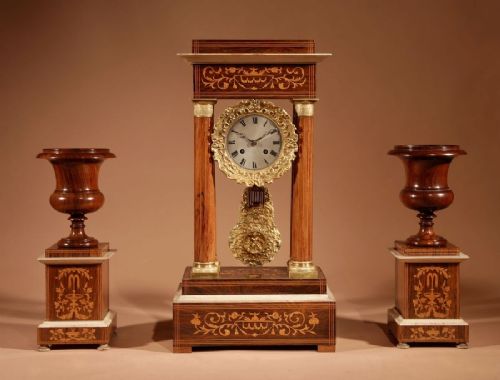
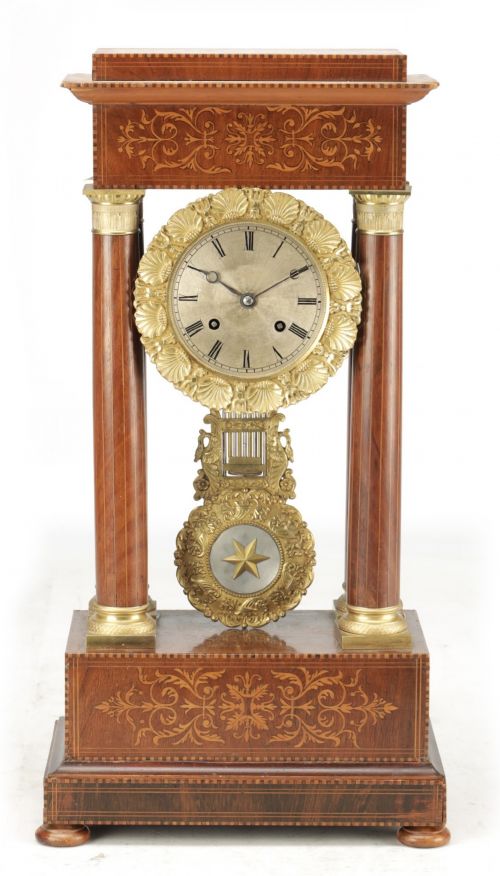
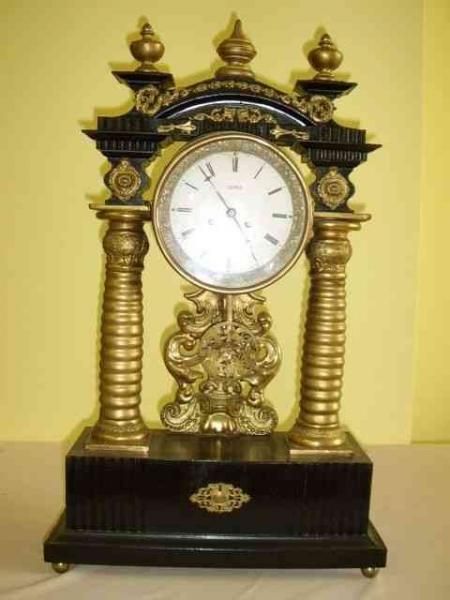
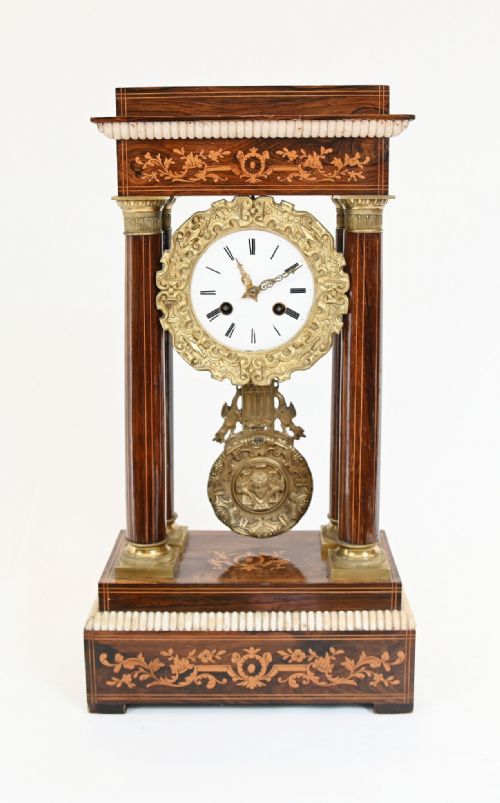
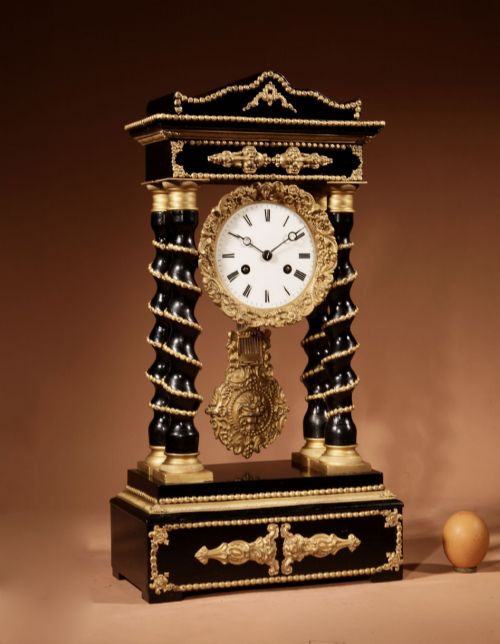


French Portico Mantel Clock
A french portico mantel clock stands on slender columns beneath a pediment, bringing architectural symmetry and refined timekeeping into the room.
French Portico Mantel Clock
A french portico mantel clock is a striking timekeeper defined by its architectural frame of four or more upright pillars supporting an upper entablature above a central suspended pendulum. These pieces emerge predominantly in the nineteenth century and the closing decades of the eighteenth century, manifesting in styles ranging from French Empire and Charles X to Louis XVI Revival and Victorian interpretations.
The architectural format adapts readily to diverse materials, appearing as substantial white marble, onyx, or pink marble structures alongside warm timber cases of rosewood, ebonised wood, and mahogany. Many examples arrive paired with matching candelabras or side ornaments as part of an integrated clock garniture set.
Buyers encounter single timepieces as well as grand multi-piece garnitures sheltered beneath glass domes. The structural composition typically centres on a circular enamel dial set within the crossbeam or suspended cleanly between the flanking columns.
Materials and construction
Craftsmen construct the architectural cases using fine timber veneers such as rosewood and satinwood over solid carcasses, or carve them from white marble, siena marble, and alabaster. Ormolu, gilt bronze, and brass mounts provide structural capitals, bases, and decorative bezels around the dial.
Movements rely on brass wheel trains, often featuring anchor escapements and pendulum suspension, housed securely between plates. Dials are constructed from white enamel with painted numeric markers, frequently protected by bevelled glass set within hinged bezels.
Listings feature architectural mantel clocks spanning from the late eighteenth century through the nineteenth century, utilising white marble, rosewood, and gilt bronze.
Judging quality and execution
Quality reveals itself in the crispness of the gilt bronze or ormolu mounts and the precision of the timber marquetry or inlay work. Finer examples display deeply chased gilt metal details and heavy, high-grade marble or richly figured rosewood cases.
The sophistication of the movement and the presence of signed dial plates or maker inscriptions elevate a piece above standard domestic timepieces. Integration with matching candelabras and original glass domes further distinguishes superior survivals.
Breguet·AD Mougin Paris·Leroy
The French Portico Mantel Clock Glossary
- Portico clock
- An architectural mantel clock supported by pillars or columns. This design places the pendulum visibly in the open space between the uprights.
- Ormolu
- Gilt bronze created by applying a mercury and gold amalgam to a bronze base. This technique produces a durable, rich golden surface finish common on luxury French pieces.
- Garniture
- A set of matching decorative objects designed to sit together on a mantelpiece. These usually comprise a central clock flanked by matching candelabras or urns.
- Fusee
- A conical pulley used within clock movements to maintain even driving force as the mainspring unwinds. This mechanism improves timekeeping accuracy across the power reserve.
- Ebonised
- Timber treated with a dark stain or finish to imitate ebony. This dark surface creates a sharp visual contrast against gilt bronze mounts.
French Portico Mantel Clock: Frequently Asked Questions
What is a portico clock?
A portico clock is an architectural timepiece structured around vertical columns that support an upper pediment. The pendulum hangs openly in the central void between these pillars.
This distinct temple-like configuration became popular across France during the late eighteenth and nineteenth centuries, merging classical design with precision clockmaking.
How do I identify a Charles X clock?
Charles X pieces typically display clean architectural lines influenced by the transition between Empire and later revival aesthetics. They frequently combine rich timber veneers with contrasting ormolu mounts.
The dials often feature crisp enamel numerals, and the overall proportions remain balanced and restrained without excessive ornamentation.
What is a clock garniture?
A clock garniture is a matched decorative set designed for display on a mantelpiece. It consists of a central clock accompanied by matching side pieces such as candelabras or urns.
These sets were produced in unified materials like marble, ormolu, or coloured stone to create a balanced decorative scheme across a fireplace.
Where should I place a marble clock?
Marble clocks require a sturdy surface capable of supporting considerable weight due to the dense stone and metal components. Placing them on a level mantelpiece or sideboard ensures the pendulum swings evenly.
Keep these pieces away from direct sunlight and moisture to preserve the polished stone and delicate enamel dials.