


Ebonised Portico Clock
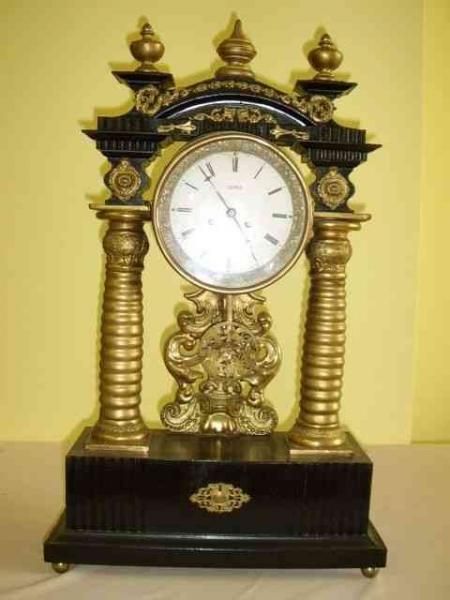
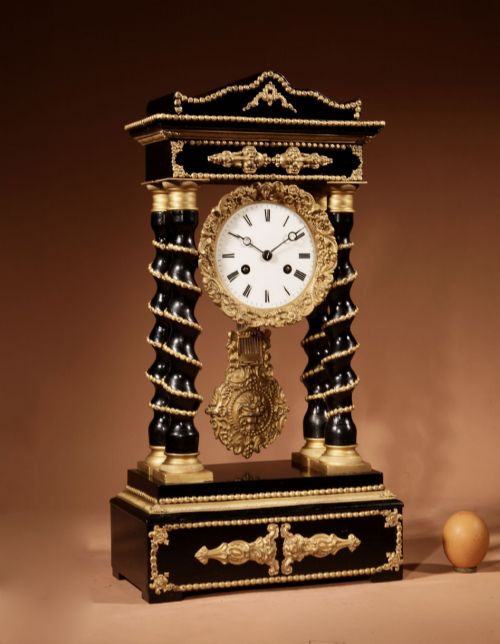
An ebonised portico clock is an architectural timepiece of pillars and pediments that brings dramatic contrast and precise French movement to a mantelpiece.
What an ebonised portico clock is
An ebonised portico clock stands as a distinct architectural form within the broader category of mantel clocks, defined by twin columns supporting a central dial housing. These pieces emerge from the 18th century, the 19th century, and the Victorian era, carrying the influence of French Empire design and 19th century French taste.
The version most commonly met on this page is the French portico clock, often housed beneath a glass dome and finished in dark ebonised wood accented with gilt bronze, ormolu, brass, or inlaid stone.
Makers such as Leroy produced notable examples, occasionally incorporating musical movements alongside traditional timekeeping. The architectural silhouette ranges from restrained classical proportions to impressive, gilded interpretations.
How they were made
The construction relies on ebonised wood for the structural columns and base, often enhanced with ormolu, gilt bronze, and brass mounts. Enamel dials provide a clear surface for the hands, while glass domes protect the delicate architecture from dust.
Craftsmen during the Empire period and the 19th century employed specialised finishing techniques to stain timber deep black, mimicking ebony, before applying gilt details to the capitals, bases, and pendulum bezels.
Retail Price Guide 2026
Typical UK retail prices for ebonised portico clock, calculated from the Sellingantiques database of over a million retail prices indexed since 2003. This retail price guide relies exclusively on Sellingantiques data; no external sources or auction records are used, so the figures do not describe the wider market.
The listings here span the 18th century, the 19th century, and the Victorian era, uniting French Empire style with ebonised wood and glass domes.
What varies in quality
The distinction between standard examples and the finest pieces rests upon the crispness of the gilt bronze or ormolu mounts and the depth of the ebonised finish on the wood. Superior clocks display refined casting and heavier architectural proportions rather than flat, plain surfaces.
Movement complexity also elevates a piece, particularly where musical capabilities are integrated into the portico structure. The presence of original matching components, including the glass dome and pendulum, marks the higher tier of survival.
Leroy
The Ebonised Portico Clock Glossary
- Ebonised wood
- Timber treated with stain or lacquer to achieve the dark, dense appearance of ebony. This finish was widely favored in French Empire and Victorian cabinet making.
- Portico clock
- A mantel clock designed with architectural columns and a pediment resembling a classical portico. The pendulum typically swings visibly between the supporting pillars.
- Ormolu
- Gilded bronze produced by applying a mercury and gold amalgam to cast bronze and firing it. This technique creates a durable, rich golden surface found on finer clock mounts.
- Enamel dial
- A clock face made by fusing powdered glass onto a metal base at high temperatures. These dials offer a smooth, durable white surface for painted numerals.
- Glass dome
- A blown glass cover placed over a clock to protect the movement and delicate exterior from dust and damage. They sit upon a fitted wooden or cloth-lined base.
Frequently Asked Questions
How do portico clocks work?
A portico clock operates through a weight-driven or spring-driven mechanical movement housed within the central entablature or pediment. The pendulum hangs freely between the supporting pillars, visible through the central opening as it swings.
Most examples rely on a traditional anchor escapement to regulate the gear train. Winding is typically performed via small arbors on the enamel dial using a matching key.
Where should I place a portico clock?
These clocks belong on a stable mantelpiece, sideboard, or console table where their architectural symmetry can be appreciated from the front and sides. Because many examples are relatively tall and narrow, ensure the supporting surface is entirely level.
Keep the clock away from direct sunlight and draughts to protect the ebonised finish and internal oils. If the piece includes a glass dome, allow sufficient vertical clearance above the display.
Are these clocks French in origin?
The majority of portico clocks follow French design traditions, particularly the French Empire style and 19th century Parisian workshop practices. Makers exported these architectural timepieces widely across Europe during the Victorian era.
Stylistic markers such as ormolu mounts, enamel dials, and distinct column capitals point directly to these continental manufacturing centres. Even when retailed elsewhere, the movements and cases generally reflect French workmanship.
How do I date a portico clock?
Dating relies on examining the materials, movement construction, and stylistic motifs present in the case architecture. Pieces from the late 18th century and early 19th century often display sharper Empire proportions, while mid to late 19th century and Victorian examples vary in their use of gilt bronze and inlaid stone.
Signatures on the enamel dial or backplate can also point to specific makers or working periods. Comparing the mounting techniques against known archives helps narrow the era of production.