

French Marquetry Writing Table
A french marquetry writing table brings floral wood-inlay and serpentine curves into a room, serving as both a functional desk and a decorative centrepiece.

French Marquetry Writing Table
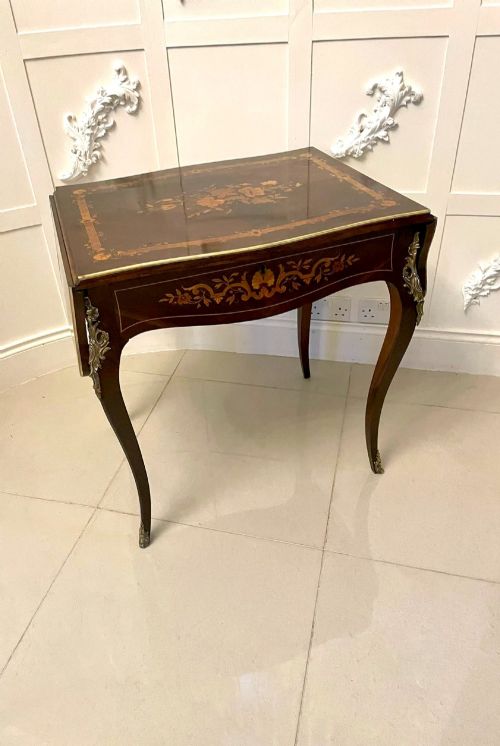
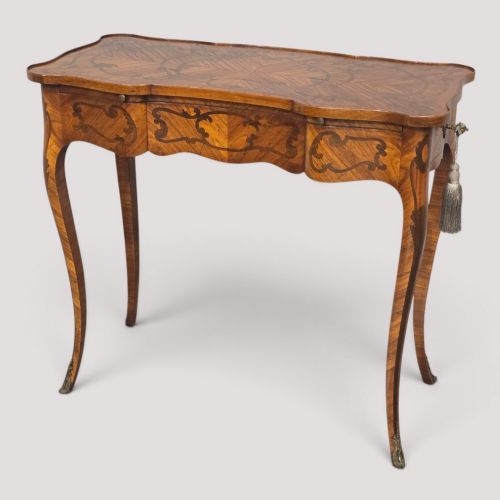
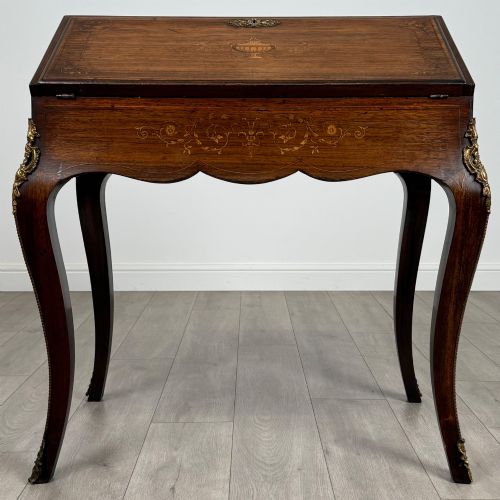
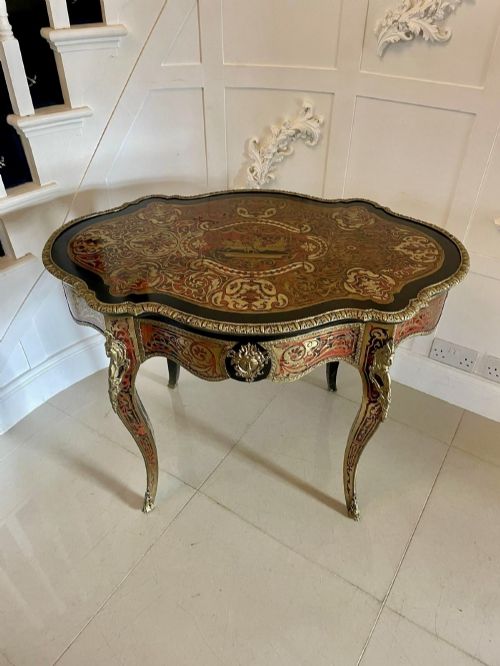
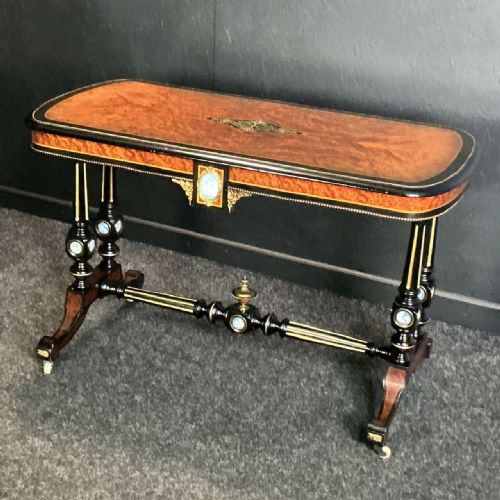
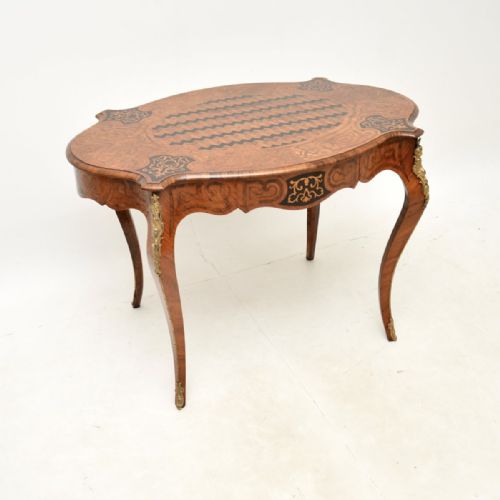
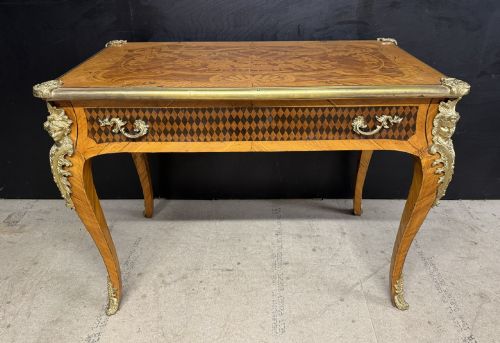
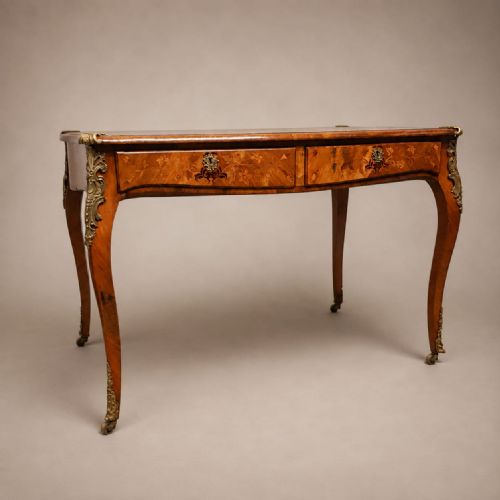
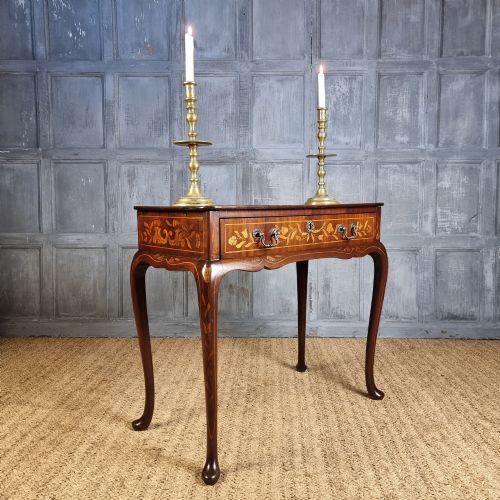
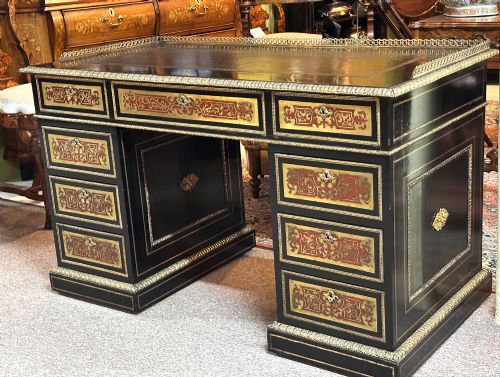
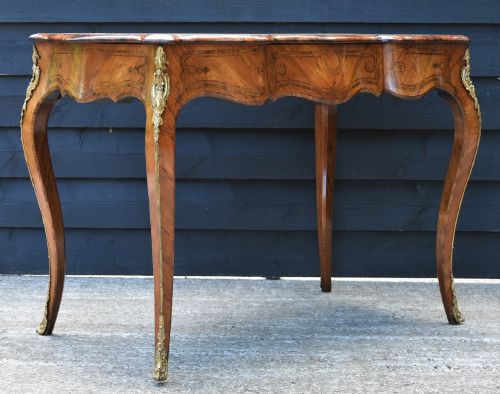
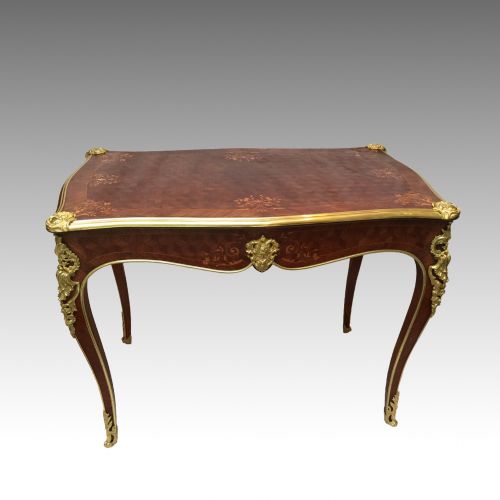
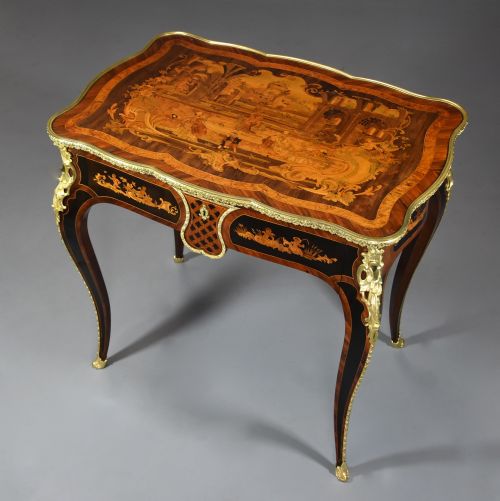
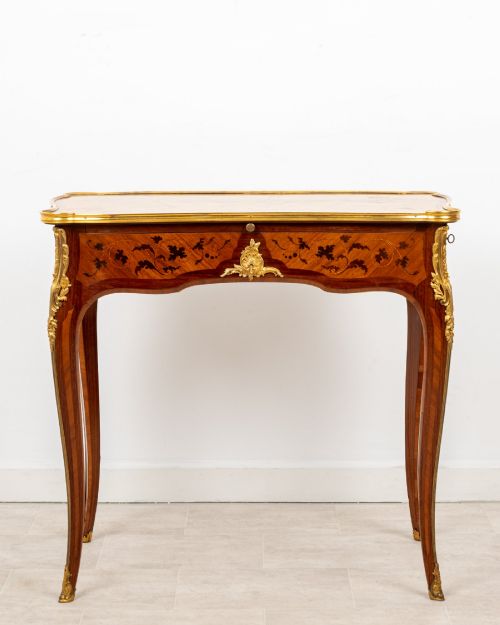
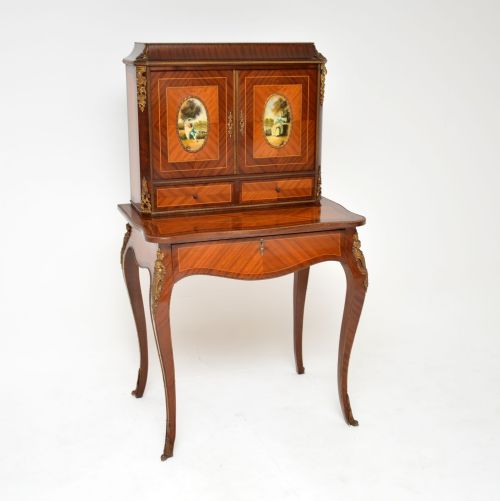
A french marquetry writing table takes several forms across the inventory, ranging from bureau plat desks and freestanding centre tables to smaller bureau de dame and bonheur du jour designs. Most examples encountered on this page belong to the nineteenth century, particularly the decades surrounding eighteen-eighty, drawing heavily on Louis XV and Louis XVI stylistic revivals.
These pieces function primarily as writing surfaces or library tables, often fitted with leather inserts and delicate drawers. The selection spans straightforward writing desks to ornate serpentine side tables and games tables, reflecting the diverse domestic needs of past centuries.
How They Were Made
Cabinetmakers built these tables using foundational carcases of walnut, burr walnut, or oak, layered with fine veneers of kingwood, rosewood, satinwood, and tulipwood. Floral and geometric marquetry patterns were meticulously hand-cut from contrasting timbers and set flush into the surface.
Gilt bronze and ormolu mounts were cast and chased to edge the drawers, corners, and legs, often paired with cast brass sabots. Leather writing inserts were frequently tooled and gilt at the borders to complete the upper surface.
French Marquetry Writing Table Retail Price Guide 2026
Typical asking prices for french marquetry writing table among the pieces listed under this phrase on Sellingantiques today, from the lower quarter to the upper quarter. They describe what is for sale here now, not the wider market.
Primary materials include kingwood, rosewood, and walnut veneers paired with ormolu mounts and tooled leather writing surfaces.
What Varies in Quality
The sophistication of the marquetry design sets exceptional pieces apart from standard workshop output. Subtle shading in the wood veneers, achieved by scorching individual pieces in hot sand, creates depth and realism within floral motifs that flat inlay lacks.
The weight and crispness of the ormolu mounts indicate the standard of production. Finer tables exhibit deeply chased bronze mounts that follow the serpentine contours precisely, whereas simpler examples rely on cast metalwork with minimal hand-finishing.
Durand·Millet
The French Marquetry Writing Table Glossary
- Marquetry
- The art of applying decorative veneer pieces to a structural carcase to form pictorial or geometric designs. Unlike simpler parquetry, marquetry typically depicts floral sprays or elaborate scenes.
- Bureau Plat
- A freestanding writing table fitted with drawers across the frieze, designed to sit in the centre of a room rather than against a wall. These desks often feature leather-lined top surfaces.
- Ormolu
- Gilded bronze mounts applied to furniture edges, corners, and legs for both reinforcement and decoration. The technique involves coating cast bronze with a mercury-gold amalgam.
- Kingwood
- A dense, richly grained tropical timber native to Brazil, prized for its dark violet-brown tones and pale streaks. It frequently appears as a primary veneer on nineteenth-century pieces.
- Bonheur du Jour
- A small ladies' writing desk featuring a tiered superstructure with drawers, shelves, or a small cupboard above the main writing surface. These dainty pieces gained popularity during the mid-eighteenth century and subsequent revivals.
French Marquetry Writing Table: Frequently Asked Questions
What is a bureau plat?
A bureau plat is a freestanding writing table equipped with drawers beneath the writing surface. These tables are finished on all sides so they can stand in the middle of a room.
They generally feature a leather-lined top and ornamental bronze mounts along the legs and apron.
How do I care for marquetry?
Marquetry surfaces require protection from direct sunlight and extreme humidity changes to prevent the delicate veneer from lifting or cracking. Regular polishing with a quality wax preserves the timber.
Avoid placing wet items directly on the wood or leather top to prevent staining.
Are these tables sturdy enough for daily work?
Most nineteenth-century writing tables were built for daily use and remain robust enough for modern writing tasks or laptop work. The structural integrity depends on the original joinery and subsequent upkeep.
Care should be taken with older joints and delicate ormolu mounts during relocation.
How do I distinguish Louis XV from Louis XVI style?
Louis XV style furniture relies on asymmetrical curves, cabriole legs, and flowing rococo ornamentation. The overall silhouette is organic and serpentine.
Louis XVI style shifts toward neoclassical symmetry, straight tapered fluted legs, and geometric restraint with rectangular proportions.