


French Enamel Pendant
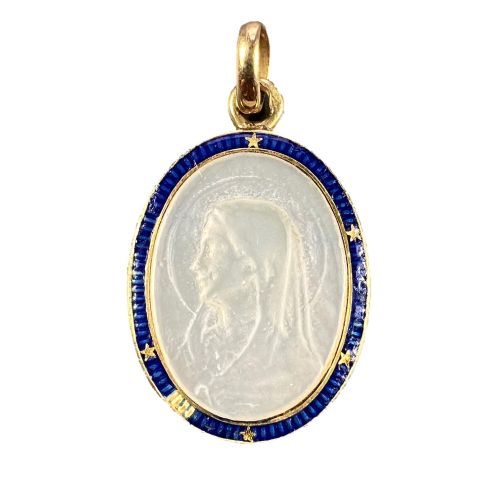
These french enamel pendant pieces combine rich metalwork and luminous coloured glass to form wearable charms, lockets, and devotional medals.
French Enamel Pendant
A french enamel pendant brings together small-scale goldsmithing and vitreous pigment work, most often taking the form of religious medals, lucky charms, or geometric modernist shapes. Buyers exploring this category encounter pieces originating from the Victorian era through the Art Deco period, with items from nineteen-ten appearing frequently.
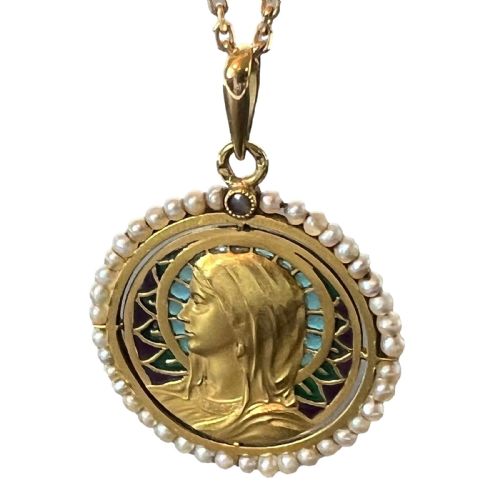
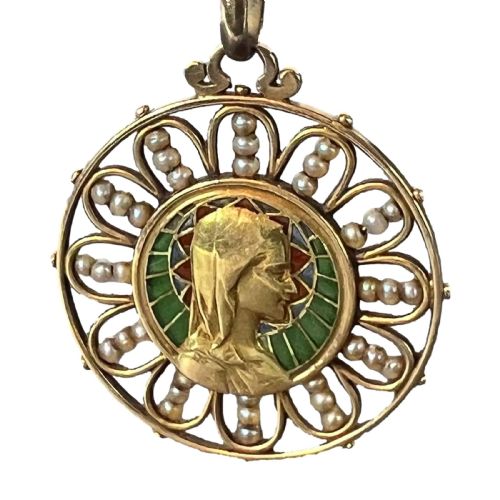
The assortment spans traditional devotional subjects such as the Virgin Mary alongside secular novelties like playing cards, dice, and love tokens. Many examples utilise eighteen-carat yellow gold and incorporate delicate seed pearls or miniature gemstones to frame the central glass design.
Materials and Techniques
Goldsmiths constructed the foundational mount in eighteen-carat yellow gold, shaping the metal into crosses, hearts, medallions, or folding frames. Vitreous enamel provides the surface colour, fused to the metal base under high heat to create a durable, glossy finish.
Plique-a-jour enamel is a notable technique seen across the pieces, executed without a backing metal so that light passes directly through the translucent coloured glass. Artisans also applied opaque red and white enamel for specific motifs, supplementing the design with seed pearls and painted miniatures.
Several charms feature working miniature dice and folding windows, turning a simple pendant into an interactive pocket puzzle.
Quality Variations
The refinement of the enamelling work dictates the distinction between standard items and superior examples, particularly in the precision of translucent plique-a-jour cells. Artisans who maintained strict control over firing temperatures achieved smooth surfaces free from cloudiness or heavy pitting.
The weight and gauge of the eighteen-carat gold mount also establish the calibre of the piece, alongside the complexity of secondary elements like seed pearls and miniature painted details. Stronger craftsmanship shows in the crispness of stamped maker marks and the balanced integration of metalwork with glass.
French Sellier
The French Enamel Pendant Glossary
- Plique-a-jour enamel
- An enamelling technique where the pigment is fired within open wire cells without a backing, producing a stained-glass effect that lets light pass through.
- Vitreous enamel
- A material created by fusing powdered glass to a metallic substrate through high-temperature firing, resulting in a smooth and permanent coloured surface.
- Seed pearl
- A very small, naturally occurring or cultured pearl often used as a delicate border or accent on nineteenth and early twentieth-century jewellery.
- Medal
- A flat, coin-like pendant typically stamped with religious iconography, civic crests, or commemorative imagery.
- Art Deco
- A design style prominent during the nineteen-twenties characterised by stylised geometric forms, clean lines, and modernist motifs.
French Enamel Pendant: Frequently Asked Questions
What is plique-a-jour enamel?
This method suspends translucent enamel within an open wire framework, creating a delicate window effect.
Light shines directly through the coloured glass, mimicking the appearance of miniature stained glass windows.
How do I date these pendants?
Stylistic indicators such as Art Nouveau curves or Art Deco geometry provide the primary chronological markers.
French gold control marks and the specific subject matter, from Victorian devotional scenes to nineteen-twenties novelties, further narrow the period.
Are these pieces made of solid gold?
The majority of items in this category utilise eighteen-carat yellow gold for the primary structure and decorative mount.
This high gold purity ensures lasting durability alongside the rich colour characteristic of the period.
What subjects appear on the medals?
Devotional imagery featuring the Virgin Mary and the Madonna and Child is common among the surviving pieces.
Secular charms also appear, including playing cards, dice, love tokens, and civic coats of arms.