

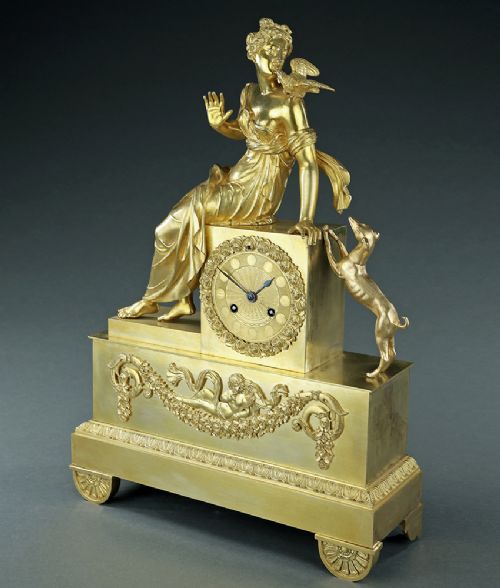


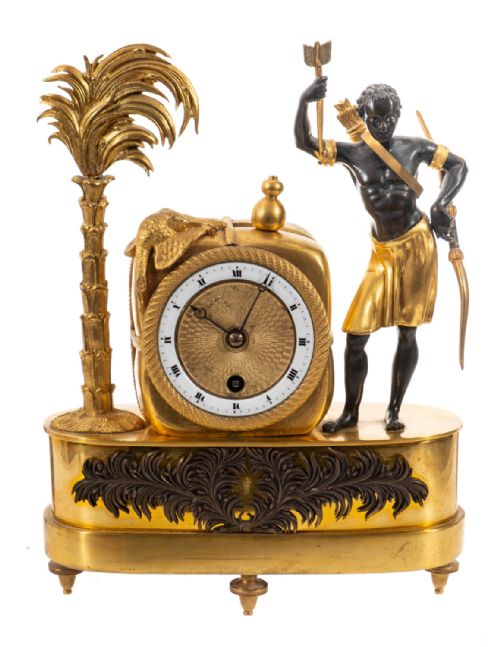


French Empire Period Timepiece
A french empire period timepiece brings classical mythology and commanding presence to a room, cast in heavy gilt and patinated bronze.
French Empire Period Timepiece
A french empire period timepiece takes the form of a heavy mantel clock or portico clock, often built around allegorical subjects like love and fidelity, classical figures, or exotic themes in the Turkish taste. These works draw on the French Empire, Regency, and French Directoire styles, bringing substantial architectural and figurative presence to a mantelpiece.
Most examples found here date from the nineteenth century, including specific decades around eighteen-twenty and eighteen-thirty with movements striking on bells or using silk suspension. Buyers encounter figural subjects ranging from lions and explorers to goats and palm trees, housed in architectural bronze and marble cases.
Judging quality and execution
The sophistication of the movement and the integration of the figural subject with the architectural case separate standard production from exceptional pieces. Signed movements by notable makers and complex allegorical compositions elevate the stature of an individual clock.
French Empire Period Timepiece Retail Price Guide 2026
Typical asking prices for french empire period timepiece among the pieces listed under this phrase on Sellingantiques today, from the lower quarter to the upper quarter. They describe what is for sale here now, not the wider market.
Several clocks depict unusual companions, including goats, palm trees, and an explorer in the Turkish taste.
Pons de Paul·Baltazart·Ravrio·FB Adams London
The French Empire Period Timepiece Glossary
- Ormolu
- Gilded bronze produced by applying a mercury and gold amalgam to a bronze base and heating it until the mercury vaporised. This technique leaves a durable, rich golden surface characteristic of the period.
- Patinated bronze
- Bronze treated with chemical solutions to darken the surface to a deep brown or black tone. It provides a striking visual contrast against bright ormolu mountings.
- Fusee
- A conical pulley used in clock movements to maintain an even pull on the gear train as the mainspring unwinds. This mechanism improves timekeeping consistency across the running period.
- Silk suspension
- A method of hanging the pendulum from a small loop of silk thread rather than a metal spring. This delicate arrangement appears frequently in early nineteenth-century French clock movements.
- Portico clock
- A clock design featuring an architectural case supported by four columns resembling a classical portico. The pendulum often swings visibly within the open space between the pillars.
French Empire Period Timepiece: Frequently Asked Questions
What is a french empire period timepiece?
A french empire period timepiece is a heavy decorative clock cast in bronze and ormolu, drawing on classical motifs and allegorical subjects from the early nineteenth century.
These clocks served both as precise instruments and as grand sculptural centrepieces for formal rooms.
How do I wind an antique clock?
Winding requires using the correct key on the arbors in the dial face, turning gently until resistance meets the stop.
Care must be taken not to overwind the mainspring, particularly on fragile or historical movements.
Where should I place a heavy bronze clock?
A heavy bronze and marble clock needs a stable, level surface such as a sturdy mantelpiece or a strong console table capable of supporting substantial weight.
Direct sunlight and damp environments should be avoided to protect the mercury gilding and internal metalwork.
How do silk suspension clocks work?
Silk suspension hangs the pendulum from a woven silk thread attached to an adjustable barrel at the top of the movement. This system regulates the swing of the pendulum and allows fine adjustment of the clock's speed.