

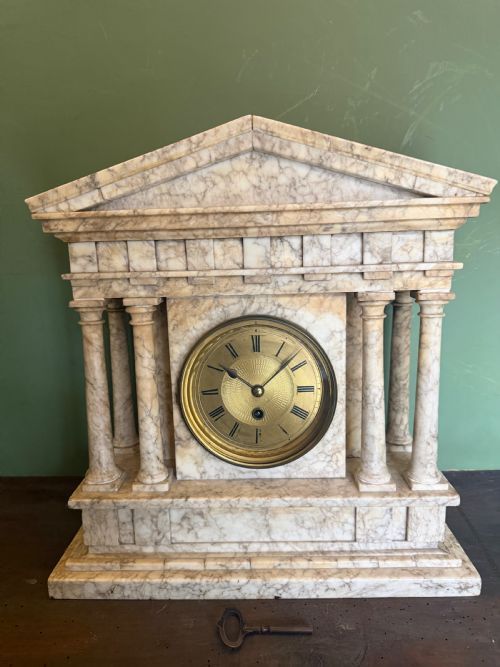
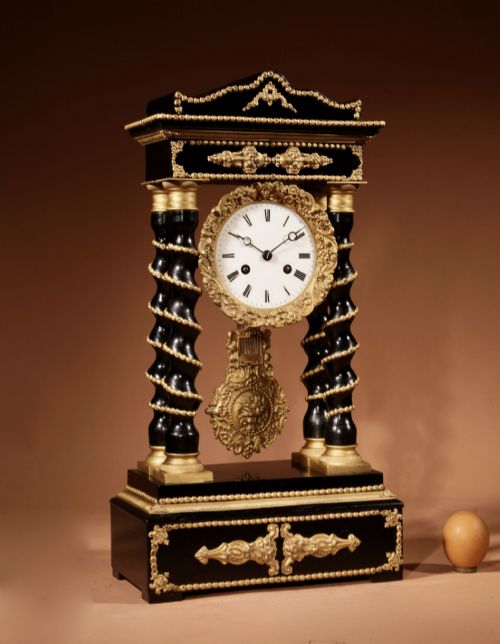
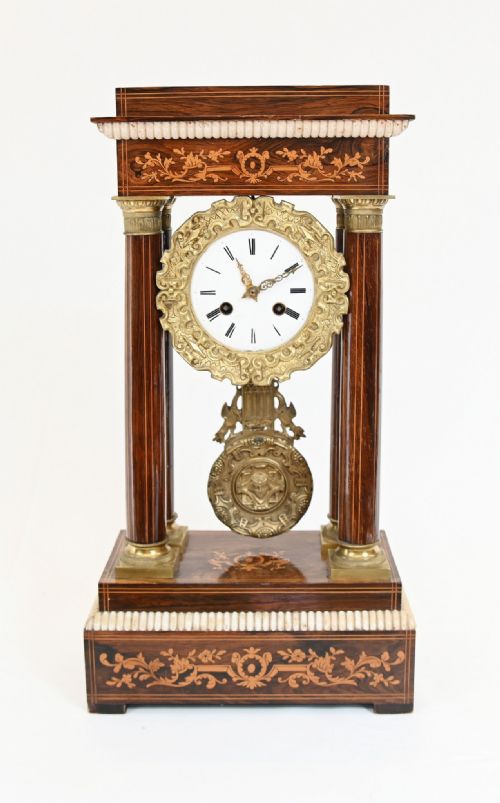


Architectural French Portico Clock
An architectural French portico clock stands as a stately household timepiece, prized for its columned frames and balanced neoclassical geometry.
Architectural French Portico Clock
An architectural French portico clock is a distinct mantel timepiece defined by its tall, columnar support structure framing a central pendulum. Buyers seeking an architectural French portico clock often find examples ranging from the austere balance of the Charles X period through to ornate Victorian iterations.
The architectural French portico clock typically takes the form of a mantel clock housed within wooden or metallic uprights. These pieces draw heavily on Neoclassical and French Empire design principles, creating a commanding visual presence on any shelf or surface.
Materials and construction
Maker workshops constructed the main body of an architectural French portico clock using dense timbers such as mahogany, rosewood, and ebonised wood, frequently enhanced with contrasting marquetry or inlay. Ormolu and gilt bronze mounts were then cast and applied to the base, capitals, and bezels to provide metallic contrast against the timber columns.
Movements within an architectural French portico clock rely on precision brass gear trains, sometimes incorporating knife edge suspension or single fusee mechanisms to regulate time accurately. Enamel, silvered, and cut crystal elements complete the dial faces and glazing, protecting the delicate internal mechanics.
Architectural French Portico Clock Retail Price Guide 2026
Typical asking prices for architectural french portico clock among the pieces listed under this phrase on Sellingantiques today, from the lower quarter to the upper quarter. They describe what is for sale here now, not the wider market.
Judging quality and execution
The refinement of cast ormolu and the precision of wood inlay dictate the upper tier of these timepieces. Pieces featuring crisp gilding, tightly joined rosewood or mahogany carcases, and original components command greater appreciation than later modifications or simpler timber frames.
The sophistication of the internal movement further separates standard examples from exceptional ones. Clocks retaining specialised escapements, such as knife edge suspension, or integrated single fusee mechanisms demonstrate superior horological ambition.
The Architectural French Portico Clock Glossary
- Portico
- A columnar porch or structure supporting a roof, which in horology describes the architectural frame enclosing the pendulum.
- Ormolu
- Gilded bronze or brass, heavily utilised for decorative mounts and decorative trim across nineteenth-century French furniture and clocks.
- Fusee
- A conical pulley used in clock movements to maintain equal driving force as the mainspring unwinds.
- Ebonised
- Wood treated with a dark stain or finish to imitate true ebony, popular in formal nineteenth-century cabinetry.
- Marquetry
- Decorative veneer applied to a timber carcase in intricate patterns, seen on select clock bases and pediments.
Architectural French Portico Clock: Frequently Asked Questions
What periods do these clocks cover?
The pieces span from the late eighteenth century through the nineteenth century, encompassing Charles X, French Restoration, Napoleon III, and Victorian eras. Each period brings subtle shifts in timber choice, column thickness, and decorative bronze mounts.
Earlier examples often lean towards neoclassical austerity with mahogany and ormolu, while later Victorian and Napoleon III pieces frequently incorporate ebonisation, intricate marquetry, or heavier patinated bronze finishes.
How do I care for the wood and ormolu?
Dust the timber and metal surfaces gently with a dry, soft cloth to prevent particulate buildup. Avoid using commercial polishes or liquid cleaners, which can strip historic patination from both the wood and the gilt bronze.
Keep the clock away from direct sunlight and fluctuating heat sources such as radiators. Extreme environmental changes cause wood to warp and can destabilise delicate veneered surfaces over time.
Are these clocks suitable for daily use?
These timepieces function well as working clocks provided they receive correct setup and occasional professional servicing. Many retain their original movements and suspension systems in active working order.
Because they are antique mechanical objects, regular monitoring of the mainspring and pendulum beat is recommended. Treat them as heritage items rather than modern utility timepieces.