




French Empire Chiffonier
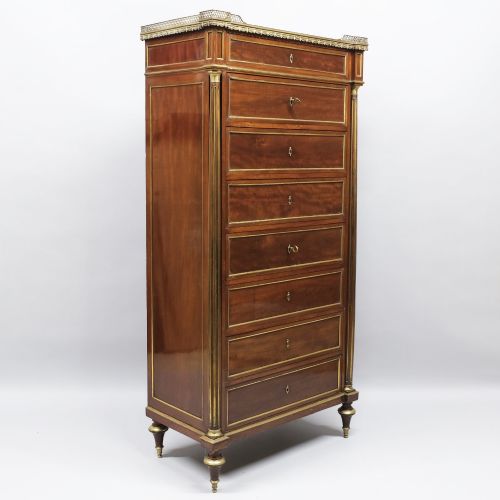
A french empire chiffonier brings neoclassical dignity and disciplined storage to a room through rich mahogany, flame mahogany veneer, and polished marble.

French Empire Chiffonier
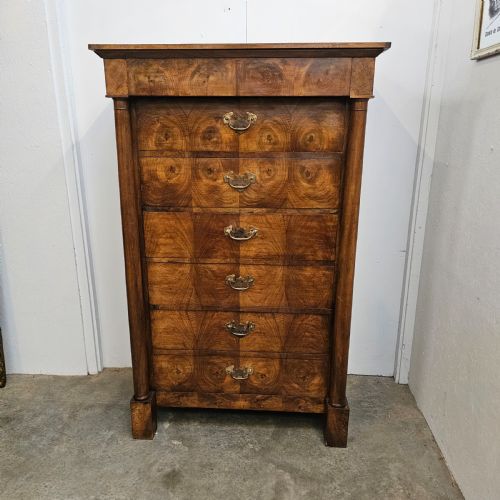
A french empire chiffonier is a tall storage cabinet designed for domestic utility, typically presenting a vertical stack of drawers or enclosed shelves beneath a flat stone top. These pieces emerge from the nineteenth century, bearing the architectural restraint and formal symmetry characteristic of the period.
The versions most commonly met on this page belong to the nineteenth century and the Regency era, constructed from dark hardwoods and fitted with metal mounts. Alongside the chiffonier proper, buyers frequently encounter related forms such as the semainier, tall chests of drawers, and side cabinets sharing the same vocabulary of design.
Originating largely within French workshops spanning the Napoleonic era through the Napoleon III and Louis Philippe periods, these items served as practical storage for linen, papers, or small valuables. Their presence anchors a room with sober proportions and dark timber surfaces.
How they were made
Cabinetmakers built these pieces using solid mahogany, walnut, and rosewood over robust structural carcasses, frequently applying bookmatched flame mahogany veneer to large flat surfaces to create symmetrical grain patterns. Ebony and satinwood stringing sometimes provide contrasting borders, while brass and ormolu mounts punctuate the corners, keyhole escutcheons, and drawer pulls.
Heavy slabs of marble, most often white or grey, form the top surfaces, providing a cool, durable counter to the timber below. Joinery relies on traditional dovetailing for the drawer construction and precise framing for the vertical sides, ensuring stability across tall, narrow proportions.
Some tall chests feature seven drawers designed so householders could store a different set of linens for each day of the week.
What varies in quality
The distinction between tiers of quality rests upon the selection of timber and the precision of the veneer work, where bookmatched figuring executed across multiple drawers commands greater regard. The crispness of cast ormolu mounts and the weight of the marble top further separate standard workshop production from finer examples.
Structural integrity in tall forms like the semainier or chiffonier depends on sound internal framing and true-running drawers that operate smoothly within their housings. Subtle details, such as the use of contrasting ebony accents or integrated locking mechanisms, denote a higher grade of craftsmanship.
The French Empire Chiffonier Glossary
- Semainier
- A tall chest of seven drawers, traditionally one for each day of the week. This form offers upright storage with a compact footprint.
- Ormolu
- Gilded bronze used for decorative mounts and accents on furniture. The technique involves applying a gold amalgam to cast bronze before heating.
- Bookmatching
- A veneer technique where adjacent slices of timber are opened like a book to mirror each other's grain pattern. This creates symmetrical decorative designs across drawer fronts.
- Escutcheon
- A protective plate surrounding a keyhole. On these pieces, they are frequently cast in brass or ormolu to match other hardware.
- Breakfront
- A cabinet design where the central section projects forward from the flanking wings. This architectural arrangement adds depth and shadow to the facade.
French Empire Chiffonier: Frequently Asked Questions
What is a french empire chiffonier used for?
These cabinets provide vertical storage for linen, silver, or personal papers within a drawing room, bedroom, or hallway.
The flat marble top also serves as a surface for displaying lamps, clocks, or decorative objects.
How do I identify a nineteenth century piece?
Authentic nineteenth century examples rely on period timber selections like mahogany, walnut, and rosewood combined with hand-cut dovetail joinery.
Stylistic cues such as austere neoclassical lines, ormolu mounts, and heavy marble tops align with the French Empire and Napoleon III eras.
Where should I place a tall chest?
Their tall, narrow proportions suit wall spaces where floor area is limited but vertical presence is desired.
They pair well with traditional interior schemes that benefit from dark timbers and restrained classical styling.
How do chiffoniers differ from sideboards?
Chiffoniers are typically taller and narrower, focusing on stacked drawer storage rather than wide serving surfaces.
Sideboards offer broader proportions intended for dining room utility and storage of larger tableware.