
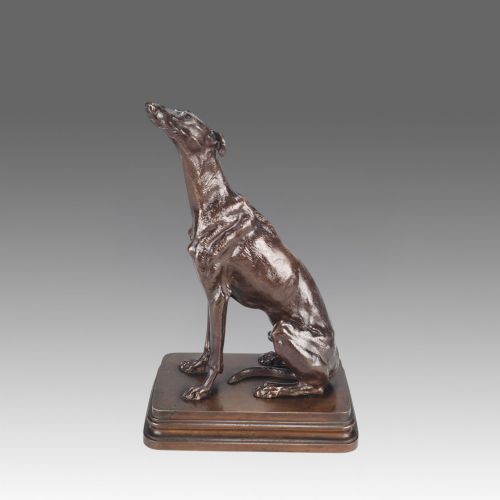
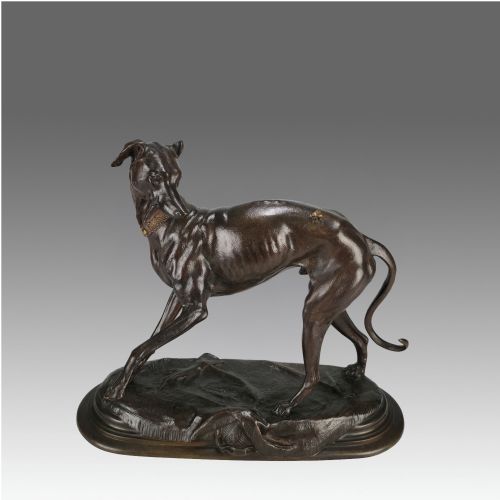


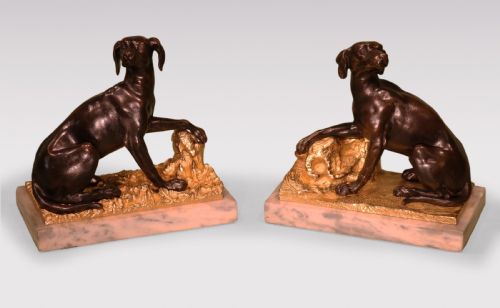
French Bronze Hound Statue
A french bronze hound statue captures canine anatomy with spirited realism, bringing sculptural authority and historic charm to any mantel or desk.
French Bronze Hound Statue
A french bronze hound statue embodies the nineteenth-century animalier movement, focusing on the realistic depiction of dogs in repose or during the hunt. These sculptures portray greyhounds, bassets, setters, and sighthounds with careful attention to muscular tension and bone structure.
The objects take several forms, appearing as solitary seated figures, resting animals paired with prey such as birds or flies, or larger group compositions. Many sit on heavy stone supports, anchoring the metalwork with substantial weight.
Most examples originate from the nineteenth century or the early twentieth-century art deco era. Buyers encounter works cast in genuine bronze alongside alternative cast metals.
Materials and casting methods
Foundries utilised the lost-wax casting method or sand casting to achieve fine detail in the animal coats, collars, and surrounding ground. Molten bronze was poured into moulds taken from sculpted models, allowing artists to capture subtle textures in the fur.
Patination was applied to the finished metal surfaces, producing varied brown, green, and dark tones that mimic natural shading. Ormolu highlights and cast iron occasionally appear alongside the primary metal.
Sculptures are frequently mounted on marble or onyx bases, providing a stable foundation and a contrasting polished perimeter to the dark metal figures.
Several hounds share the room with unexpected companions, captured mid-chase after a fly or guarding a small ball.
Evaluating quality and finish
The integrity of the patination contributes significantly to the visual depth of the sculpture, with superior examples showing rich, even colouration rather than flat or uniform paint. The weight and quality of the supporting marble or onyx base also reflect the standing of the original production.
Alfred Dubucand·Alfred Barye·Pierre Jules Mene·Auguste Nicholas Cain·Arthur Waagen·Geo Maxim·Antoine Louis Barye·Joseph Francois Victor Chemin·Christophe Fratin
The French Bronze Hound Statue Glossary
- Animalier
- A nineteenth-century artistic movement dedicated to the realistic portrayal of animals, particularly in sculpture. Practitioners focused on capturing wildlife and domestic breeds in motion or repose.
- Patina
- The chemical or natural surface coloration applied to bronze over time. This layer protects the metal and defines the visual tone of the sculpture.
- Lost-wax casting
- A historic method where a molten metal is poured into a mould that has been created by means of a wax model. The wax is melted and drained away to receive the metal.
- Ormolu
- Gilded bronze, where finely ground gold is applied to a bronze base using a mercury amalgam. This technique adds a bright golden finish to decorative details.
- Spelter
- A zinc alloy frequently utilised as a substitute for bronze in decorative figures. It is softer and lighter than true bronze.
French Bronze Hound Statue: Frequently Asked Questions
What materials are used?
These sculptures are primarily cast in bronze, patinated metal, or spelter. Many feature bases made from marble, onyx, or cast iron.
Secondary elements may include ormolu highlights or patinated bronze finishes that accentuate the texture of the animal coats.
How do I date them?
Dating relies on stylistic markers and foundry signatures, ranging from nineteenth-century animalier works to 1930s art deco pieces. Earlier nineteenth-century examples often focus strictly on naturalistic anatomy.
Later pieces from the twentieth century frequently incorporate geometric art deco styling or distinct running human figures alongside the hounds.
Where were they displayed?
These statues were traditionally placed on desks, library tables, and mantelpieces in nineteenth-century homes. Fireside hunting dog statues specifically decorated hearth areas.
They served as decorative art objects that celebrated canine companionship and sporting pursuits.
What is animalier art?
Animalier art is a nineteenth-century genre focusing on realistic sculptures of animals. Artists studied anatomy closely to depict hounds and other subjects with lifelike accuracy.
This tradition produced detailed figures of resting, hunting, and playing dogs.