


French Bronze Hearth Accessories
French bronze hearth accessories bring sculptural weight and gilded detail to an active fireplace.
French Bronze Hearth Accessories
French bronze hearth accessories comprise decorative and functional metalwork designed for the fireplace, including pairs of chenets, fire dogs, and folding fire screens. These pieces serve to support logs and protect the room from stray embers while introducing ornamental metalwork to the chimney breast.
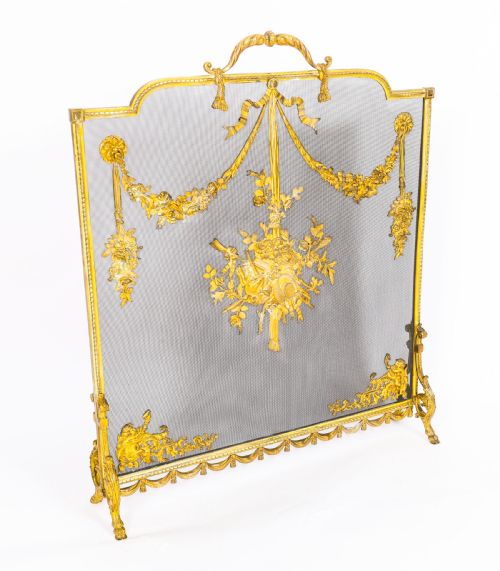
The selections encountered here span the nineteenth century, drawing heavily on Regency, Louis XV, and Rococo design vocabularies. Buyers will frequently find matched pairs of chenets alongside gilt bronze fire screens featuring cast musical trophies or floral motifs.
How they were made
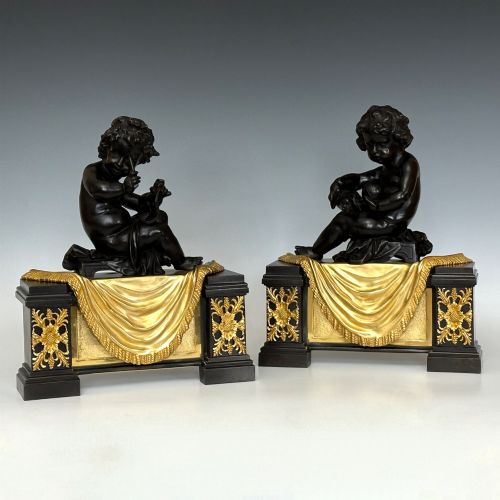
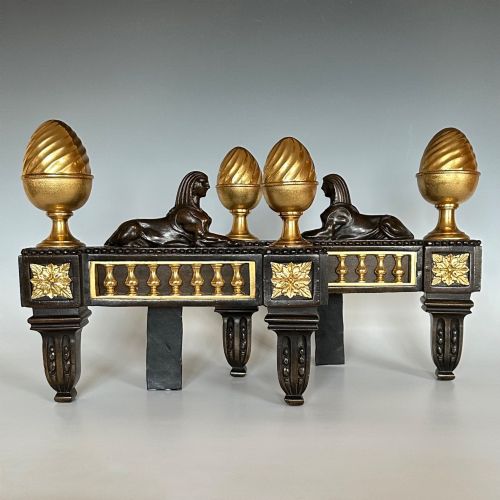
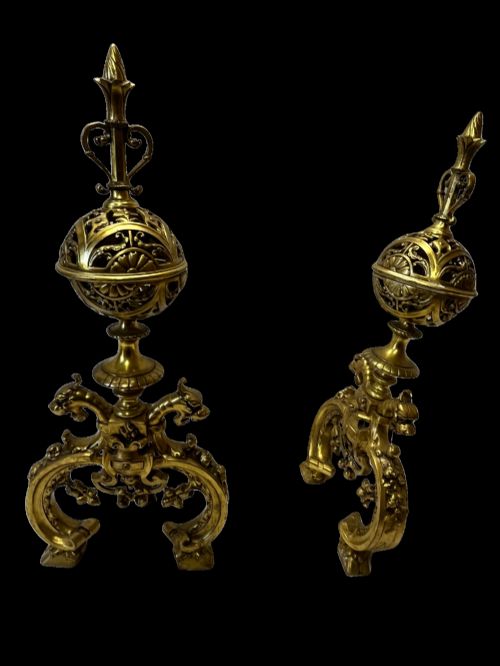
These items rely primarily on cast bronze, brass, and iron, often finished with fire gilding or ormolu to create contrasting surface textures. Patinated dark bronze frequently sits alongside bright gilt highlights, accentuating cast details like cherubs and scrolling foliage.
Many screens incorporate fine wire mesh panels held within decorative metal frames, while chenets combine heavy cast brass and iron bars designed to withstand direct hearth heat.
Several pieces feature cast cherubs standing guard over the hearth, watching the coals.
What varies in quality
Quality rests upon the crispness of the chasing and the depth of the casting, which determines how sharply details such as musical trophies and figural cherubs emerge from the metal. Finer examples retain their original fire gilding and ormolu finishes, showing precise hand-tooling across the bronze surface after casting.
Heavier gauge metal and substantial weight indicate superior construction, particularly in fire dogs and chenets meant to bear the physical demands of burning fuel. Lesser examples show softer cast definitions and more uniform, modern surface treatments.
The French Bronze Hearth Accessories Glossary
- Chenet
- An ornamental metal support placed on the hearth to hold logs, often synonymous with andirons. They form matched pairs flanking the fire.
- Ormolu
- Finely ground high-carat gold mercury-gilded to a bronze object. This technique yields a deep, enduring metallic lustre.
- Rococo
- A decorative style characterised by asymmetrical scrolls, C-curves, and naturalistic plant motifs. It heavily influences nineteenth-century French hearth hardware.
- Patinated bronze
- Bronze that has been chemically treated to alter its surface colour, usually towards dark brown or black. This finish contrasts sharply with gilt highlights.
French Bronze Hearth Accessories: Frequently Asked Questions
What is the difference between chenets and andirons?
Chenets and andirons perform the same function of supporting logs within the hearth, though the terms often reflect regional naming preferences. Both appear as matched pairs framing the fireplace opening.
In practice, items labelled as chenets in French metalwork frequently emphasise decorative front facades with figural or rococo ornament.
How do I use antique fire screens safely?
Antique fire screens with wire mesh panels primarily serve to catch sparks and shield the room from sudden flare-ups. They stand directly in front of the active fireplace opening.
Care should be taken with older frames and delicate gilt bronze mounts to avoid direct, prolonged exposure to excessive heat.
How do I identify Louis XV style pieces?
Louis XV style hearth accessories rely heavily on asymmetrical curves, shell motifs, and scrolling foliage. These designs avoid rigid symmetry in favour of fluid, organic movement.
Nineteenth-century revivals frequently adopted these eighteenth-century motifs for grand chateau interiors.
Can these accessories be used in a working fireplace?
Many bronze and iron chenets and fire dogs are structurally robust enough to hold firewood in an active hearth. The iron bars attached to the decorative fronts are built to withstand heat.
Wire mesh fire screens require careful placement to protect the historic metalwork from soot and extreme thermal shock.