


French Bronze Clock Set
When you select a french bronze clock set, you acquire a substantial mantel centrepiece accompanied by matched garniture urns or candelabra from the nineteenth century.
French Bronze Clock Set
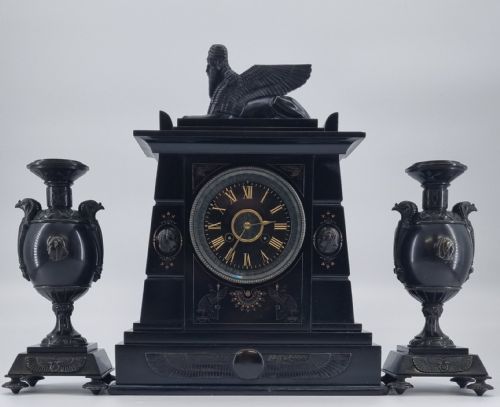
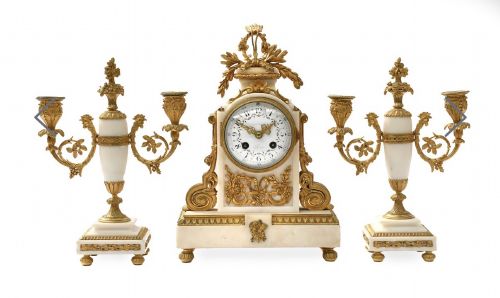
A french bronze clock set typically comprises a central mantel clock flanked by matching side ornaments such as candelabra or urns, creating a balanced decorative ensemble for a room. These arrangements appear frequently in nineteenth-century styles ranging from ornate Rococo and Baroque revivals to restrained Louis XVI and Egyptian Revival designs.
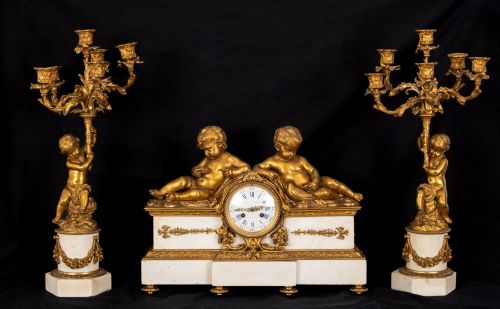
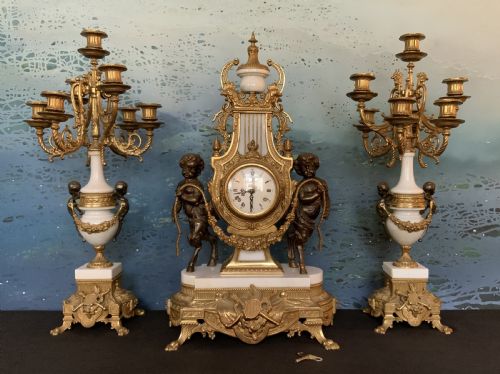
Makers often paired cast metal figures with contrasting bases of white marble, sienna marble, or onyx, sometimes incorporating glass domes to protect the more delicate components. The accompanying pieces repeat the motifs of the main timepiece, establishing a unified decorative scheme that dominated formal interiors of the period.
Materials and Construction
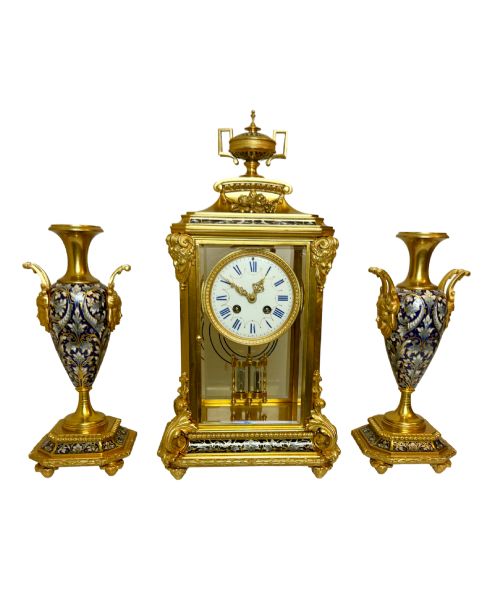
Foundries produced these assemblies using cast bronze or brass, applying mercury gilding or modern electroplating to create the bright ormolu surfaces characteristic of the better examples. Artisans combined these metallic elements with hand-carved stone plinths and enamel dials featuring Arabic or Roman numerals.
Movements came from specialised workshops, housing eight-day striking mechanisms that required precise gear cutting and assembly. Skilled metalworkers chased the cast bronze surfaces by hand to sharpen details before finishing the metal with patination or gilding.
Some nineteenth-century French bronze clock sets feature startled greyhounds or fire-breathing dragons guarding the clock face.
Evaluating Quality and Execution
The distinction between ordinary and exceptional sets lies in the depth and crispness of the bronze chasing, where sharper, deeper carving indicates superior hand labour by the foundry. Finer sets feature heavier gauge metals and solid marble bases rather than lighter plated substitutes.
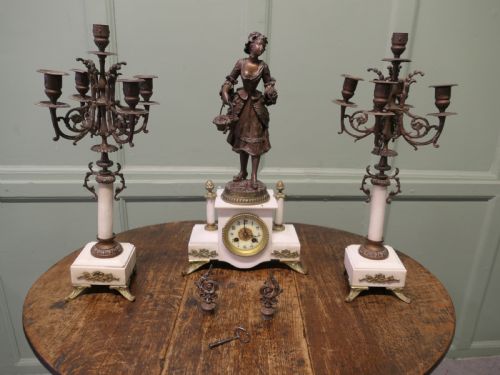
The integration of the garniture pieces with the central clock reveals the ambition of the original commission, with top-tier examples incorporating signed movements from notable makers and elaborate multi-light candelabra rather than simple side urns.
Henry Dasson·Japy Freres·Samuel Marti·Louis Japy·A.D Mougin·H Luppens Paris
The French Bronze Clock Set Glossary
- Garniture
- A matched set of ornamental objects designed to be displayed together on a mantelpiece, usually consisting of a central clock and two matching side pieces.
- Ormolu
- Metal gilt with a gold amalgam using a mercury process, producing a rich golden surface finish common on nineteenth-century decorative bronzes.
- Champlevé
- An enamelling technique where troughs or cells are scooped out of a metal surface and filled with vitreous enamel before firing.
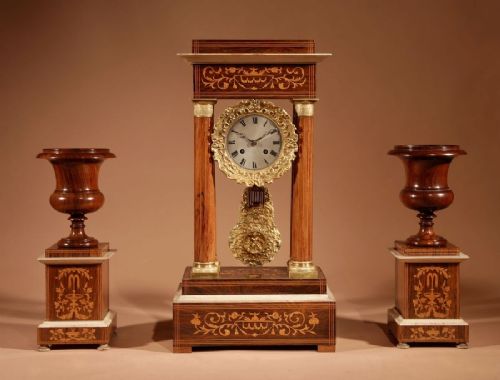
- Portico Clock
- A clock design featuring an architectural frame supported by four columns, often housing a pendulum suspended within the open central space.
- Candelabra
- Branched candlesticks designed to hold multiple candles, frequently supplied as the matching side pieces in a garniture set.
French Bronze Clock Set: Frequently Asked Questions
How do I maintain the clock movement?
Maintenance requires professional cleaning and oiling of the mechanical gear train every few years to prevent wear on the brass pivots. Avoid using harsh chemical polishes near the movement or the dial enamel.
Ensure the clock rests on a level surface so the pendulum swings evenly and maintains accurate timekeeping over its usual eight-day cycle.
Where should I display a garniture set?
These assemblies suit heavy mantelpieces, sideboards, or console tables where the central clock and matching side pieces create a symmetrical arrangement. Keep them away from direct sunlight and damp environments to protect the mercury gilding and marble surfaces.
Ensure the supporting furniture is sturdy enough to bear the substantial weight of the bronze and stone components.
How can I identify the period?
Stylistic cues such as classical columns point to Louis XVI revivals, while asymmetrical scrolling foliage indicates Rococo designs common in the middle decades of the nineteenth century. Examining the backplate of the movement often reveals maker stamps and serial numbers tied to known production dates.
The choice of materials, from heavy ormolu mounts to specific types of marble, helps narrow down the decade of manufacture.
What does signed mean on these pieces?
A signature usually appears stamped on the brass movement backplate or painted onto the enamel dial, identifying the workshop that produced the mechanism rather than the retailer. Retailers sometimes added their own names to the dial face where they sold the completed assembly.
Finding a documented maker mark adds historical context to the set and confirms the origin of the mechanical components.