


Vintage French Clock Set
A vintage french clock set brings a room together with a central timepiece and matching side pieces.
Vintage French Clock Set
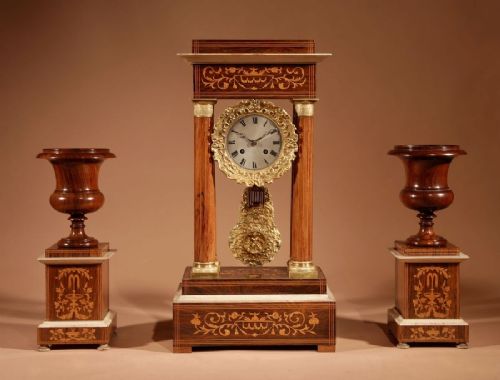
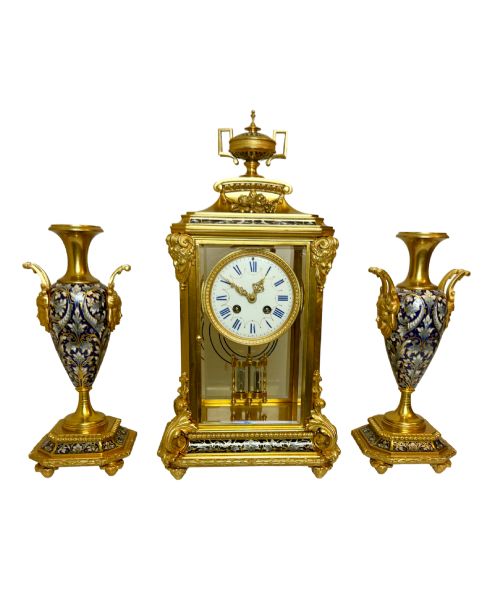
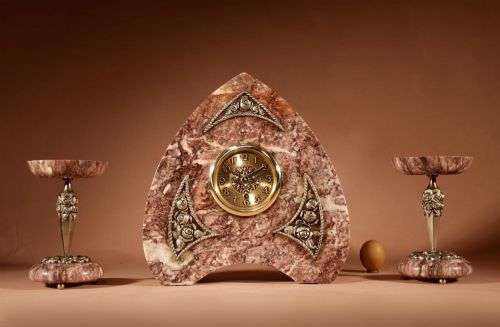
A vintage french clock set typically comprises a main mantel clock accompanied by a pair of matching side ornaments such as garnitures, urns, candelabras, or flanking sculptures. When searching for a vintage french clock set, buyers encounter configurations ranging from nineteenth century marble portico designs to twentieth century Art Deco examples.
The materials span from traditional white and pink marble, green onyx, and brass to gilt bronze, ormolu, champleve enamel, and spelter. These ensembles often include figural subjects, such as greyhounds, German shepherd dogs by sculptors like Michel Decoux, or elephants, alongside architectural desk compendiums and barometer combinations.
The periods represented stretch across the Victorian era, the nineteenth century generally, and twentieth century milestones including the 1920s and 1930s. Most pieces originate from French workshops adhering to styles such as Louis Philippe, Louis XVI, Second Empire, and Rococo Revival alongside geometric Art Deco lines.
Materials and construction
Construction relies heavily on dense substrates like marble, onyx, and glass paired with cast metal elements in brass, ormolu, gilt bronze, and silver-plated bronze. Movements are commonly eight-day striking mechanisms, sometimes featuring visible pendulums within glass housings or architectural portico frames.
Decorative surfaces incorporate champleve enamel details, hand-painted porcelain panels, and cast figural sculptures in spelter or bronze. The side pieces are manufactured to echo the materials and design motifs of the central clock, creating a cohesive three-piece or multi-piece garniture arrangement.
Greyhounds and German shepherds keep a watchful eye over time, proving that even French clockmakers appreciated a faithful hound on the mantelpiece.
Evaluating quality and execution
Quality separates simple production items from exceptional works through the crispness of bronze casting, the depth of gilding, and the selection of stones like grey breccia marble or green onyx. Superior examples feature integrated sculptural artistry, such as named animal bronzes or intricate architectural marble porticos.
The internal movement also dictates value, with eight-day striking movements and visible escapements commanding attention. Completeness matters greatly; sets retaining their original matching pair of candelabras, urns, or flanking sculptures maintain their intended decorative harmony.
The Vintage French Clock Set Glossary
- Clock garniture
- A central clock displayed with a matching pair of side ornaments, such as urns, vases, or candelabras. These sets were designed to sit symmetrically on a mantelpiece.
- Portico clock
- A mantel clock built in the architectural form of a classical portico with columns supporting an upper entablature. The pendulum typically swings visibly within the open central space.
- Champleve enamel
- A technique where troughs or cells are sunk into the surface of a metal object and filled with vitreous enamel powder before firing. This creates colourful decorative patterns across bronze mounts.
- Ormolu
- Finely ground high-carat gold mercury-gilded to a bronze object. It provides a rich, warm metallic finish seen on nineteenth-century French mounts.
- Spelter
- A zinc alloy frequently used as a cost-effective substitute for bronze in casting figural sculptures and clock cases. It is typically painted or electroplated to resemble bronze or brass.
- Desk compendium
- A multi-instrument desk accessory combining a clock with other functional dials such as barometers or thermometers. These pieces are often housed in architectural oak or marble cases.
Vintage French Clock Set: Frequently Asked Questions
What is included in a clock garniture?
A clock garniture consists of a main timepiece and a matching pair of decorative side pieces. These companions are usually urns, vases, or candelabras designed to match the clock's materials and style.
Placed together on a mantelpiece or sideboard, they create a balanced, symmetrical decorative display characteristic of French interiors.
How do I wind an eight-day French clock?
Most antique French clocks utilise an eight-day movement requiring a key to wind the springs once a week. You insert the key into the winding holes on the dial and turn gently until resistance is met.
Care should be taken not to overwind the mechanism, and it is best to consult the specific movement type before adjusting the hands or striking sequence.
Are Art Deco clock sets French?
Many Art Deco clock sets originate from France, combining geometric marble cases with metallic animal sculptures or streamlined silhouettes. These pieces date predominantly to the 1920s and 1930s.
They reflect the transition from ornate nineteenth-century revivals to modern, stylised forms while retaining the traditional three-piece garniture format.
How do I tell nineteenth century marble clocks apart?
Nineteenth century marble clocks vary by the type of stone used, ranging from plain white and pink marble to decorative green onyx and grey breccia. Earlier Victorian and Louis Philippe examples often feature classical architectural details like porticos.
Later nineteenth-century and turn-of-the-century pieces lean towards heavier, ornate castings, visible pendulums, and champleve enamel accents.