


French Bronze Cartel Clock
A french bronze cartel clock is an ornate wall timepiece driven by classical or flamboyant styling, designed to command a room.
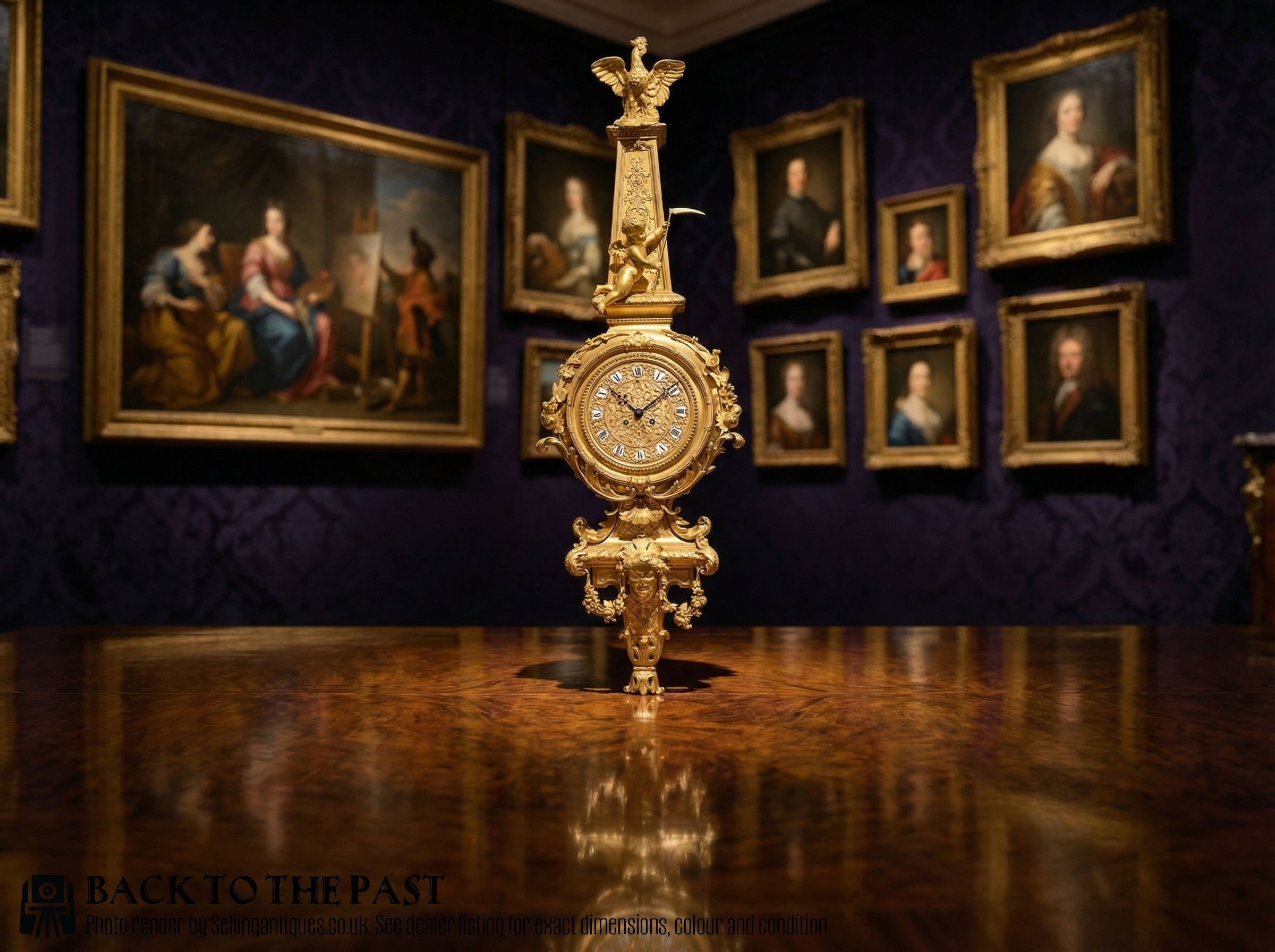
French Bronze Cartel Clock
A french bronze cartel clock is an opulent wall-mounted timepiece designed to serve as a principal decorative feature in a domestic interior. These pieces emerge predominantly from the nineteenth century, spanning distinct periods such as eighteen eighty and eighteen ninety, alongside Victorian manifestations.
The form is characterised by wall clock constructions that project outward from the plaster. Buyers encounter styles rooted in French Rococo, Louis the Sixteenth Neoclassical, and Baroque traditions.
Makers recorded in the archive include Japy Freres, Samuel Marti, Raingo Freres, and Henri Marc of Paris. Their works appear alongside substantial examples featuring bronze, ormolu, and gilt metal.
Materials and construction
The primary material framework relies upon bronze, brass, and cast ormolu, often enriched with fire gilding to achieve a lustrous metallic sheen. Artisans also incorporate glass panels to protect the dial, alongside enamel for the clock face numerals.
Surfaces frequently display elaborate hand-chased detailing characteristic of Rococo scrolls or Louis the Sixteenth symmetry. Some specialised variants integrate painted wood or tortoiseshell elements into the housing.
Hounds of the devil lurk among the traditional scrolls on at least one fierce gothic bronze creation.
Gradations in craftsmanship
The upper tier of the range is distinguished by the crispness of the bronze chasing and the depth of the gilding. Master founders achieved sculptural precision in asymmetrical scrollwork and figural motifs such as dragons.
Lesser examples exhibit softer cast definition and simpler metal alloys that lack the hand-finished brilliance of documented makers. The integration of movement signatures from established Paris houses elevates the standing of an individual piece.
Henri Marc of Paris·Japy Freres·Raingo Freres·Samuel Marti
The French Bronze Cartel Clock Glossary
- Cartel clock
- A wall-mounted clock housed in an ornate frame made of gilt bronze, brass, or wood. This format gained immense popularity in France during the eighteenth and nineteenth centuries.
- Ormolu
- Finely ground high-carat gold applied to a bronze base using a mercury amalgamation technique. It produces a rich golden finish that resists tarnishing over decades.
- Rococo
- An artistic style characterised by elaborate ornamentation, asymmetrical scrollwork, curves, and naturalistic plant motifs. It dominates many nineteenth-century French clock designs.
- Neoclassical
- A revival style drawing inspiration from classical antiquity, featuring restrained symmetry, urns, swags, and geometric lines. It defines the Louis the Sixteenth aesthetic.
- Chasing
- The art of refining a cast metal surface by hand using small steel punches and hammers. Superior chasing provides sharp contours and tactile depth to bronze ornament.
French Bronze Cartel Clock: Frequently Asked Questions
How do I hang a heavy cartel clock?
These timepieces require direct anchorage into structural wall studs or solid masonry using heavy-duty steel fixings. The substantial weight of cast bronze and internal mechanical movements demands secure support.
Avoid hanging them on drywall alone, as the pendulum vibrations and overall mass will compromise standard picture hooks over time.
Are these clocks suitable for daily use?
Most examples function reliably when professionally serviced, though mechanical movements require regular winding and occasional professional adjustment. They operate with pendulum mechanisms that demand a level wall surface to keep accurate time.
Many collectors maintain them as decorative focal points while running them intermittently for special occasions.
How do I distinguish Rococo from Louis XVI styles?
Rococo designs embrace asymmetry, flamboyant C-scrolls, and exuberant natural motifs without rigid geometric boundaries. They feel fluid and dynamic across the bronze case.
Louis the Sixteenth pieces return to strict symmetry, straight lines, architectural proportions, and classical ornamentation such as urns and laurel wreaths.
What is the difference between bronze and ormolu?
Bronze is the underlying copper and tin alloy cast into the decorative case shape. Ormolu refers specifically to the applied gold coating that gives the bronze its brilliant yellow-gold appearance.
Over years of handling, some pieces retain their full fire-gilded brilliance while others show warm bronze undertones where the gold layer has thinned.