
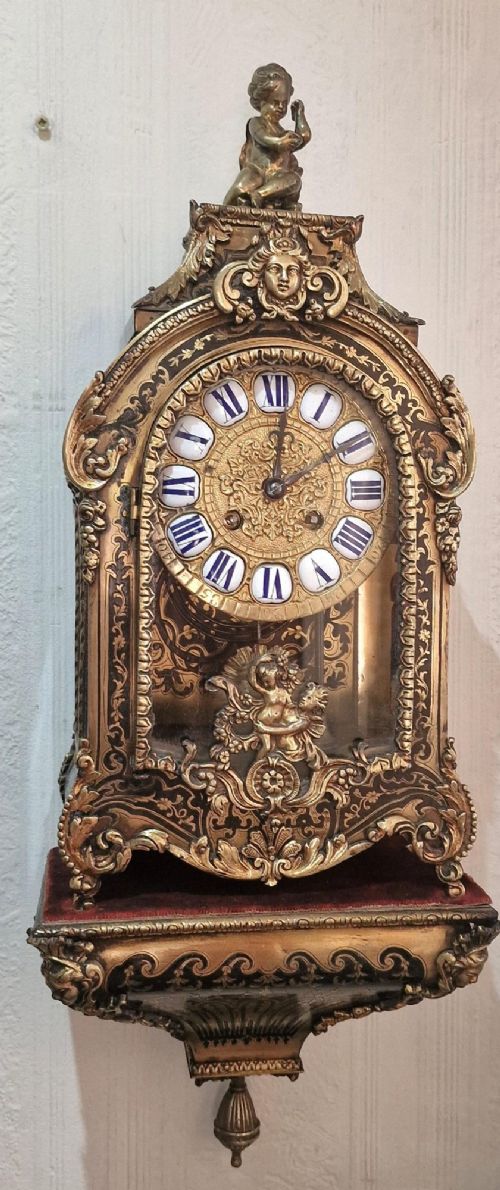


French Ormolu Wall Clock
A french ormolu wall clock brings dramatic gilt brass presence and precise nineteenth-century timekeeping to a room.

French Ormolu Wall Clock
When you search for a french ormolu wall clock, you encounter ornate cartel clocks and bracket clocks dating from the nineteenth century. These wall-mounted timepieces emerge in distinct stylistic revivals, notably French Rococo, Louis XVI, and Napoleon III.
The most common form on this page is the cartel clock, designed to hang directly on a wall via a secure bracket. You also find bracket clocks paired with their matching wooden wall shelves, sometimes incorporating tortoiseshell finishes.
Originating largely from Parisian workshops, these pieces draw upon classic decorative motifs such as scrolling foliage, dolphins, and neoclassical symmetry. They combine utility with sculptural metalwork that dominates the wall space they occupy.
Materials and construction methods
Makers constructed these clocks using cast bronze and brass, applying mercury gilding or chemical ormolu finishes to create the characteristic bright gold surface. Enamel dials, often featuring individual cartouches for the numerals, face behind protective curved glass covers.
Underneath the metal mounts, wooden carcases occasionally incorporate boulle work using tortoiseshell and brass inlay. Patinated bronze details contrast against the polished gilt bronze to emphasise depth within the cast ornament.
Several cartel clocks incorporate playful cast bronze dolphins creeping through the rococo scrolls.
Distinctions in craftsmanship
Quality rests upon the crispness of the bronze casting and the depth of the subsequent chasing work. Finer examples display sharply defined acanthus leaves and scrolls rather than soft, rounded edges resulting from worn moulds.
The integration of the movement with the case also marks the grade of the piece. Master makers housed movements that matched the heavy proportions of the gilt bronze mounts and bore signature stamps from renowned Parisian firms.
Henri Marc of Paris·Henri Dasson·Vincenti and Cie·Maison Bagues Paris
The French Ormolu Wall Clock Glossary
- Ormolu
- Gilt bronze produced by applying a mercury and gold amalgam to a bronze base and firing it. This technique creates a durable, luminous golden finish characteristic of French decorative arts.
- Cartel clock
- A wall-mounted clock featuring an ornate frame integrated into the case design. These clocks hang directly from wall hooks rather than resting on mantelpieces.
- Bracket clock
- A portable clock traditionally placed on a matching wall bracket or shelf. The surviving wall bracket often mirrors the inlay and timber of the main clock case.
- Boulle work
- A form of marquetry utilising tortoiseshell and brass inlay developed in France. It appears on several clock cases and matching wall brackets.
- Cartouche
- A small enamelled plaque bearing a single numeral on the clock face. Multiple individual cartouches are pinned to the dial background rather than numbers painted directly onto a single plate.
French Ormolu Wall Clock: Frequently Asked Questions
What is the difference between cartel and bracket clocks?
A cartel clock mounts directly to the wall as a single unified hanging object. Its decorative bronze frame incorporates the hanging mechanism within its own silhouette.
A bracket clock sits upon a separate projecting wooden shelf or bracket attached to the wall below it. This shelf often shares the same tortoiseshell and brass inlay as the clock case itself.
How do I tell Louis XV and Louis XVI styles apart?
Louis XV style pieces, often linked to French Rococo, feature asymmetrical curves, flowing natural forms, and scrolling foliage. The designs avoid straight lines in favour of organic movement and C-scroll motifs.
Louis XVI style pieces embrace neoclassical symmetry, straight vertical lines, urns, and geometric restraint. They rely on balanced proportions, ribbons, and classical architectural elements rather than flowing asymmetry.
How should I clean ormolu mounts?
Dust gilt bronze mounts gently with a soft, dry artist brush to remove particles from deep crevices. Avoid all commercial brass cleaners or abrasive cloths which strip the delicate gold layer.
Professional conservation is recommended if tarnishing obscures the brightness of the metal. Keeping the clock away from direct sunlight and high humidity preserves the ormolu finish.