


Framed Harvest Oil Painting
A framed harvest oil painting captures agricultural labour and rural landscapes across the nineteenth and twentieth centuries.
Framed Harvest Oil Painting
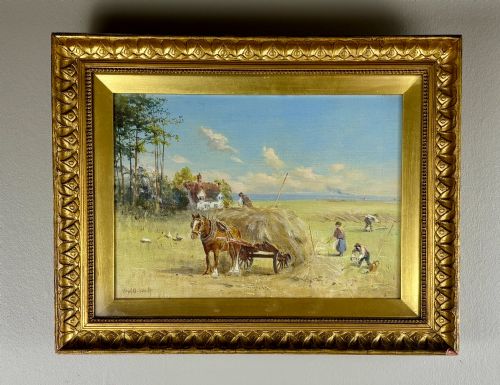
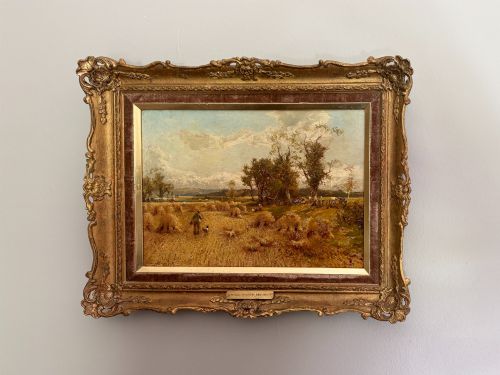
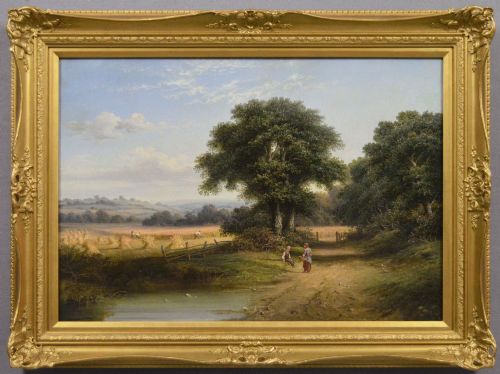
A framed harvest oil painting depicts rural scenes of agricultural work, cornfields, haymaking, and farmers during the nineteenth and twentieth centuries. These artworks frequently record landscapes from British and European settings, ranging from Victorian pastoral views to twentieth-century realism.
Buyers most commonly encounter nineteenth-century works on this page, particularly Victorian rural naturalism and British impressionism. Canvas works housed in giltwood or gesso frames dominate the selection, portraying figures harvesting wheat, tending to hayricks, or resting near harvest fields.
How they were made
These works utilise oil paint applied to canvas supports, employing techniques characteristic of nineteenth- and twentieth-century painting schools. Artists built up textures using traditional brushwork to render fields, skies, and figures.
Listings feature oil on canvas materials housed in wood, giltwood, and gesso frames across the 19th and 20th centuries.
What varies in quality
Quality rests upon the artist's ability to handle light, atmospheric perspective, and the naturalistic depiction of human figures and animals within the landscape. Works by established named painters demonstrate superior draughtsmanship and composition compared to anonymous or naive school pieces.
The preservation of the oil pigment and the original condition of the wood and giltwood frame influence the overall integrity of the piece. Finer examples retain their original surface textures and framing without heavy overpainting or structural compromise.
Walter Heath Williams·Henry John Boddington·William Grant Murray·Henry H Parker·James William Booth·Helmut Reuter·Herbert Royle·Arthur Walker Redgate·Joseph Paulman·Henry John Kinnaird·George Cole·Joseph Thors·Alfred Augustus Glendening Snr·William Kay Blacklock·John Clayton Adams·Arthur Heinrich Wilhelm Fitger
The Framed Harvest Oil Painting Glossary
- Oil on Canvas
- A painting medium where pigments suspended in drying oils are applied to stretched fabric. This combination provides durability and allows for rich colour blending.
- Gesso
- A plaster-like mixture applied to wood frames to create a smooth surface for gilding or painting. It allows for intricate moulded decorative details.
- Pastoral
- A genre of art depicting rural life and idyllic agricultural scenes. These works romanticise the labour and landscapes of the countryside.
- Impressionism
- An artistic style focusing on light, loose brushwork, and ordinary subject matter. British and Scottish variations appear frequently in these rural landscapes.
Framed Harvest Oil Painting: Frequently Asked Questions
What periods do these paintings cover?
The selection spans from the nineteenth century through the mid-twentieth century. Pieces date from the 1860s up to the 1950s, representing Victorian, impressionist, and realist movements.
Most works cluster in the late nineteenth and early twentieth centuries, reflecting the height of British and European rural naturalism.
How were these artworks framed?
Original mountings typically consist of wood frames finished with gesso and giltwood. These surrounds often feature moulded ornamentation suited to the period of the canvas.
Many retain their period frames, which contribute significantly to the historical context of the artwork.
What subjects appear in harvest paintings?
Common subjects include farmworkers gathering wheat, haymaking in rural fields, and agricultural landscapes with horses and carts. Scenes often incorporate local British geography, such as the Vale of Evesham or the river Kennet.
Artists also depicted genre details like harvesters picnicking, ducks in cornfields, and approaching storms over farmland.
Are the paintings signed by artists?
Numerous works feature signatures or attributions to documented painters of the nineteenth and twentieth centuries. Named British and European artists created many of the listed landscapes.
Unsigned examples also occur, often attributed to broader categories such as the naive school or the European school.