


Four Glass Regulator Clock
A four glass regulator clock brings together precision engineering and transparent housing, offering an uninterrupted view of the intricate movement within.
Four Glass Regulator Clock
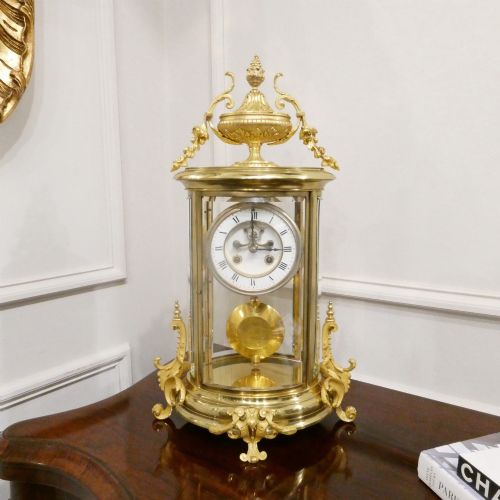
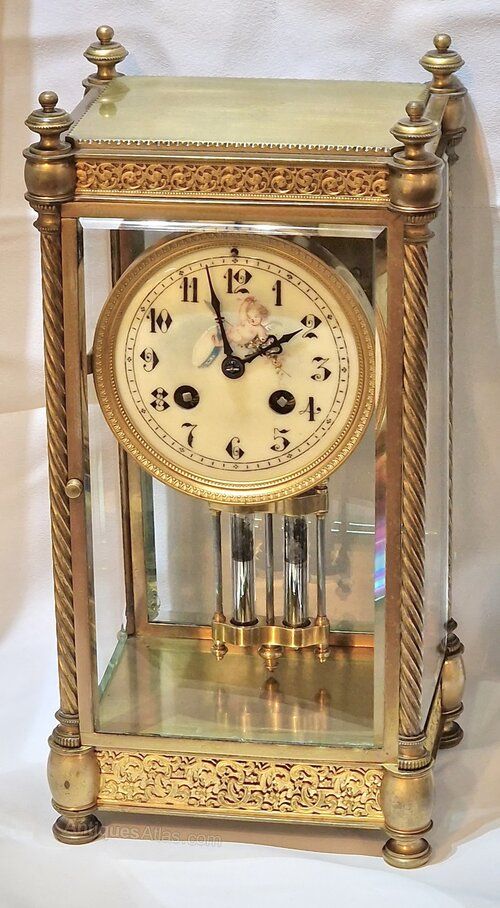
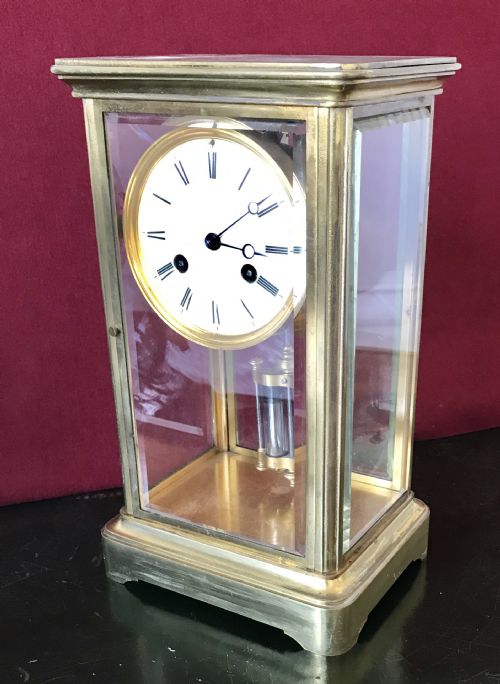
A four glass regulator clock is a mantel timepiece housed within a brass, gilt bronze, or ormolu frame fitted with transparent bevelled glass panels on all four sides. These architectural cases permit light to pass straight through the mechanism, displaying the pendulum and escapement from multiple angles.
The versions most frequently met on this page are French examples dating from the late nineteenth century, spanning periods such as the Victorian era, the 1880s, 1890s, and 1900. Alongside standard rectangular cases, variants include bow-fronted designs, oval shapes, and pieces incorporating onyx, marble, or enamel details.
Materials and construction
Cases are constructed predominantly from brass, gilt bronze, or ormolu, formed to create heavy structural frames that support thick panels of bevelled glass. Enamel appears on the clock faces, often paired with delicate hands and intricate dial markings.
Movements are precision mechanical assemblies engineered by specialist makers, designed to drive mercury or gridiron pendulums. The glass panels are precisely cut to fit flush within the metal channels, protecting the brass gear trains from dust while maintaining maximum visibility.
Some dials feature hand-painted cherubs peering out from behind the numerals, keeping a silent, gilded watch over the ticking escapement.
Assessing quality and craftsmanship
Quality in a four glass regulator clock rests upon the weight and casting finish of the metal frame, alongside the crispness of the dial ornamentation and the refinement of the movement. Heavier gilt bronze or ormolu housings with finely chased surface details indicate superior workshop production.
The incorporation of specialist complications, such as moon-phase dials, cherub motifs, or accompanying garniture sets, distinguishes higher-tier pieces from simpler standard mantel models.
Samuel Marti·L Epee·Japy Freres·Tiffany and Co
The Four Glass Regulator Clock Glossary
- Regulator
- A precision clock designed to keep exceptionally accurate time, often featuring a mercury or compensated pendulum to counteract temperature variations.
- Ormolu
- Gilt bronze produced by applying a finely ground high-carat gold-mercury amalgam to a bronze base, then heated to drive off the mercury.
- Bevelled glass
- Glass panes featuring an angled, polished edge that catches the light and fits securely into the metal rebate of the clock case.
- Escapement
- The mechanical linkage that restrains the gear train, converting continuous force into regulated impulses to drive the pendulum.
Four Glass Regulator Clock: Frequently Asked Questions
How do I wind a four glass regulator clock?
Most of these movements require a specialised key inserted into the dial face to tension the spring barrels every week or fortnight.
Care must be taken not to over-wind the mechanism, stopping firmly as soon as resistance is felt.
Why is it called a regulator?
The term originates from clocks used as reference standards in workshops and observatories for setting other timepieces.
In domestic French clocks, the name stayed to describe high-grade pendulum movements housed in glass cases.
Where should I place a four glass clock?
Select a sturdy mantelpiece, shelf, or table where the clock remains completely level and free from vibrations.
Because the movement is exposed on all four sides, positioning it away from heavy foot traffic protects the glass panels from accidental knocks.
How do I date a French regulator?
Dating relies on maker stamps stamped on the brass backplate, stylistic cues like Rococo Revival curves or Louis XVI symmetry, and materials such as onyx or marble.
Many late nineteenth-century pieces bear foundry medals or exhibition marks that narrow down their decade of manufacture.