



Fluted Leg Serving Table
A fluted leg serving table brings architectural proportion and sturdy dining room utility into a room, offering a long surface grounded by carved vertical channels.
Fluted Leg Serving Table
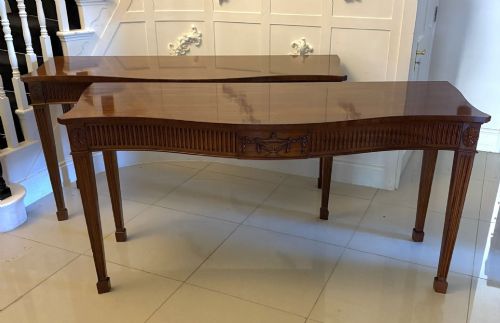
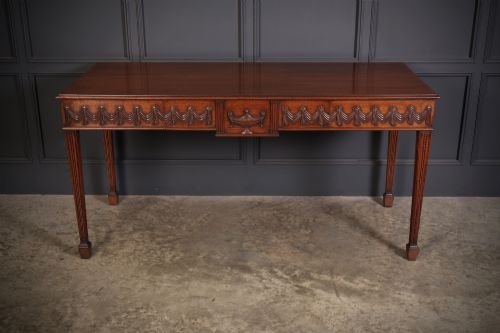
A fluted leg serving table is a substantial dining or hall furniture form designed to stand against a wall, appearing most frequently in mahogany across periods spanning the Georgian era through the twentieth century. These pieces function as console tables, servers, and side tables, often featuring rectangular or serpentine tops supported by straight or tapered legs.
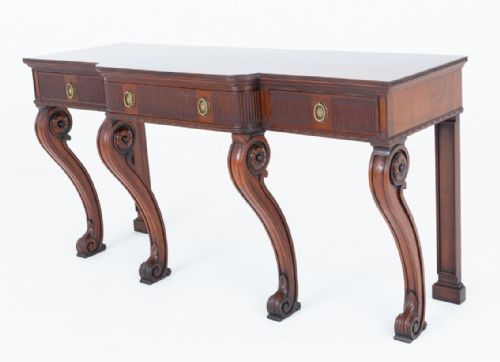
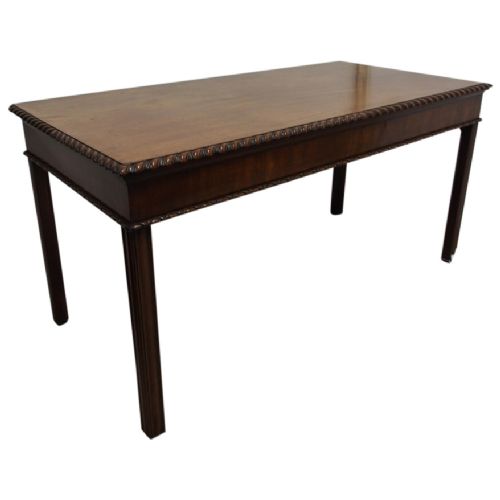
The examples gathered here range from eighteenth-century George III originals to Edwardian oak variations and later Georgian Revival interpretations. Makers and cabinetmakers adopted Neoclassical, Regency, and Chippendale vocabularies, applying carved details such as fluting to the leg supports while keeping the primary timber polished or painted.
How they were made
Cabinetmakers constructed these tables primarily from solid and veneered mahogany, alongside oak, painted pine, and satinwood, occasionally incorporating brass hardware and gold leaf or gesso highlights. Timbers were selected for grain pattern and density, then joined using traditional mortise and tenon techniques suitable for heavy dining room use.
Carvers cut vertical channels, known as flutes, directly into the wood of the leg supports, aligning them with Neoclassical decorative schemes popular during the Georgian and Regency periods. Surfaces received hand-applied finishes such as wax polish or paint, building a protective layer over the timber.
Listings span the Georgian period, the nineteenth century, and the early twentieth century, utilising mahogany, oak, painted wood, and brass.
What varies in quality
Quality in these tables rests upon the crispness of the hand-carved fluting on the legs and the selection of timber for the top and frame. Superior pieces demonstrate precise joinery and balanced proportions, whereas simpler iterations rely on plain surfaces and minimal decorative carving.
The integration of secondary timbers and the handling of serpentine or rectangular shapes further distinguish regional and period workshops. Finer examples exhibit thoughtful detailing in the frieze and legs, reflecting the stylistic ambitions of periods like the George III era or English Regency.
Gillows
The Fluted Leg Serving Table Glossary
- Fluting
- A series of shallow, parallel concave grooves cut vertically into a column or leg. This decorative technique draws on classical architecture to add linear texture.
- Serpentine
- A curved line or surface that bends outward at the centre and inward at the sides, or vice versa. It requires careful carpentry to shape the timber smoothly.
- Frieze
- The horizontal band running directly beneath the top surface of the table. Cabinetmakers often decorated this area with carving or contrasting veneers.
- Pier Table
- A table designed to stand against a wall, typically between two windows beneath a mirror. These pieces share similar proportions with serving tables.
- Neoclassical
- A style spanning the eighteenth and nineteenth centuries that revived classical Roman and Greek motifs. It governs the straight lines and symmetrical carved details seen on many fluted leg serving tables.
Fluted Leg Serving Table: Frequently Asked Questions
What is a fluted leg serving table used for?
These tables provide a long surface for displaying dishes, serving food, or placing decorative objects against a dining room or hallway wall. Their narrow depth allows them to sit comfortably in circulation spaces without blocking movement.
Historically, they supported large dining services before the widespread adoption of sideboards with built-in cabinetry. Today, they function equally well as console tables or side tables in living spaces.
How can I tell a Georgian table from a later revival?
Georgian tables display construction methods, timber ageing, and tool marks consistent with eighteenth-century workshop practices. The wood develops a deep patina over centuries of polishing.
Revival pieces, such as those from the Edwardian period or the nineteen-twenties, often exhibit cleaner internal timbers and standardised machine-assisted joinery while copying earlier Neoclassical styles.
Where should I place a serving table at home?
A serving table suits entrance halls, dining rooms, or long corridors where a shallow wall table creates a focal point. Pairing the table with a mirror or artwork above balances its visual weight.
Because these tables were built to be viewed from the front and sides, keeping the fluted legs visible enhances their architectural design.
What woods were used for these tables?
Mahogany remains the dominant timber across the majority of these pieces, prized for its strength and rich reddish-brown colour. Oak, satinwood, and painted pine also appear in regional and later variations.
Accents of gesso and gold leaf sometimes highlight carved elements on Neoclassical and Regency examples.